Ambedkar Jayanti Special: Why Ambedkar Remains Outside the Curriculum – The Politics of Exclusion

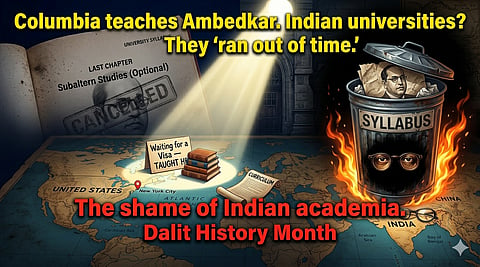
A striking example is his autobiographical work, Waiting for a Visa, which is taught at universities such as Columbia, while many in India have not even encountered it in their formal education.
 Ambedkar’s radical critique of caste, Brahmanism, and social hierarchy challenges dominant narratives, making his work inconvenient to comfortably accommodate within traditional academic frameworks.
Ignoring the teachings of B. R. Ambedkar in classrooms does more than sideline his importance; it also downplays caste as a critical social issue. AI generated symbolic image
Published on

— ✍️ Apeksha Singegol & Rasni Bai

Every year on April 14, we celebrate Ambedkar Jayanti, remembering a towering intellectual, a visionary constitutionalist, and a relentless advocate of justice. Yet, there remains a persistent, discomforting question: where is Ambedkar in our classrooms, especially in universities?

Despite his vast intellectual contributions, Ambedkar is often reduced to a singular identity: a “Dalit leader” or, at best, a “social reformer” or “father of the Indian constitution,” which is now hastily questioned in the Savarna debate. This narrow framing sidelines his profound engagements with economics, sociology, law, political theory, religion, history, and philosophy. His writings on democracy, labour, federalism, caste, and capitalism are rarely accorded the same academic space as those of other canonical thinkers. As sociologists, we would like to say that in mainstream curricula, Ambedkar is not absent, but he is certainly not present in proportion to his intellectual magnitude.

This marginalisation is not accidental. It reflects deeper structures of knowledge production, in which certain voices are amplified while others are contained. Ambedkar’s radical critique of caste, Brahmanism, and social hierarchy challenges dominant narratives, making his work inconvenient to comfortably accommodate within traditional academic frameworks.

 Ambedkar’s legacy is not just historical; it is urgently contemporary. His powerful call to “Educate, Agitate, Organise” is not merely a slogan but a method.
Ambedkar’s legacy is not just historical; it is urgently contemporary. His powerful call to “Educate, Agitate, Organise” is not merely a slogan but a method.AI generated image

When we look at syllabi from prominent universities, we can see that Ambedkar is conveniently and forcefully included in subaltern studies, which is often the last unit in the course plans for social theory or Indian society-related papers in sociology. Indian sociology begins with GS Ghurye, who is best known for his work on caste, whose theories have been armchair philosophies taught in classrooms for weeks. Whereas Ambedkar, who was a contemporary of GS Ghurye and whose works on caste are based on lived experiences and a deeper understanding of society, and not at all armchair stagnant writing, was never considered worthy to be part of caste studies to begin with. Why add Ambedkar to subaltern studies is the question! The only person of his times to analyse caste so critically that the society feared his writing — well, it still does! Ambedkar should be included in the initial units. Everyone conveniently says that the mindset of society should change to get rid of casteism. But ‘how’? By skipping Ambedkar in classrooms? First, Ambedkar comes at the end; second, the teachers are in a rush by the time they reach the last units of the syllabus; and third, most of them are not interested in reading or teaching Ambedkar. When we spoke to certain students from certain universities (which we would not want to name), the students clearly said that teachers entered classrooms and said, “I had not read Ambedkar before; we have it in the syllabus now…” Another student mentioned that “the teacher never taught or mentioned Ambedkar in class, although it was part of the syllabus”. Subaltern studies came up as a field to study the marginalised; however, let alone the marginalised, subaltern studies has been excluded or conveniently ignored by disciplines like sociology.

 Ambedkar’s radical critique of caste, Brahmanism, and social hierarchy challenges dominant narratives, making his work inconvenient to comfortably accommodate within traditional academic frameworks.
Dalit History Month| Caste Discrimination Register- How Will It Help Dalits Fight Casteism in Australia?

The marginalisation of Ambedkar in academic curricula reflects a broader pattern identified by Subaltern Studies scholars, in which knowledge produced by oppressed communities is systematically excluded from the dominant archive. Ambedkar’s legacy is not just historical; it is urgently contemporary. His powerful call to “Educate, Agitate, Organise” is not merely a slogan but a method. Education, for him, was not about degrees or employability alone; it was about cultivating critical consciousness, dignity, and the courage to question injustice. Therefore, he also said, “Cultivation of mind should be the ultimate aim of human existence”. He insisted that education must build character, morality, and humanity, without which it becomes dangerous. We see Indian classrooms moving in a similar direction. A classroom where students laugh while they watch documentaries like Indian Untouched. And question teachers on the existence of caste. I was once asked the same in a classroom. Ignoring the teachings of B. R. Ambedkar in classrooms does more than sideline his importance; it also downplays caste as a critical social issue. A student once asked me, “Why didn’t Ambedkar wait until India gained independence to challenge the caste system? Shouldn’t he have prioritised the nation’s freedom first?” They never ask the same question: why Ram Mohan Roy fought against Sati or Ishwar Chandra Vidyasagar fought for widow remarriage. Again, we need to draw attention to Annihilation of Caste, where Ambedkar argues that the focus of the freedom movement was on social problems affecting Brahmins, such as Sati. They never looked at the caste system as an issue as it did not affect their lives; in fact, it worked for their benefit.

In this context, the recent observation by K. Ashokvardhan Shetty becomes strikingly relevant:

“Don’t make the mistake of thinking just because someone is highly educated or holding a high post or successful in life, he must be a rational thinker. On the contrary, many such persons may be very superstitious and active purveyors of pseudoscientific nonsense. In fact, an educated fool is more dangerous than an uneducated fool.”
To foreground Ambedkar in education, therefore, is not just about including his texts, but about transforming classrooms into spaces of equality, rational inquiry, and social responsibility where learning itself becomes an act of democratic practice.

This insight echoes Ambedkar’s own warning that education without rationality, ethics, and social responsibility can deepen ignorance rather than dismantle it. In a society like India, where advanced science coexists with entrenched superstition, Ambedkar’s insistence on critical thinking becomes indispensable.

Ambedkar’s writings and speeches remain a rich archive for truth-seeking. Whether it is Annihilation of Caste, his debates on democracy, or his reflections on religion and equality, his work compels us to confront uncomfortable realities. Yet, these texts are not widely or deeply engaged with within academic spaces. Instead, Ambedkar is often commemorated symbolically rather than studied substantively. As scholars have pointed out, the contributions of Dr. B. R. Ambedkar have rarely been central to narratives of the development of the social sciences in India, despite his rigorous engagement with questions of caste, race, and social structure. His work challenged dominant racial theories of caste by shifting the debate towards cultural and historical explanations, offering a fundamentally different understanding of untouchability.

At a time when many scholars framed caste through racial hierarchies, Ambedkar rejected such notions and argued against the idea of inherent inferiority, thereby producing a powerful counter-theory grounded in historical and social analysis. Yet, despite engaging with methods and debates central to sociology and anthropology, he remains excluded from the core theoretical canon, revealing a deeper bias in how disciplines recognise and value knowledge. Ambedkar is reduced to being an architect of the Indian constitution, while ignoring all his contributions to the study of the most inhumane caste system, which quite often works to defeat the constitution.

Classrooms, ideally, should be democratic spaces where ideas are not merely delivered but debated, questioned, and critically engaged with. In this sense, education must go beyond passive learning and become a process of awakening that encourages students to think, dissent, and reflect. It is here that Dr. B. R. Ambedkar’s call to “Educate, Agitate, Organise” gains profound relevance. Democracy is not sustained only through institutions like elections or laws; it begins in everyday spaces like classrooms, where voices are heard, hierarchies are challenged, and critical consciousness is nurtured. When classrooms fail to create room for dialogue, they risk reproducing the very inequalities they should dismantle. In such a context, Ambedkar is not a thinker who can be relegated to the margins or treated as optional; he is central to any meaningful understanding of equality and democracy. To foreground Ambedkar in education, therefore, is not just about including his texts, but about transforming classrooms into spaces of equality, rational inquiry, and social responsibility where learning itself becomes an act of democratic practice.

Ambedkar reminds us that true education is a tool of liberation, a means to dismantle oppressive structures and reimagine society. As he emphasised, “A great man is not the one who earns great wealth but the one who imparts knowledge.” To read Ambedkar, then, is not an act of tribute alone; it is an act of intellectual responsibility. We need universities and classrooms where Dr. B. R. Ambedkar is not pushed to the margins, or forcefully presented and rushed through in a single class, but placed at the centre of knowledge, debate, and critical thought; where he is not remembered symbolically, but read, questioned, and engaged with. Babasaheb’s books and academic writings are studied and celebrated across the globe, yet remain relatively neglected within India itself.

A striking example is his autobiographical work, Waiting for a Visa, which is taught at universities such as Columbia, while many in India have not even encountered it in their formal education. This contrast reveals not just a gap in curriculum, but a deeper crisis in how knowledge is valued and transmitted within Indian academia. As highlighted in a review in Frontline, works such as Ambedkar in London: Educate, Agitate, Organise further underscore Ambedkar’s intellectual journey, his education, political formation, and global engagements. This Ambedkar Jayanti, the need of the hour is not just celebration, but serious engagement to bring Ambedkar from the margins of the syllabus to the centre of critical thought, and from symbolic remembrance to lived practice.

- Apeksha Singegol and Rasni Bai are research scholars in Sociology at Christ University, Bangalore.

 Ambedkar’s radical critique of caste, Brahmanism, and social hierarchy challenges dominant narratives, making his work inconvenient to comfortably accommodate within traditional academic frameworks.
Former CM Ashok Gehlot, LoP Jully Slams Rajasthan University's 'Dalit-Hostile' Neglect: Ambedkar Chair Scrapped in Secrecy, Phule Removed from Syllabus!
 Ambedkar’s radical critique of caste, Brahmanism, and social hierarchy challenges dominant narratives, making his work inconvenient to comfortably accommodate within traditional academic frameworks.
Dr. B.R. Ambedkar: A Public Health Visionary Ahead of His Time | Dalit History Month
 Ambedkar’s radical critique of caste, Brahmanism, and social hierarchy challenges dominant narratives, making his work inconvenient to comfortably accommodate within traditional academic frameworks.
Dalit History Month | Ambedkar Wanted Reservations Only For 10 Years? They Lied to You. Read The Truth

You can also join our WhatsApp group to get premium and selected news of The Mooknayak on WhatsApp. Click here to join the WhatsApp group.

Support The Mooknayak

'The Mooknayak' practices democratic journalism. It is a media platform committed to the Constitution, democracy, and social justice. If you also want 'The Mooknayak' to always raise the voices of the marginalized and show the pain of the voiceless, please support us.

Please Contribute
The Mooknayak English - Voice Of The Voiceless
en.themooknayak.com