— ✍️ Jaidev Gaikwad
The man in a light-colored sherwani and trademark round glasses exuded regal dignity, and I still recall my mother’s description of him, which hinted at his elevated status among our community people in India.
“Aare… Babasaheb is our king!” she would say indulgently every time I would pester her about the man sitting in the middle of a black-and-white group photograph that hung on the worn-out, crumbling front wall of our humble village home.
My mother would boast that he was by far the most learned Indian of his time, adding for effect, perhaps, that he was “more learned than even Mahatma Gandhi and Pandit Nehru!”
I would look at the man with naïve, wide-eyed admiration and struggle in vain to read, or rather decipher, the long list of academic degrees that were appended to his name.
My mother, who couldn’t read or write, was of little help when it came to the long list of his degrees from universities, both at home and abroad.
She would invariably point to another man in the photograph, and say with pride: “And that’s your father, sitting right there beside Babasaheb!”
The child in me would easily get diverted and start eying Marutrao Sabaji Gaikwad, sitting in the same row, very close to “our king.”
My father, too, wore glasses and looked impressive in a bright three-piece suit. The men had spent considerable time together.
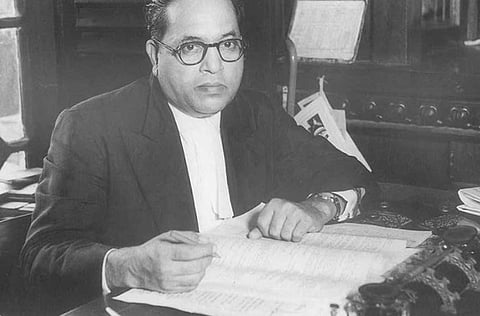
‘Babasaheb,’ better known today as Bharat Ratna Bhimrao Ramji Ambedkar, the chief architect of the Indian constitution and the messiah of India’s Dalits or former untouchables, was a young man then.
My father worked for the Indian Railways as a charge man – a technical post re-designated as a junior engineer in the present times – in Bombay (now Mumbai) during the British colonial era. I know next to nothing about his educational qualifications, but I was told by the elders in the family that he could speak in English with the ‘gora sahebs.’
More importantly, he earned a handsome salary for his time and lived a comfortable life in British-era Bombay.
My father’s greatest achievement in his life was welcoming Babasaheb – as we, his caste fellows, refer to Dr. Ambedkar with a certain affinity to this day – when he returned home with an M.A. degree from Columbia University in the United States.
This, as per the family legend confirmed later by me, was Babasaheb’s first public felicitation in India. It was held on November 11, 1917, and my father had the honor of reading the citation/ resolution acknowledging the great man’s academic achievement.
Of course, the felicitation was a way for Babasaheb’s people to convey to him that the time was ripe for him to take over the reins as their community leader.
Thus, my father became one of Babasaheb’s many lieutenants in the struggle to free the then-untouchables of India from the centuries-old yoke of caste-based discrimination.
The photograph of the two men, along with their colleagues in Bombay, continues to be a priceless jewel in the family collection to this day.
Today, Babasaheb is a much-revered figure across the globe. Even Columbia University, whose campus I visited in 2019, has acknowledged him as arguably one of its “most illustrious alumni, a democratic thinker, and constitutional lawyer who had an enormous impact in shaping India, the world’s largest democracy.”
Ambedkar went to Columbia University in 1913 to start a doctoral program in political science. He graduated in 1915 with a master’s degree and got his doctorate in 1927 after studying with some of the greatest figures of interwar American thought like John Dewey.
Columbia University awarded Ambedkar with an honorary LL.D. in 1952.
What my father did – organize a felicitation in Bombay – pales before Babasaheb’s academic and overall achievements, but as his son, I feel proud of him for the rare honor he brought our family.
I was curious to know more about my father as I grew up. But I’ve had little success over the years.
My father did not write anything about himself, his life and times, and there was hardly any educated soul in the family who could enlighten me about those early years, his educational and professional life, and his contributions to the social and political sphere.
There were a couple of old wooden boxes stacked in the house, containing my father’s diaries and correspondence – one letter was addressed to Babasaheb informing him how he, Marutrao, had successfully contested an election to the local municipal board.
Then there were a few black-and-white photographs, mostly showing groups of men with Babasaheb at the center. Regrettably, all of it was lost with time.
Little else is known about the family’s past. In fact, nothing beyond our grandfather’s name is known to us.
Life was never supposed to be a bed of roses for India’s untouchables.
The world has known about untouchability for as long as they have known Hinduism. But the average man or woman has little knowledge of the life of the untouchables.
The untouchables of his times remained mute. They seldom spoke out. They had neither education, nor wealth, nor social or political influence.
The Mahars are one of the most important of the untouchable communities found in western India. Like Dr. Ambedkar, my father too belonged to this community.
Gaon Tethe Maharwada is a popular saying in Marathi, the language commonly spoken in our area in the northern parts of the Deccan Plateau, now a province or state called Maharashtra.
Loosely translated, it means: ‘Where there is a village, there is a Mahar quarter.’
Those familiar with the Marathi language will recognize the tone of contempt in its utterance, as if ‘there is a black sheep in every flock.’
The Mahars were outcastes who were kept out of the ‘Hindu’ fold, a pre-medieval term, which, interestingly was first used by the Islamic conquerors to refer to the natives across the Sindh valley in the northern parts of the subcontinent.
But the native religion regarded and treated the mixing of its innumerable castes and subcastes into one ‘Hindu’ fold as a mortal sin.
So, a Brahmin village clerk employed by the British colonialists may have enrolled the Mahar as a ‘Hindu’ in the revenue records or census sheets but did not admit him into his place of worship or home.
Why bother about trivial issues of the past in the age of information technology and Yoga? Mahar Mela, Mal Gela (The Mahar is dead, the dirt is gone) goes another Marathi proverb.
The Maharwada, as the cluster our people lived in was commonly referred to, would invariably be located on the east end of the village, except for the odd location, where the natural ‘west-to-east’ drainage path of the Deccan land changed course.
The Mahars were always located on the lower side of the town, to avoid polluting the air and water of the village.
The Mahar of any class, gender, or occupation was untouchable. None of the twice-born classes of Hindus could touch him or be touched by him without contracting ceremonial pollution. A Mahar could not enter the house or place of worship of the twice-born Hindus without carrying defilement into it.
Untouchable and nameless he may have been, but the Mahar was an indispensable part of the village organization. There were certain duties to be performed by men of this caste by the village law and customs.
The earliest and perhaps foremost literary evidence of the Mahar’s social standing in the village community is to be found in the poems attributed to Sant Chokhamela, a great Marathi Bhakti poet who was himself a Mahar, and his caste fellows who flourished at the beginning of the fourteenth century.
These poems reveal that the Mahar was engaged in menial occupations and receiving stale food as alms from the village households.
But certain duties demanded a moral character and certain intelligence from the Mahar. He was the village watchman, gatekeeper, messenger, porter, guide to visiting officials, and a legal referee whenever disputes about land or something else occurred in the village.
It was perhaps the menial job of removing the carcasses of dead animals that made the Mahars untouchable. But it must be mentioned here that the Mahar never removed the carcasses of a dog or a pig. That task must’ve been left to someone lower in the complicated caste hierarchy, or the carcasses were simply left to rot away.
When the British rulers took over the administration of the land sometime in the nineteenth century, they found the Mahar to be the most useful and trustworthy among the twelve customary village servants, right from the Brahmin at the top to the manual scavenger at the bottom.
A recurring theme among Mahars to this day concerns the faithfulness of their ancestors to their masters and the rights and recognition of their services from time to time by their masters over the centuries.
The fact that my father landed a job with the railways, that too as a charge man in Bombay, is an indicator that he had moved on from being a traditional village servant and charted his own course, defying the rigid social structure of the time.
He must have gained some education, about which it is difficult to gather any information now. British rule opened doors of education and jobs in the railways, textile mills, and dockyards, municipal and military services, for the untouchables in western India, especially the Mahars.
My father apparently had some 200 workers under his supervision, and whenever he traveled with the family, presumably between Bombay and Pune, he would book a saloon car on the train, my mother would recall.
He was also a labour union leader and found an honorable mention in the works of Changdeo Bhavanrao alias Abasaheb Khairmode, the eminent biographer of Dr. Babasaheb Ambedkar, along with other prominent Dalit activists of his time like Davidbua alias Devidas Abrahim, Revanji Dagduji Dolas, Kondiram Mankoji Rokade, Shantaram Annaji Upsham, Dadasaheb Gaikwad, and so on. His contemporaries in Pune included Shivram Janba Kamble, Narayan Krishnaji Kadam, and Ganesh Akkaji Gavai.
Babasaheb’s felicitation finds a detailed mention in Khairmode’s biography of Ambedkar. In the chair was Judge Narayanrao Chandavarkar and the resolution/citation tabled by Marutrao Sabaji Gaikwad expressed the happiness of the Mahar community at their brilliant youngster’s return after completing his studies at Columbia University with the help of Maharaja Sayajirao Gaikwad, the progressive ruler of the Baroda princely state. It congratulated Dr. Ambedkar and also expressed gratitude to the Maharaja.
The fact that my father tabled the resolution meant he was one of the leading activists of his time. Khairmode also mentions him as one of the active members of the ‘Somvanshiya Nirashrit Mandir Fund’ for which funds to the tune of 650 rupees were collected and deposited in a joint account with Bombay Bank of which my father was an account holder.
This social organization apparently ran schools in Marathi and English mediums at Dagdi Chawl and Kamathipura in Bombay, which meant my father was involved in educational activities as well.
He must have been in his late thirties in 1917, the year of Babasaheb’s felicitation. How could he have reached the social status he seemed to enjoy in his own community by this time? He must have struggled a lot. Who knows?
I learned from my mother that he had actively participated in the 1920 Mangaon Conference for the emancipation of the downtrodden masses, convened by Rajashri Shahu Maharaj, the progressive ruler from Kolhapur princely state in southern Maharashtra, and presided over by Babasaheb himself; the 1927 Mahad struggle for access to water; and the 1930-35 temple entry agitation at Kalaram Mandir in Nashik.
My mother, too, had actively participated in the Nashik agitation and recalled the brutal violence that followed the Dalits’ attempts to gain entry into the Hindu temple. Stones rained on them from all sides, and the able-bodied men formed a human shield around Babasaheb to protect him. The Mahars ensured their leader did not sustain a scratch on his body while they were covered in blood, my mother would tell us with great pride.
I’ve always admired my mother for her deep commitment to the Dalit cause and to her family’s welfare.
My father was mostly busy with his socio-political engagements in Bombay and Poona district. He had organized a conference of untouchable people at Narayangaon, around 75 kilometers from Poona in Junnar taluka, on October 4, 1936.
The event was graced by Babasaheb, besides senior district officials, including an additional district magistrate, assistant collector, police officers, and representatives of Brahmin, other Hindu castes, Muslims, and European Christians.
At this conference, my father raised the issue of allotting forest lands to the untouchables who were mostly landless and without any means of livelihood.
My mother would recall her days at their Parel home in the Baramadi locality near Poibawadi. Babasaheb also used to stay in the same locality and would every day set out for his morning walk.
My father had assigned the task of protecting him to my maternal uncle, Dagduba, who would follow him everywhere. Like my grandfather, Dagduba too was a professional wrestler with a solid physique and an intimidating appearance.
Mother was happy. She had a nice house in the Western style that my father had come to adopt in Bombay.
Once they invited Babasaheb for dinner and father decided the menu would be mutton, chicken, and fish delicacies. He relished what was offered and profusely thanked my parents, but while leaving, lightheartedly mentioned to my mother that he would’ve loved to eat the humble pithla-bhakri, a traditional Maharashtrian cuisine made of spicy gram flour curry and served with coarse millet bread and an onion.
My mother would often recall his words. Perhaps it was rare for an Indian woman to receive a compliment and be spoken to as an equal by a man, least of all a great, learned soul.
If there was anything she treasured throughout her life, besides the group photograph hanging in our village home that underlined her husband’s achievement, it was Babasaheb’s kind words – and the rare experience of being treated as an equal human.
While a lot is said and written about Dr. Ambedkar’s shining qualities, I can testify that he did treat a humble homemaker with the respect she deserved. That was his greatness.
- Jaideo Gaikwad, a founding member of the Dalit Panthers in 1970s Pune who later worked with Prakash Ambedkar's BHARIPA and is now national general secretary of Sharad Pawar's NCP (Sharad Pawar faction). He has drawn this article from a chapter of his biography—originally written in Marathi, which spans 5,000 words, chronicles his parents' close ties with Dr. Babasaheb Ambedkar, and traces their journey through Phule-Ambedkarite inspiration.
You can also join our WhatsApp group to get premium and selected news of The Mooknayak on WhatsApp. Click here to join the WhatsApp group.
‘The Mooknayak’ practices people-centric and democratic journalism. It is a media platform committed to upholding the Constitution, democracy, and social justice. We consistently raise the voices of the marginalized, highlight the struggles of the voiceless, and bring their pain to the forefront. If you also believe that ‘The Mooknayak’ should continue to stand with the oppressed and amplify the concerns of those pushed to the margins, please support us.
Please Contribute