Bahujan Nayak
Pandit C. Iyothee Thass – A Visionary Who Challenged Caste Through Buddhism and Dravidian Identity
Remembered on Mahaparinirvana Day

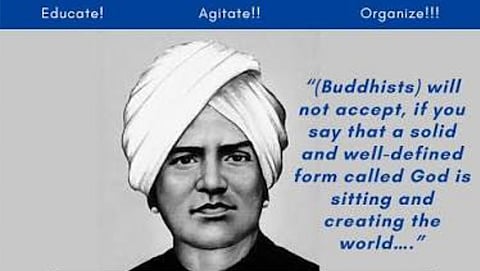

Chennai- On the anniversary of his Mahaparinirvana, Tamil Nadu and the broader Dalit-Buddhist movements across India pay homage to Pandita C. Iyothee Thass (born Kathavarayan), a towering figure in the struggle against caste oppression.
Born on May 20, 1845, in Thousand Lights, Madras (now Chennai), Iyothee Thass emerged as South India’s foremost anti-caste intellectual, Siddha practitioner, journalist, and the first notable Scheduled Caste leader to embrace Buddhism as a vehicle for liberation. He passed away on May 5, 1914, at the age of 68.
A multifaceted personality proficient in Tamil, English, Sanskrit, and Pali, Iyothee Thass trained in Siddha medicine and came from a family with roots in indigenous healing traditions. His grandfather had served as a butler to British officials, providing some exposure to colonial structures while remaining rooted in marginalized Parayar community experiences. He spent significant years in the Nilgiris district, where he began organizing tribal and marginalized groups, laying the groundwork for his lifelong activism.
In 1876, at the age of about 31, Iyothee Thass founded the Advaidananda Sabha in Udhagamandalam (Ooty). This early organization sought to explore the emancipatory potential within Advaitic traditions to challenge caste hierarchies while countering aggressive Christian missionary activities. His engagement evolved rapidly; by the 1880s, he collaborated with Rev. John Rathinam to launch the magazine Dravida Pandian, using print as a tool for social awakening. In 1886, he made a landmark declaration that the so-called untouchables were not Hindus, asserting an independent identity for the oppressed communities.
Iyothee Thass demonstrated remarkable foresight on administrative tools of identity. He recognized the importance of the colonial Census and urged depressed classes to register as “Poorva Tamizhar” (Original Tamils) or “Casteless Dravidians” rather than as Hindus. This demand challenged the Brahmanical framework imposed on Dravidian societies and sought official recognition of their distinct origins.
In 1891, he established the Dravida Mahajana Sabha and organized its first conference in Ooty on December 1. The gathering passed key resolutions demanding civic rights, educational access and scholarships for depressed classes, removal of discriminatory jail rules, economic opportunities, and representation in local governance. When the Indian National Congress showed little engagement, Iyothee Thass critiqued it sharply as a Brahmin-dominated body, predicting its fragmentation along caste lines.
His most transformative shift came through Buddhism. Arguing that Dalits in Tamil land were originally Buddhists whose egalitarian traditions were suppressed by the imposition of the caste system and Brahmanical dominance, Iyothee Thass led efforts to reclaim this heritage. With assistance from Theosophist Col. Henry Steel Olcott, he visited Sri Lanka around 1898–1900, where he received Buddhist initiation (diksha) from Bhikkhu Sumangala Nayake at Maligakanda Vihara. Upon returning, he founded the Sakya Buddhist Society (also known as the Indian Buddhist Association) in Madras in 1898, with branches spreading across South India and even to diaspora communities.
The society promoted education, established Panchama schools for depressed classes with Olcott’s help, and advanced a vision of Tamil Buddhism intertwined with Dravidian identity. Iyothee Thass viewed conversion not merely as a religious change but as a return to an original casteless heritage.
On June 19, 1907, he launched the influential weekly Oru Paisa Tamizhan (One Paisa Tamilian), later renamed The Tamilan from August 1908. Priced affordably to reach the masses, the newspaper became a powerful platform for anti-caste discourse, historical reinterpretation, Buddhist teachings, women’s issues, and critiques of social hierarchies. It ran until his death and continued briefly afterward, serializing works that reconstructed Tamil history from a subaltern Buddhist perspective. Iyothee Thass authored hundreds of articles on political, social, religious, and literary themes.
Iyothee Thass’s legacy as the “Father of Social Reforms in South India” and “Dravida Peroli” (Light of the Dravidians) profoundly influenced later movements. Leaders like Periyar E.V. Ramasamy and Dr. B.R. Ambedkar are seen as inheritors of his ideas on caste annihilation, identity reconstruction, and Buddhism as a path to equality. His emphasis on education, land rights, and cultural revival remains relevant in contemporary struggles for social justice.
You can also join our WhatsApp group to get premium and selected news of The Mooknayak on WhatsApp. Click here to join the WhatsApp group.
'The Mooknayak' practices democratic journalism. It is a media platform committed to the Constitution, democracy, and social justice. If you also want 'The Mooknayak' to always raise the voices of the marginalized and show the pain of the voiceless, please subscribe.
PLEASE SUBSCRIBE US