Weaponized Identity: Mapping Coordinated Digital Assaults on Women Dissenters at the Intersection of Caste, Faith and Politics

An investigation into the resilience of India's women dissenters, documenting their fight against weaponized hate campaigns rooted in caste, faith, and gender.
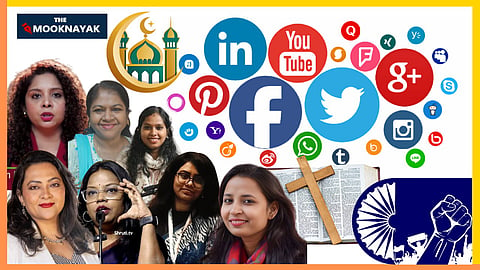
Women are targeted with abuse online not just for their opinions - but also for various identities such as religion, caste, profession and marital status.
Women are targeted with abuse online not just for their opinions - but also for various identities such as religion, caste, profession and marital status. Graphic- Asif Nisar/ The Mooknayak
Published on

New Delhi- For the women at the heart of this story, logging on to social media is not about sharing memes or connecting with friends. It is an act of courage. It is stepping onto a digital battlefield where their gender, their caste, their faith and their political affiliations are twisted into weapons and used against them in brutal, organized campaigns.

This report is an investigation into a specific and alarming pattern of violence in India’s digital public square. It documents how coordinated online attacks are waged not just against women who dissent, but specifically against women whose identities make them doubly or triply vulnerable: Dalit feminists, Muslim journalists, Christian activists, and other minority women in the public eye.

The infamous "Bulli Bai" and "Sulli Deals" apps--where photos of Muslim women were uploaded (2021- 2022) for a simulated auction, were a global scandal. But they were not a one-time event. They were the most shocking public display of a daily, grinding reality. This is a story of how online hate is engineered, how it follows a playbook, and how it aims to do one thing: silence critical voices by attacking the very core of who they are.

A Digital Nation, A Divided Reality

India's journey to becoming a digital giant is a landmark tale of policy and proliferation. The trajectory is well-charted: beginning with economic liberalization in 1991, followed by the National Telecom Policy of 1994, spectrum auctions, and the entry of major telecom players. This infrastructure boom made India the world's second-largest internet population, with over 73% of access happening via mobile phones by 2020. Social media platforms, particularly Twitter, saw explosive growth. Twitter India alone reported a staggering 74% year-on-year increase in daily active users in the last quarter of 2020.

According to Simon Kemp's Digital 2025 report, India stands as an undisputed digital Goliath. With a population of 1.46 billion, the country now boasts 806 million internet users, a penetration rate of 55.3%—powered by a staggering 1.12 billion cellular connections. The social media landscape is equally colossal, with 491 million active users engaging across platforms, meaning one in every three Indians is connected.

Meta's dominance is clear, with Instagram leading at 414 million users and Facebook following closely with 384 million. However, the data reveals a crucial, contrasting trend for the platform most associated with public discourse: X (formerly Twitter). With just 24.1 million users (1.7% of the population), X's reach in India is not only niche but is actively contracting, having decreased by 7.7% over the past year.

The horrific "Bulli Bai" and "Sulli Deals" apps, which "auctioned" Muslim women, were not isolated events. They were shocking examples of a much larger, everyday reality.
The horrific "Bulli Bai" and "Sulli Deals" apps, which "auctioned" Muslim women, were not isolated events. They were shocking examples of a much larger, everyday reality.AI generated image

For women, this digital awakening held immense promise. Academics and researchers framed it as a potential great equalizer—a space that could erode social boundaries and provide "empowering tools" to express themselves freely, moving away from repressive offline gender norms. It was seen as a new frontier for "freedom, choice and independence," particularly for discussing issues like gender-based violence.

However, data and lived experience now paint a starkly different picture. The platform that promised liberation has become, in the words of a landmark 2020 Amnesty International India report, a 'battlefield'. That report, which used crowdsourced data and data science to analyze abuse against women politicians during the 2019 General Elections, found the volume of hateful and abusive content to be "extraordinarily high."

The 76-page report, Troll Patrol India: Exposing Online Abuse Faced by Women Politicians in India, analysed more than 114,000 tweets sent to 95 women politicians in the three months during and after last year’s general elections in India.

The research found that women are targeted with abuse online not just for their opinions - but also for various identities, such as gender, religion, caste, and marital status.

Shazia Ilmi from the Bharatiya Janata Party said: “More women should be entering politics. But the price that I pay is too much for what I choose to do. The price includes being trolled incessantly, being the victim of online harassment, having a lot of remarks passed about what I look like, my marital status, why I have or don’t have children, etc. - all the filthiest things you can think of. If they don’t like my strong opinions, they do not remark on my work but call me a ‘whore’ in every language that is used in India.”

A July 2019 survey titled ‘Spotlight on online habits of young Indian women’, conducted by Verizon Media, claimed that 40 percent of Indian women fear irrelevant comments being trolled and followed.

In a July 2025 research work titled, "Cyberstalking, Cyberbullying and Online Trolling: An Insightful Study", Sushilkumar M. Parmar, an Assistant Professor at Maharaja Sayajirao University of Baroda reveals there were 19.9 per cent of tweets that are relating to sexism or misogyny, while 14.6 per cent of tweets were concerning to ethnic or religious slurs. For women, online trolling is the extension of routine domestic harassment. Amnesty International had conducted a survey in year 2017 wherein it is reported that 70 percent of female internet users were compelled to change the way of using the internet due to online violence.

Similarly, 1/3rd of them restrict themselves to post any comment on the digital platforms. In this line, Cyber Crime Cell and the Ministry of Women and Child Development have been putting in so much efforts to prevent such type of harassment.

Besides, according to the Cyberbullying Statistics, Facts and Trends - 2023, India, Brazil and the USA are the top three countries where the incidents of maximum online harassment and trolling are being reported. The survey of Norton conducted by Symantec revealed that out of 10, eight Indians experience online harassment.

In their article, "Indian female Twitter influencers’ perceptions of trolls" authors Varsha Pillai and Munmun Ghosh elaborate how women journalists have been among the main targets of trolls in India and have been facing massive online abuse and trolling due to reporting any political issue, a socio-cultural event, or national or international occurrences.

In 2021, Kotwal founded The Mooknayak with a mission to bring Dalit, Adivasi, backward class, and minority issues into the national conversation.
In 2021, Kotwal founded The Mooknayak with a mission to bring Dalit, Adivasi, backward class, and minority issues into the national conversation. The Mooknayak

If endurance has a face, it's Meena Kotwal's. Kotwal, the founder of The Mooknayak, a Dalit-led news platform launched in 2021 to amplify marginalized voices, has faced relentless online trolling and threats for her bold critiques of caste discrimination, including her advocacy for reservations and intersectional feminism.

In December 2021, she ignited widespread backlash by uploading a video burning pages of the Manusmriti, a Hindu text symbolizing caste hierarchies, while calling out caste bias in Indian newsrooms; the clip went viral, drawing a flood of death threats, rape threats, and casteist slurs from Hindutva-linked accounts, forcing her to publicly warn that such groups would be responsible for any harm to her.

The abuse extended to smear campaigns that slashed her platform's funding radically, yet Kotwal persists, using her reporting on affirmative action and gender-caste intersections to challenge systemic inequities, even as trolls continue targeting her for "anti-Hindu" activism.

Muslim journalist and author Rana Ayyub has faced relentless, graphic death and rape threats online, prompting intervention from United Nations human rights experts.

For Muslim women like journalists Rana Ayyub and Arfa Khanum Sherwani, the digital onslaught is communal, labeling them “jihadi” or “anti-national".

In 2018, Rana Ayyub became a doxing victim after receiving rape and death threats online; the matter attained international attention when five UN special rapporteurs called upon India to protect Ayyub from the ‘online hate campaign’. Most recently, Ayyub received death threats in early November, including demands to write a column glorifying the assassins of former Prime Minister Indira Gandhi, with warnings of violence against her and her father.

The threats originated from a Canadian phone number and were delivered via WhatsApp messages, voice notes, and video calls. Ayyub, a Washington Post columnist known for her reporting on communal violence and minority rights, filed a complaint with Navi Mumbai police, but authorities initially registered only a non-cognizable offense, declining to file a First Information Report (FIR).

The Committee to Protect Journalists (CPJ), along with nine other organizations including Reporters Without Borders (RSF), the International Press Institute (IPI), and the International Women's Media Foundation (IWMF), issued an open letter on November 19 urging Navi Mumbai Police Commissioner to investigate and provide immediate protection. "Authorities must take immediate steps to guarantee the safety of Ayyub and her family," CPJ stated, noting the threats as part of a pattern of coordinated online abuse and legal harassment she has faced for years.

In the shocking Sulli Deals app scandal of July 2021, Muslim women's photos were "auctioned" online like objects, full of hate and misogyny. Just six months later, in January 2022, the similar Bulli Bai app repeated the horror, listing New Delhi journalist Arfa Khanum Sherwani's image for sale with cruel slurs targeting her outspoken criticism of hate crimes. A colleague sent her the link, but Arfa, who had bravely covered the first auction, couldn't open it. "I'm a journalist, I wrote about the July one. But I couldn't find the strength to look. I had work and didn't want to get mentally shaken," she said, revealing the deep fear it caused. The app also targeted actress Shabana Azmi, turning personal attacks into a wide campaign to scare and silence bold Muslim women in India.

Priyanka Bharti, a Rashtriya Janata Dal (RJD) spokesperson and Dalit activist from Bihar, has documented routine online trolling, including the derogatory terms "Bhimti" and " Neelchatti" – a slur combining B.R. Ambedkar's name with a menstrual insult – used to demean her caste and gender. Following RJD's performance in the November 2025 Bihar assembly elections, Bharti faced a surge in abuse on X (formerly Twitter), with threads compiling clips of her TV debates labeled "Gems of Loudmouth Priyanka Bharti – Bhimti Priyanka Bharti." One viral thread, posted November 15, accused her outspoken commentary of costing the party votes, garnering over 2,000 likes and shares.

Bharti, who gained attention for tearing pages of the Manusmriti during a 2024 TV debate – an act that led to an FIR later rejected by an Aligarh court in September 2025 – has described the harassment as extending beyond political disagreement to personal attacks on her Dalit identity.

British journalist and author Laurie Penny said that gender trolling is sexual harassment”.
Author and activist Shalin Maria Lawrence faces casteist abuse coded as "Blue Sangi," body-shaming, and image-based harassment for her activism on caste and gender.
Author and activist Shalin Maria Lawrence faces casteist abuse coded as "Blue Sangi," body-shaming, and image-based harassment for her activism on caste and gender.The Mooknayak

"They have code names for me- Blue Sangi & Blue Elephant"

Shalin Maria Lawrence is a Dalit Christian activist and author from Chennai. Her work focuses on caste and gender justice. Online, she is a target. “A normal day two years back would start with an anxiety attack as soon as I get up and look at my phone,” she says.

For Shalin, the abuse is not generic misogyny. It is precise. Trolls have created casteist code names for her: “Blue Sangi” and “Blue Elephant.” They attack her for speaking English, for wearing lipstick, for succeeding. "Also over the ten years of abuse and trolls what I have seen is that upper caste and OBC women don't get much trolls or such shaming like how i get . I am treated different because I openly talk Dalit politics and Dalit feminism . Even OBC women have abused me for talking intersectionality . And then when I say the say thing like a Dalit man online ,the Dalit man never gets body shamed or character assassinated but I do get", she stresses.

"Not just trolls; organized swarms from DMK and VCK handles. They body-shame my curves, mock my divorce at 23, call me 'Blue Sangi' – code for my 'impure' Christian-Dalit blood," she adds further. Its a clear pattern . Being a Dalit women is the main reason of the volume of attacks on me and the cruel nature of it", she explains.

In March 2023, the Network of Women in Media, India (NWMI) condemned "continuous and ongoing harassment" against her on X and Facebook, triggered by her writings on caste and gender in Tamil publications. Lawrence reported rape threats, cyberstalking, and morphed images sent to her husband's professional email, as detailed in a 2023 Federal report. But the online hatred hadnt stopped a bit. "Recently DMK guys morphed my picture into a soft porn movie pic and they spread it that its me . I want to kill them for this. I really wish I could", she spoke with much pain in her voice.

The trolling affected her personal life badly. " Parents get very worried whenever I write or speak on issues . Since political parties are involved . They even call us up . So they get scared . Fearing the privacy of my kid . I have to think so badly even to post a family picture . And when people meet me they go “Oh you get trolled so often” and chuckle . Its like they are enjoying my dehumanization . Even when I go to a function where I am guest," she explains.

Perhaps one of the most painful aspects for activists like Shalin is the abandonment they feel from presumed allies. "The lack of support I get from other Dalit or feminist groups is very, very painful," she shares, noting some believe she "asked for it" by being vocal. This isolation, documented in research as a common experience, leaves women to fight coordinated networks alone, exacerbating the trauma.

However, the digital bitterness has transformed her. Shalin says, "It has made me a strong person . And I started studying the pattern , I have worked with academicians on it and finding a way to stop it systematically . I even took a class on the same at the Marquette University’s Diederich college of communication ,Milwaukee,Wisconsin during my recent trip to the US. Also I am one of the very few people in India who has taken this as a serious campaign, to put an end to online violence , so it has become my mission."

Mehraz Bhanu notes that coordinated trolling  aims to "humiliate outspoken minority women and assert control over our presence in public discourse."
Mehraz Bhanu notes that coordinated trolling aims to "humiliate outspoken minority women and assert control over our presence in public discourse."The Mooknayak

Mehraz Banu, in her late 20's, is a law student at the University of Delhi, with a strong interest in public policy, real-time politics, and social issues. Mehraz exposes the engineered online terror faced by minority and Dalit women activists. "As minority and Dalit women activists, we have repeatedly faced coordinated online harassment that targets our gender, religious identity, and political positions in order to portray us as 'anti-national' or morally corrupt," she states.

The Bulli Bai and Sulli Deals incidents laid bare the cruelty, with anonymous right-wing groups "auctioning" Muslim women activists to humiliate outspoken minorities and dominate public discourse. "Even beyond that moment, we continue to experience doxxing attempts, synchronised troll floods, stolen images circulated with obscene commentary, and relentless religious slurs that aim to silence women who challenge dominant narratives." Caste discussions provoke fiercer retaliation: minority women are silenced on "Sanatan issues," overlooking caste's hold on subcontinental Abrahamic religions, while Dalit women suffer casteist and misogynistic assaults from dominant-caste and OBC men to undermine their credibility.

Banu details the calculated nature of the abuse: "The harassment we face shows clear signs of organisation and coordination. Troll accounts often use identical language, hashtags, and accusations within minutes of one another, indicating pre-planned messaging amplified through networks of anonymous or bot-like handles." These strikes align precisely with advocacy on caste oppression, hate crimes, or constitutional rights, mobilizing against women upending inequality. "This constant hostility erodes our sense of safety and creates an environment where we feel monitored and targeted for every public statement." It breeds caution: restrained online activity, timed posts, and withheld voices amid threats of surge.

Platforms exacerbate the inequity, Banu asserts: "Across major digital platforms, we have consistently observed that our legitimate political speech, especially when it addresses caste, communal violence, or gender justice—is subjected to disproportionate scrutiny, downranking, or shadow suppression." Minority posts are deemed "sensitive" and curtailed, yet slurs like "anti-national," "jihadi," "immoral," or caste-based remain despite reports. Instagram buries rights content under sexist or communal virality; Facebook's harassment groups persist unabated. "This unequal enforcement deepens the harm, creating a digital environment where hate speech thrives freely while women’s counter-speech is stifled."

The ripple effects are devastating: "The digital assaults we face significantly affect our activism, mental health, and relationships. Constant harassment drains emotional energy, forcing women activists to spend time defending themselves instead of focusing on community work or policy advocacy." Anxiety and vigilance invade daily life, taxing families amid surveillance gaps, literacy divides, and caste patriarchy that vilifies women's input. "For minority and Dalit women, the intersection of gender, caste, and religion compounds both online vulnerability and offline marginalisation, making digital violence not just personal but structural."

So how does she keeps herself safe? Mehraz shares her strategy. "To protect ourselves, we rely on collective resilience and strategic self-preservation—blocking and muting coordinated troll armies, forming solidarity networks among women activists, avoiding the sharing of sensitive personal information, using safer digital alternatives, and pursuing legal action when threats become severe."

But piecemeal fixes fall short. "We urgently need platforms to recognise identity-based digital harassment as a serious threat, remove coordinated troll networks proactively, and stop penalising the counter-speech of women from minority and Dalit communities." From policymakers: fortified digital rights, platform enforcement, and safeguards for caste, gender, and minority advocates. "Only then can the digital space become a safer environment where our voices can exist without fear."

 Independent journalist Cynthia Stephen has documented how algorithmic suppression has drastically reduced the visibility of her social justice content, a form of silent censorship.
Independent journalist Cynthia Stephen has documented how algorithmic suppression has drastically reduced the visibility of her social justice content, a form of silent censorship.The Mooknayak

Karnataka-based independent journalist and social policy researcher Cynthia Stephen has been somewhat luckier than her peers, spared the direct onslaught of online bullying or body-shaming. Yet, she grapples with a subtler form of suppression: algorithmic shadow-banning that throttles her reach.

"I have not stopped or been intimidated into silence but I know that they have pushed my views down. Where I used to get hundreds of views now I only get a few dozen views. I do see that they have ensured that my timeline doesn't show up much on my followers' timeline even though I have well over 5000 followers," she laments. As she noted "definitely there's a loss of visibility and voice since we are propagating views on minorities and marginalised sections' issues. It's a silencing of our voices and issues."

To counter this, Stephen employs deliberate strategies for self-preservation: "One of the strategies is to ignore ad hominem attacks. I also refuse to get scared or intimidated by replies which are intended to instil fear. Since I don't show any reaction which they expect their weapon is blunted and gets no results. Another thing is that if I start tagging people and bringing them into the discussion it's a way to give them publicity so I don't give them that opportunity."

Looking ahead, she urges platforms to act decisively: "About suggestions to platforms I feel they need to take online trolling and intimidation more attention. Often when we report an offending remark they don't take action saying that the post doesn't violate their community standards."

Swara and Richa have faced intense online trolling and communal vitriol for their interfaith marriages to Muslim men.

Trolling Richa Chadha and Swara Bhasker for Muslim Marriages

Bollywood actresses Richa Chadha and Swara Bhasker have faced intense online trolling and communal vitriol for their interfaith marriages to Muslim men, often framed as "love jihad" by right-wing netizens. Chadha, who married actor Ali Fazal in October 2022, endured rape and death threats as early as 2021 for dating him, with abusers on Twitter (now X) hurling slurs and demanding platform bans, prompting support from Bhasker and filmmaker Pooja Bhatt who condemned the harassment as violations of community standards.

Post-wedding, Chadha was lumped into broader attacks on Hindu women "betraying" their faith, echoing the backlash during her festivities amid the Aftab Poonawala murder case's shadow. Similarly, Bhasker announced her January 2023 court marriage to political activist Fahad Ahmad on February 16, unleashing a torrent of Islamophobic tweets from Hindu extremists, referencing the Shraddha Walkar killing with taunts like "congratulations in advance for covering Swara in black tarpaulin," and tying her to Chadha in narratives of doomed interfaith unions. Both women, known for outspoken feminism and minority rights advocacy, have highlighted how such coordinated abuse weaponizes religion to police personal choices.

The Survivors’ Prescription for a Safer, More Just Internet

Online toxicity is the flip side of the digital culture. In most of the cases, immaturity, sadistic pleasure, vengeance, existence crisis, malice intentions are the reasons behind such undesirable behaviour.

The women who endure these digital assaults offer a clear path forward for reclaiming social media as a tool for empowerment, not hatred. They unanimously define the abuse not as mere “trolling,” but as “sexual harassment” and “online bullying at its worst”, a direct extension of offline patriarchy.

To combat this, they demand concrete action: social media platforms must implement faster, stricter moderation, particularly against repeat offenders issuing rape threats, and expand their vigilance beyond English and Hindi to include India’s many regional languages where much of this hate thrives.

Crucially, they argue that accountability cannot rest on platforms alone. Political leadership must unequivocally condemn this misogynistic and casteist trolling, sending a powerful signal that such coordinated attacks are unacceptable. Ultimately, their testimony highlights that any effective solution must view this violence through an “intersectional prism,” recognizing how caste, religion, and gender compound the attacks. Without this multifaceted response, combating both the online symptoms and the offline prejudice they mirror, the digital space will remain a battlefield, undermining the very empowerment it once promised.

- Geetha Sunil Pillai is a Laadli Media Fellow. The opinions and views expressed are those of the author. Laadli and UNFPA do not necessarily endorse the views.

Women are targeted with abuse online not just for their opinions - but also for various identities such as religion, caste, profession and marital status.
Lights, Camera, Cruelty: How India's Most Popular Reality Show Transforms Female Participants into Targets of Real-World Digital Violence
Women are targeted with abuse online not just for their opinions - but also for various identities such as religion, caste, profession and marital status.
Bodies as Battlegrounds: What Fuels the Epidemic of Violence Against Women in India?

You can also join our WhatsApp group to get premium and selected news of The Mooknayak on WhatsApp. Click here to join the WhatsApp group.

The Mooknayak English - Voice Of The Voiceless
en.themooknayak.com