Women News
Constitution Day Special | How Women Went Beyond Reservation to Win 70% of Zila Pramukh Posts in Rajasthan
Babasaheb's Promise of Equality Is Taking Shape in Rajasthan's Rural Politics. In 26 of 37 Districts, Zila Pramukhs Are Women.

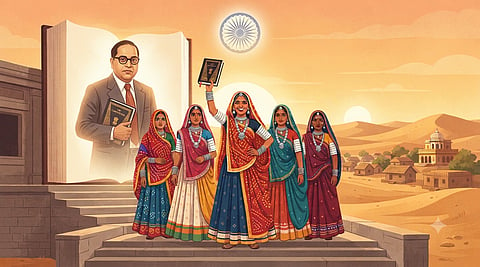

Jaipur: On this Constitution Day, the nation marks 77 years since the Constituent Assembly adopted the Constitution on November 26, 1949. The charter guaranteed every citizen equality before the law, and a striking portrait of Babasaheb Dr. Bhimrao Ambedkar's vision has now emerged from rural Rajasthan. In the results declared on November 25, women won the post of Zila Pramukh (district council chief) in 26 of the 37 districts that went to the polls. That is roughly 70.27 percent of the posts, while men prevailed in just 11 districts.
Article 14 of the Constitution enshrines equality, and Article 243D mandates at least one-third reservation for women in panchayats. Rajasthan goes further, setting aside 50 percent of seats for women in panchayati raj elections, whereas urban local bodies remain at 33 percent. This year's results show that women in many districts won well beyond the reserved limit.
The reservation arithmetic makes the achievement more striking. In the lottery for the 41 district councils, 20 Zila Pramukh posts were reserved for women, yet their victories went well past that figure. With 26 women elected, six won posts that were not reserved for them. Following delimitation, the number of Zila Pramukh posts has risen from 33 to 41. Results are in for 37 districts, and the remaining four will be declared on December 17.
Party-wise, the Congress secured 24 posts, the BJP 10, the Bharat Adivasi Party (BAP) two and the RLP one. Among the women chiefs, 18 belong to the Congress, seven to the BJP and one to the BAP, while the RLP's Nagaur chief is a man. The Congress thus leads in the number of women chiefs, though the BJP, too, gave women seven of its 10 posts.
Reservation by category
The state government's lottery reserved the following posts for women in 2026:
General women (11): Churu, Ajmer, Jhunjhunu, Chittorgarh, Hanumangarh, Deeg, Sriganganagar, Jhalawar, Phalodi, Bikaner and Kota
Scheduled Caste women (4): Dausa, Bharatpur, Tonk and Dholpur
Scheduled Tribe women (3): Salumbar, Pratapgarh and Alwar
OBC women (2): Beawar and Sikar
The outcomes outstripped these allotments. Only two seats were reserved for OBC women, yet they won nine, including the General seats of Jodhpur and Rajsamand. A consolidated, official category-wise list of winners is not yet available.
In the previous cycle, in 2020, there were 33 Zila Pramukh posts, 16 of them reserved for women: three for SC women, two for ST women, two for OBC women and nine for General women. On political outcomes, the BJP won 17 posts, the Congress 13 and others three.
Youth leadership has also drawn attention this time. Seven women under the age of 30 have been elected. Santosh Kumari of Jaisalmer and Varsha Jhala of Jhalawar are both 21, while Mamta Gurjar of Beawar and Komal Bhanwariya of Jhunjhunu are 22. Nikita of Bikaner is 27, Hansa Gurjar of Bundi is 28 and Anisha Singh of Dholpur is 29. According to Amar Ujala, the average age of all Zila Pramukhs is about 41, and 13 of the 14 chiefs aged 35 or below are women. Congress women candidates were also returned unopposed in Dausa, Jaisalmer and Sawai Madhopur.
Dr. Ambedkar sought to secure equality, dignity and rights for women through the Constitution, legislation and social reform. Article 14 guarantees equality before the law, Article 15 prohibits discrimination on grounds of sex or caste while Article 15(3) permits special provisions for women, and Article 16 ensures equal opportunity in public employment. The Constitution also gave women the same right to vote as men.
Through the Hindu Code Bill of 1951, he championed women's right to a share in ancestral property, inheritance and divorce, along with a ban on polygamy. He resigned as Law Minister amid fierce resistance to the bill, though portions of it were later enacted as separate laws. He also advanced the principle of equal pay for equal work under Article 39 and campaigned for paid maternity leave and better working conditions. In the sphere of social reform, he urged that women be educated and made self-reliant, and that evils such as child marriage and the devadasi system be abolished.
Sociologists and women's rights activists have welcomed the election of so many women as Zila Pramukh, but they caution that it also carries a heavy responsibility. In their view, the 50 percent reservation in panchayati raj institutions has undeniably widened women's participation, yet the "sarpanch pati" practice persists in many places, with husbands or other male relatives running the office in place of the elected woman. How effectively the new chiefs will exercise their authority therefore remains an open question.
Archana Vyas, a senior advocate in Udaipur, observes that patriarchy still runs deep across many layers of Rajasthani society, although urbanisation, education and government schemes are bringing gradual change. She hopes the newly elected women will take their own decisions and refuse to delegate their authority to fathers, husbands or brothers.
You can also join our WhatsApp group to get premium and selected news of The Mooknayak on WhatsApp. Click here to join the WhatsApp group.
'The Mooknayak' practices democratic journalism. It is a media platform committed to the Constitution, democracy, and social justice. If you also want 'The Mooknayak' to always raise the voices of the marginalized and show the pain of the voiceless, please subscribe.
PLEASE SUBSCRIBE US