Tribal
Telangana: Chenchu Adivasis Resist Relocation, Assert Community & Habitat Rights over Nallamalla Forests
Meet authorities and activists in Hyderabad

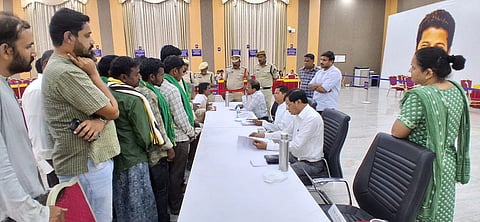

Nagarkurnool- As concerns regarding violations of rights of Chenchu (PVTG) adivasis have surfaced once again in the context of the Amrabad Tiger Reserve, in Nagarkurnool district of Telangana; both the adivasis and activists-in-solidarity have strongly asserted the legal and democratic rights of the Chenchu community in the Nallamalla forests.
These concerns were expressed strongly in a series of actions last week – including:
a) the letters sent to various Central and state authorities and meetings with senior state officials,
b) the Hyderabad civil society round table, on 17th April, in which a large number of Chenchu adivasis spoke resolutely against involuntary relocation and
c) in the Prajavani meeting with Chinna Reddy, (Vice-Chairman of State Planning Board), where Chenchu adivasis were assured that their rights would be safeguarded and district forest officials were asked to comply with law.
Some of the key demands in all these meetings and representations include a) an immediate end to issuing cheques and forcible relocation, in violation of law, b) pursuing the harmonious co-existence model in Amrabad Tiger Reserve and ensuring the democratic participation of communities in forest governance c) withdrawal of fabricated cases against Chenchu adivasi leaders and d) full compliance with all the relevant laws including the Forest Rights Act, 2006; especially community forest rights and habitat rights of Chenchus, Wildlife Protection Act, 1972 (as amended in 2006), Panchayats (Extension to Scheduled Areas) Act, 1996 and the Land Acquisition and Rehabilitation Act, 2013.
Chenchus are a Particularly Vulnerable Tribal Group (PVTG) residing in the Nallamalla forests of Telangana, since generations. They are recorded as one of the ancient food gathering communities with rich traditional knowledge of forest produce, medicinal plants and live in close association with nature. As also recommended by Sir Christoph Von Haimendorf in 1940, their cultural significance with Nallamala forest should be rightly recognized, by declaring the region as a ‘Chenchu Conservation Bio-Reserve’, in order to protect their socio-cultural rights and their natural habitats.
The introduction of ‘Project Tiger’, has resulted in persistent efforts to forcibly relocate them from their natural habitats. The latest threat to their co-existence in the forest has been by way of cheques being issued in March 2026, by senior ministers of the state government, as part of Amrabad Tiger Reserve ‘Relocation package’. It is a gross injustice that without appropriate consultation and consent, as mandated by law, the Chenchu adivasis are sought to be removed and relocated outside the Schedule-V Area, where they would have no access to wild foods or forest produce and where they will lose all their Scheduled Area constitutional safeguards.
In this context, many Chenchu community members from affected villages of Sarlapally, Vatwarlapally, Kollampenta, Rayuletupenta, Uppununtala, Kudichintalabayalu came to Hyderabad on 17th April to submit petitions to the Chief Minister, through the Prajavani Grievance Cell, against the involuntary relocation and excesses of the Forest Department. They also shared their struggles and perspectives with many civil society and citizens groups, during a well-attended round table consultation on the same day. The youth and women gave very clear and cogent reasons as to why they do not want to leave their forest and how there was no proper consent or consultation with their Gram Sabhas. As Chiguru Nagamma of Kommanipenta said, “We have seen how our forefathers were displaced for other projects and whatever money came was wasted on liquor, so we do not want any money or land somewhere else. We will survive in the forest that has sustained us”.
Tirupathaiah of Sarlapally gave examples of how basic development activities are not being allowed in their villages and how even the banks or government departments are refusing to give them loans or benefits of schemes because they are under ‘relocation’. Mallikarjun, the ex-sarpanch, spoke about how their forest rights under the RoFR Act are pending and that shifting them outside the Scheduled Area would make them lose all their constitutional entitlements under PESA, FRA, LARR and LTR Acts. Guravaiah stated that he filed several detailed RTIs and appeals seeking information about the relocation details, but did not receive proper responses.
The youth expressed their anguish that they are being criminalized with false cases for speaking out for their rights. They said that, along with state officials, some ‘pro-conservation groups’ are also creating a false narrative of ‘voluntary relocation’. They claimed that most of the people whose consent was taken so far, are not adivasis and they are non-local people, who want to benefit from the package. The Chenchu women said that their men are being given petty jobs (such as forest watchers) to put pressure on their families for giving consent to relocate. This is a deliberate attempt to divide the Chenchus and create friction among them. However, they very clearly conveyed that they will not give consent to any relocation package and would continue to co-exist with the wildlife in harmony, as that is how the Chenchus always survived in the forest.
Speakers at the consultation also raised many legal concerns including non-implementation of the Forest Rights Act, non-recognition of community forest rights and habitat rights of Chenchus, deliberate misinterpretation of the Wildlife Protection Act to displace Chenchus in the name of making the forests ‘inviolate’, violations under PESA and lack of prior informed consent procedures, non-implementation of the Land Acquisition Act of 2013 (LARR). The recent relocation of Adivasis from Mysampet and Rampur in Kawal tiger reserve where the displaced community became landless wage labour still awaiting the promised land and cash compensation is a classic example of non-compliance with legal and statutory accountability mechanisms in relocation.
Veteran civil rights activist Prof. Haragopal said that the State wants Chenchus out of the forest, both because adivasi regions are mineral resource rich, but also because the capitalist order wants to extinguish the selfless and community way of living of adivasis. Other activists who were present and spoke at the Consultation in solidarity include Usha Seethalakshmi, K. Satyavathi, Sajaya K, Dr. Ramkishan, Sandhya V, Ashalatha S, Bhanu Kalluri, Girija, Ravi Kanneganti, Shankar, Kalpana, Meera Sanghamitra, Sanjeev, Soumitri, Ravichander etc.
The efforts over the past three months, by the Community Forest Rights Working Group of Telangana also resulted in the formation of Chenchu Solidarity Forum (CSF), on the eve of Earth Day, as an independent citizens’ collective to support the struggles of the Chenchu adivasi communities, co-existence and democratic governance in Nallamalla forests and ensure their rights, guaranteed by various laws and the Constitution, are not violated.
Immediately stop issuing cheques and stop the process of unconstitutional relocation of the Chenchus living in Amrabad tiger reserve area.
Implement the Forest Rights Act including recognition of Community Forest Rights and Habitat Rights, settlement of pending IFR claims and resurvey of claims rejected and pending.
The forest department has to place in public domain the mandatory report as per WLPA (with 2006 amendment) of the scientific study conducted in consultation with the Chenchus, that proves ‘irrevocable damage to wildlife’ by the Chenchus.
The forest department should make public the details of core and buffer zone demarcations, details of consultations conducted with concerned Gram Sabhas and details of conditions on which consent was obtained, including details of Social Impact Assessment report, R&R Plan, Gram Sabha resolutions and consent letters.
Govt must share the details of notifying villages in core and buffer zones in Amrabad Tiger Reserve.
Strengthen the governance of forests through co-existence of chenchus with their forests and wildlife using the Constitutional and legal mechanisms of the PESA, FRA, LARR for community centred conservation which is globally recognized as the most sustainable form of Conservation and Climate Protection.
Withdraw all the false criminal cases on the Chenchu youth, community leaders and intimidation tactics to prevent them from voicing their concerns.
Safeguard the Nallamalla ecosystem and declare the Nallamalla forests as Chenchu Conservation Bio-Region Reserve.
The Chenchu Solidarity Forum is an independent collective of concerned citizens and activists to extend support to the struggles of the Chenchu PVTG adivasi communities, residing in the Nallamalla forests, since generations. The Forum is an outcome of a series of solidarity efforts over the past three months, which also led to a large meeting in Hyderabad in April, where Chenchu community women, men and youth resisting evictions & forced relocations, asserted their right to forests and sought support from wider democratic forces. CSF is fully committed to the rights of Chenchus as per various protective laws and the Constitution and also to the conservation of Nallamalla ecosystem.
You can also join our WhatsApp group to get premium and selected news of The Mooknayak on WhatsApp. Click here to join the WhatsApp group.
'The Mooknayak' practices democratic journalism. It is a media platform committed to the Constitution, democracy, and social justice. If you also want 'The Mooknayak' to always raise the voices of the marginalized and show the pain of the voiceless, please subscribe.
PLEASE SUBSCRIBE US