Society
Public Meeting at Press Club of India Demands Release of People ‘s Lawyer Surendra Gadling
Activist Surendra Gadling is detained for his human rights and civil rights work for marginalized religious communities.

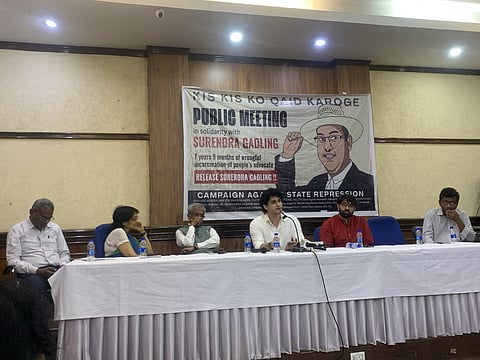

New Delhi- Campaign Against State Repression (CASR) organised a public meeting at the Press Club of India on 12 March demanding the immediate release of people’s lawyer Surendra Gadling, who has been incarcerated in the Bhima Koregaon case. Lawyers, journalists, and academics addressed the gathering, highlighting the implications of the case for democratic rights, civil liberties, and the independence of the legal profession.
Advocate Jagdish Meshram, a close associate of Gadling, spoke about Gadling’s long standing legal work defending Adivasi and marginalized communities. He highlighted the commitment with which Gadling took up cases of those who often lacked access to legal representation and stressed that his incarceration represents a serious attack on lawyers working with the most vulnerable sections of society. He also emphasised on the huge amount of threats Gadling used to get from the police and state machinery.
Advocate Prashant Bhushan spoke about the broader misuse of stringent laws against activists, lawyers, and intellectuals, warning that such cases weaken democratic institutions and erode civil liberties. He emphasized that the continued incarceration of individuals under harsh legal provisions raises serious concerns for the rule of law.
Legal Research scholar Gautam Bhatia referred to an article written by Hany Babu and Surendra Gadling discussing legal issues surrounding the interpretation of the Watali judgment under the Unlawful Activities (Prevention) Act (UAPA). He said that Gadling and Hany babu argue the Act defines the term “court” in a way that effectively allows only sessions courts to evaluate the prima facie accusations made by the police when considering bail, thereby limiting the scope of review by higher courts such as the High Court and the Supreme Court. He further pointed to Section 43D(5) of the UAPA, noting that the inclusion of the word “reasonable” implies that courts must do more than simply accept allegations at face value
Investigative journalist Sourav Das argued that the functioning of the judiciary, particularly the Supreme Court, increasingly reflects what he described as a “managerial court” working in alignment with the state. He also alleged that the presence of “fixers” within the legal system has grown, raising serious concerns about the integrity and independence of the justice system.
Senior advocate Sanjay Hegde emphasized that the judiciary must function as the “breaks” of the system rather than its “accelerator,” stressing that courts are meant to restrain the excesses of state power. He reminded the audience that judges were once lawyers themselves and argued that when history is written, members of the judiciary should be able to stand before the public with dignity and accountability.
Professor Nandita Narain, former President of the Delhi University Teachers’ Association (DUTA), emphasized the importance of public solidarity in defending constitutional rights and democratic freedoms. She called upon teachers, students, and democratic organisations to raise their voices against the continued incarceration of lawyers, activists, and intellectuals under stringent laws.
The speakers collectively called for the immediate release of Surendra Gadling and urged citizens, civil society groups, and democratic organisations to strengthen collective resistance against state repression and defend democratic freedoms.
You can also join our WhatsApp group to get premium and selected news of The Mooknayak on WhatsApp. Click here to join the WhatsApp group.
'The Mooknayak' practices democratic journalism. It is a media platform committed to the Constitution, democracy, and social justice. If you also want 'The Mooknayak' to always raise the voices of the marginalized and show the pain of the voiceless, please subscribe.
PLEASE SUBSCRIBE US