The appeal, submitted by the Zero Tolerance to Sexual Violence (ZeTo) Campaign, has garnered the support of 30 organisations and over 200 individual signatories, including filmmakers, historians, retired civil servants, journalists, lawyers, and academics.
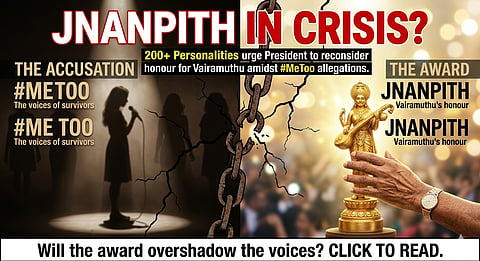
The appeal, submitted by the Zero Tolerance to Sexual Violence (ZeTo) Campaign, has garnered the support of 30 organisations and over 200 individual signatories, including filmmakers, historians, retired civil servants, journalists, lawyers, and academics. AI generated image

'National Honours Not Merely Recognitions of Artistic Output': 200+ Personalities Urge President to Review Vairamuthu's Jnanpith Award

The appeal directly invokes the moral authority of the President's office, describing it as the "moral conscience of the Republic." It argues that at a time when women across India continue to struggle against violence and institutional indifference, overlooking such allegations risks deepening public cynicism about the country's commitment to gender justice.
Published on

New Delhi- In a significant intervention ahead of India's highest literary honour being conferred, a broad coalition of civil society groups and prominent individuals has formally appealed to President Droupadi Murmu to reconsider the decision to bestow the Jnanpith Award on celebrated Tamil lyricist R. Vairamuthu, citing multiple public allegations of sexual harassment against him.

The appeal, submitted by the Zero Tolerance to Sexual Violence (ZeTo) Campaign on Wednesday, has garnered the support of 30 organisations and over 200 individual signatories, including filmmakers, historians, retired civil servants, journalists, lawyers, and academics. The move brings the #MeToo movement's unresolved questions back into sharp focus, directly challenging a cultural establishment that they argue has chosen to overlook serious allegations in favour of artistic accomplishment.

The letter, addressed to President Droupadi Murmu, acknowledges Vairamuthu's decades-long presence and contribution to Tamil literature and cinema. However, it argues that national honours like the Jnanpith "do not merely recognise artistic output" but also "symbolise the ethical stature of public cultural figures whose work is held up as representing the moral imagination of the nation."

The appeal, submitted by the Zero Tolerance to Sexual Violence (ZeTo) Campaign, has garnered the support of 30 organisations and over 200 individual signatories, including filmmakers, historians, retired civil servants, journalists, lawyers, and academics.
India's First 'Contract Rape' Case: Survivor Bares Her Soul Publicly, Reveals 'These 6 Reasons I Lost Faith in the Trial Court'

It is precisely on these ethical grounds, the signatories contend, that the decision has caused "shock, distress, and disbelief" among women, artists, and civil society groups across the country.

The appeal references the testimonies that emerged prominently during the #MeToo movement in India in 2018, particularly the account of singer Chinmayi Sripaada, who spoke publicly about her experiences and the testimonies shared with her by other women from the Tamil film and music industry. The letter notes that several women subsequently came forward to recount similar experiences of harassment, intimidation, and inappropriate conduct, describing patterns involving the abuse of professional power over younger women artists.

"These testimonies were widely reported in national and regional media outlets," the appeal states. It also highlights that Chinmayi Sripaada has publicly stated that after speaking out, she faced professional repercussions and ostracisation within the industry.

While acknowledging the complexities of legal processes, the appeal insists that the existence of multiple, publicly documented complaints should have necessitated the "highest level of due diligence" before conferring India's most prestigious literary honour.

The signatories warn of the broader societal message such a conferment sends. "When women who speak about harassment are ignored or silenced while the accused are elevated to the nation's highest platforms of recognition, a troubling message is sent, not only to survivors but to society at large," the letter reads. "It suggests that artistic accomplishment can eclipse accountability, and that the voices of women may be treated as secondary to the reputational weight of powerful men."

The appeal directly invokes the moral authority of the President's office, describing it as the "moral conscience of the Republic." It argues that at a time when women across India continue to struggle against violence and institutional indifference, overlooking such allegations risks deepening public cynicism about the country's commitment to gender justice.

"We therefore respectfully urge that the decision to confer the Jnanpith Award on Shri Vairamuthu be reconsidered through an independent review, taking into account the serious concerns raised by women who have spoken publicly about harassment and misconduct," the letter states.

The appeal clarifies that this call is not about censorship or erasing literary contributions, but about ensuring that national honours are bestowed with "full ethical scrutiny." It argues that such a step would not diminish the prestige of the award, but rather "strengthen the moral authority of the Jnanpith and affirm that India's highest cultural recognitions are inseparable from the principles of dignity, accountability, and justice."

The list of organisational endorsements includes a wide spectrum of groups, from the All India Progressive Women's Association (AIPWA), the Network for Women in Media (NWMI), and the People's Union for Civil Liberties to grassroots women's collectives like Bhumika, Sahaja, and Vanaja Collective, as well as trade unions and cultural forums.

The individual signatories form an impressive cross-section of Indian civil society. Prominent among them are acclaimed historian Romila Thapar, veteran journalist Palagummi Sainath, former IAS officer Sheela Rani Chunkath, writer and activist John Dayal, and filmmaker-activists like Dr. Anjali Monteiro. The list also includes a host of film industry professionals such as directors BV Nandini Reddy and Jhansi Laxmi, actor Divya Gopinath, and several film editors and technicians. Academics from leading institutions, including Dr. Pramod K. Nayar, Mamta Sagar, and numerous research scholars, have also put their weight behind the appeal, alongside lawyers, gender specialists, and community workers from across the country.

The appeal, organised by the Zero Tolerance to Sexual Violence (ZeTo) Campaign, invites more organisations and individuals to endorse their call, framing it as a moment to affirm that "the dignity of women and the credibility of national institutions cannot be separated."

Summary

The letter concludes with a powerful reminder: "Ignoring these voices does not protect the dignity of India's democratic institutions. It weakens them."

The appeal, submitted by the Zero Tolerance to Sexual Violence (ZeTo) Campaign, has garnered the support of 30 organisations and over 200 individual signatories, including filmmakers, historians, retired civil servants, journalists, lawyers, and academics.
#Avalkoppam Resurges in Outrage: After Dileep's Acquittal in Landmark Kerala Assault Case, Actresses and Feminists Rally Behind Survivor on Social Media

You can also join our WhatsApp group to get premium and selected news of The Mooknayak on WhatsApp. Click here to join the WhatsApp group.

The Mooknayak English - Voice Of The Voiceless
en.themooknayak.com