The Tears That Brought Down Pinarayi's Fortress: How Kerala's Forgotten Victims Ended Ten Years of LDF Rule

This result also marks the end of communist governance in India: with the Left's earlier losses in West Bengal (2011) and Tripura (2018), Kerala was the last remaining communist-governed state. For the first time in five decades, India will not have a single communist chief minister.
Pinarayi Vijayan spent approximately 25 consecutive years either as the all-powerful Secretary of the CPI(M) Kerala State Committee or as Chief Minister making him the longest-serving Kerala CM in history at the time of his second term.
Published on

As the UDF sweeps to power with nearly 100 seats, Kerala's most dominant chief minister in a generation finds himself trailing in his own stronghold: a verdict shaped by ten years of nepotism, corruption allegations, and the suppression of dissent within his own party.

Ten years is a long time to govern a state. It is long enough to build a fortress of loyalty, of party machinery, of institutional control and it is long enough for the cracks in that fortress to widen into something irreparable.

On May 4, Kerala's voters finished what those cracks had started. The United Democratic Front crossed the majority mark with seats to spare. The Left Democratic Front, which had made history in 2021 by winning a consecutive term, something no Kerala government had done in living memory, lost more than half its legislative strength in a single day.

Pinarayi Vijayan, the most dominant politician this state had produced in a generation, found himself trailing in his own home constituency. The fortress had fallen. And the people who had brought it down were not, in the main, the opposition strategists or the Congress campaigners.

They were a widow in Kannur whose officer husband had been humiliated to death at his own farewell function. They were the parents of a young veterinary student from Thiruvananthapuram who was beaten for three days in a Wayanad hostel and found dead in a washroom. They were the landslide survivors of Mundakkai and Chooralmala, still waiting in temporary shelters while reconstruction funds arrived in fractions. They were Kerala's forgotten victims and on counting day, they had the last word.

The death of ADM Naveen Babu

Of all the cases that defined the final years of the Vijayan government, none struck the public more viscerally than the death of Additional District Magistrate K Naveen Babu. On the afternoon of October 14, 2024, PP Divya, a senior CPI(M) leader serving as Kannur District Panchayat President arrived uninvited at Naveen Babu's farewell function at the Kannur Collectorate. She brought with her a private local television channel. Before the assembled colleagues of a departing civil servant, she delivered a speech publicly accusing Naveen Babu of corruption, specifically alleging that he had deliberately delayed issuing a No Objection Certificate for a petrol pump in Chengalayi. The following morning, October 15, Naveen Babu was found dead at his official residence. Police investigation concluded he had died by suicide. He was survived by his wife Manjusha, herself an Additional Tahsildar at Konni, and their two daughters.

What followed in the courts established the legal gravity of what Divya had done. The Thalassery Principal Sessions Court rejected her anticipatory bail application, with the presiding judge finding prima facie evidence that her act of instigation had been pre-planned and premeditated. She was subsequently arrested and remanded to police custody. In March 2025, Kerala Police submitted a chargesheet before the First Class Judicial Magistrate Court in Kannur, naming Divya as the sole accused and charging her with abetment of suicide. The chargesheet included scientific evidence and was based on statements recorded from 82 individuals. 

Naveen Babu's family maintained that his death was not a suicide but a murder, and demanded a CBI investigation. Police found no scientific evidence to support a murder theory, and the government resisted the CBI probe. The criminal trial on the abetment charge is ongoing and no final conviction has been delivered.

The case became a symbol of what critics described as an administration in which political power was used to intimidate independent civil servants. Naveen Babu's widow, Manjusha, said publicly after Divya's arrest: "The person who destroyed our life must be arrested. The police should not protect her." The image of a government that had at first remained silent about the circumstances of the farewell function and a Collector who did not intervene as a public official was being humiliated before a camera, stayed in the public consciousness through election day.

The death of veterinary student Siddharth at Pookode

On February 18, 2024, JS Siddharth, a 20-year-old second-year veterinary student from Thiruvananthapuram, was found dead in the washroom of his hostel at the Kerala Veterinary and Animal Sciences University in Pookode, Wayanad. What initially appeared to be a suicide quickly revealed something more disturbing. The post-mortem report confirmed that Siddharth had sustained multiple blunt injuries before his death and that his stomach was empty, indicating he had been deprived of food for a significant period. Police investigation, documented in the remand report, established that on the nights of February 16 and 17, Siddharth had been subjected to a sustained ordeal of physical assault and what witnesses described as a mock public trial, reportedly because he had danced with senior female students at a Valentine's Day event on campus. The assaults took place at multiple locations, including a hill behind the college hostel.

Police ultimately arrested eleven individuals, most of them members of the Students' Federation of India, the student wing of the CPI(M). Cases were registered under IPC provisions for abetment of suicide, wrongful restraint, and voluntarily causing hurt, as well as the Kerala Prohibition of Ragging Act. The SFI suspended the accused members. When Siddharth's parents sought to challenge the proceedings, the Kerala High Court's Division Bench, hearing an appeal by his mother, M R Sheeba, acknowledged the anti-ragging committee's preliminary report confirming that Siddharth had been a victim of assault, and stayed a lower court order that had allowed the accused students to resume studies at a different campus.

Siddharth's father, T Jayaprakash, alleged publicly that the CPI(M) was shielding the principal accused and that police had hesitated to make arrests due to political pressure. The SFI unit president, who was initially absconding, surrendered only after sustained public pressure. No court has made a finding specifically on the allegation of political interference in the investigation. The criminal trial is ongoing. What the case left behind, irrefutably, was a documented culture of campus violence under the watch of the party's student wing and the image of a state government that appeared slow to act until the scale of public outrage left it no choice.

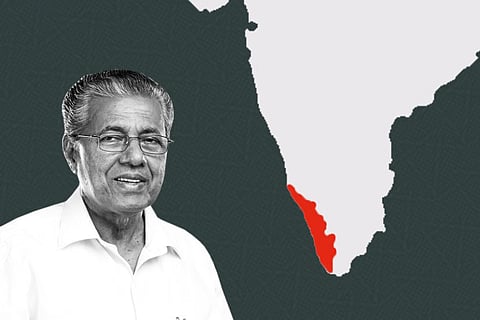
For the first time since 1978, when Nripen Chakraborty took office in Tripura, India had always had at least one communist chief minister somewhere in the country. With Kerala's verdict on May 4, that unbroken stretch of nearly five decades comes to an end.

A protest treated as attempted murder

In June 2022, three Youth Congress leaders Farzin Majeed, Naveen Kumar, and Sunith Narayan waved black flags at Chief Minister Vijayan aboard an IndiGo flight travelling from Kannur to Thiruvananthapuram. It was an act of political protest. The Valiyathura police registered a case against all three under Section 307 of the Indian Penal Code , the section that deals with attempt to murder based on a complaint from the Chief Minister's security personnel. The charges drew immediate criticism from across the political spectrum as wildly disproportionate. Farzin Majeed, who was also a school teacher, was suspended from his post for fifteen days following demonstrations by SFI and DYFI activists at his school, with a DYFI leader reportedly threatening that his leg would be broken if he returned.

The Union government, when approached by the Kerala state government seeking prosecution under the more relevant Aviation Safety Act and the Aircraft Act, declined not once but eight times across formal requests, as documented in a November 2025 report by Onmanorama. The refusal of the central government to treat the incident as an aviation offence the only framework under which a meaningful prosecution for conduct on a plane could conceivably be sustained , effectively exposed the hollowness of the state's attempt-to-murder charge. By the time the 2026 elections came around, the accused had become campaign symbols of political persecution, leading UDF canvassing in CPI(M) strongholds across Kannur and, by all accounts, finding a receptive audience among voters who remembered the case.

Pinarayi Vijayan spent approximately 25 consecutive years either as the all-powerful Secretary of the CPI(M) Kerala State Committee or as Chief Minister making him the longest-serving Kerala CM in history at the time of his second term.
Centre Declares Wayanad Landslide a Disaster of Severe Nature

Wayanad: India's largest debris flow and its aftermath

On July 30, 2024, catastrophic landslides struck the villages of Mundakkai and Chooralmala in Wayanad district. The Post-Disaster Needs Assessment, conducted under UN framework guidelines, confirmed it was the largest recorded debris flow in India's history. More than 200 people were killed, hundreds more were injured, and over 1,300 homes were completely destroyed. Schools, the local panchayat office, the electricity board office, and 136 community buildings were damaged or lost. Thousands were displaced to relief camps. The disaster was declared a Level 3 event, indicating a catastrophic situation that overwhelmed both district and state capacities.

The Kerala government formally assessed the reconstruction cost at ₹2,221 crore and sought this amount from the National Disaster Response Fund. After fourteen months, the Union government sanctioned ₹260.56 crore , approximately eleven percent of the amount requested. Survivors, meanwhile, continued to receive bank loan recovery notices for tractors, cattle, homes, and farmland buried under tonnes of mud, a second disaster of a financial nature, as described by Down to Earth in February 2026. The Kerala government ultimately announced a debt write-off scheme for affected families.

Activists and critics allege that public donations collected for Wayanad victims were siphoned and misused by the ruling establishment. The Kerala government denied all such claims and pointed to an electronic audit trail in the Chief Minister's Distress Relief Fund, overseen by the State Bank of India and the Principal Secretary (Finance).

DGP TP Senkumar: removal overturned by Supreme Court

Within weeks of the LDF government coming to power in 2016, TP Senkumar was removed from his post as Director General of Police and State Police Chief of Kerala and reassigned to a lower position. Senkumar challenged his removal before the Central Administrative Tribunal and, subsequently, before the Supreme Court. On April 24, 2017, a Supreme Court bench comprising Justice Madan B Lokur and Justice Deepak Gupta ordered his reinstatement. The court held explicitly that the state government's stated justifications for removing Senkumar including his handling of the Kollam fire tragedy were unacceptable and did not hold ground. The government was directed to reinstate him as State Police Chief, which it was compelled to do. The case established in court record that the removal of a senior police officer by the Vijayan government had no valid basis in law.

Comrades voted against the party

Perhaps the most telling element of this electoral collapse is found not in the opposition's gains but in where the CPI(M) lost its own ground. In Payyanur, a constituency so deeply embedded in the CPI(M) that it has been considered an organisational heartland , V Kunjikrishnan, who had been expelled from the party after publicly alleging the diversion of party martyrs' welfare funds, and whose home had subsequently been attacked, contested as an independent aligned with the UDF.

Kunjikrishnan won by approximately 7,000 votes over the official CPI(M) candidate. In Thalipparambu, where the CPI(M) had previously won by 25,000 votes, a similarly expelled local figure won by over 10,000. In Mattannur, where the CPI(M) had secured a majority of 65,000 votes in 2021, the party fell dramatically short of that benchmark.

 Political analyst MG Radhakrishnan had written recently in The News Minute that "both the strength and weakness of the LDF is Pinarayi Vijayan," observing that the total concentration of authority in one leader, while electorally powerful in 2021, had created structural fragility. The results of May 4 bore out that assessment with a precision that no exit poll had fully captured. The party's own comrades : men and women who had spent their lives canvassing in the red, who had given their evenings to party meetings and their weekends to campaigns voted against the official candidate in constituencies where such a thing had been unthinkable a decade ago. That is not minority polarisation, as some LDF voices suggested. That is a party's own base delivering a verdict on its leadership.

Corruption & Nepotism

Two cases that loomed over the final years of the Vijayan government and that opposition campaigners returned to repeatedly on the campaign trail concerned the Chief Minister's own family and his closest official aide.

In 2020, M Sivasankar, the Principal Secretary to Vijayan and one of the most powerful bureaucrats in Kerala, was suspended and subsequently arrested after a National Investigation Agency probe into the seizure of 30 kg of gold worth ₹14.82 crore from a diplomatic bag at Thiruvananthapuram Airport. Investigation confirmed his links to Swapna Suresh, a former UAE Consulate employee and one of the primary accused in the smuggling operation. Enforcement Directorate and FCRA cases followed against Sivasankar.

What the cases left behind was a question the government never fully answered. Sivasankar had been Vijayan's most trusted bureaucratic lieutenant, the man who sat outside the Chief Minister's door. Opposition parties alleged that the investigation had begun pointing toward higher levels of the Chief Minister's Office before it appeared to lose momentum, and demanded Vijayan's resignation.

The second case concerned his daughter. Congress MLA Mathew Kuzhalnadan filed a formal complaint alleging that Cochin Minerals and Rutile Ltd, a mining company, had paid ₹1.72 crore to Exalogic Solutions, a firm owned by Vijayan's daughter Veena Vijayan for services that were never rendered. The Serious Fraud Investigation Office subsequently alleged the figure was closer to ₹2.7 crore. Vijayan dismissed the charges as a political witch-hunt and accused central investigative agencies of targeting him for political reasons.

The Kerala High Court dismissed petitions seeking a probe, finding the evidence presented to be circumstantial rather than conclusive. The Supreme Court also declined to intervene. No conviction has been delivered, and the allegations against both Vijayan and his daughter remain legally unproven.

What these two cases did, however, regardless of their legal outcome, was establish in the public mind a pattern that proved impossible for the LDF to shake off during the election campaign.

A quarter-century of power and its end

Pinarayi Vijayan spent approximately 25 consecutive years either as the all-powerful Secretary of the CPI(M) Kerala State Committee or as Chief Minister making him the longest-serving Kerala CM in history at the time of his second term. He is 80 years old. He contested the 2026 election despite reported health difficulties, seeking what would have been an unprecedented third consecutive term. As counting progressed on Monday, the constituency of Dharmadam which he had won by more than 40,000 votes in 2021 remained in a volatile contest with his Congress challenger V P Abdul Rasheed, with the result declared too close to call as this report was finalised. Whatever Dharmadam's final outcome, the surrounding collapse of the LDF across Kerala made clear that the era defined by Vijayan's dominance was over.

For Kerala, a state that has prided itself on political literacy, high voter turnout, and a tradition of peaceful transfers of power, the 2026 verdict arrived with unusual emotional weight. It came freighted with the memory of Manjusha, the widow of ADM Naveen Babu, asking the police not to protect her husband's tormentor. It came bearing the grief of the parents of Siddharth, whose son was beaten for three days by his classmates and found dead in a washroom. It came from the anger of young men charged with attempted murder for waving a cloth on a plane. And it came from the exhausted, displaced families of Wayanad, living in temporary shelters while reconstruction funds arrived in fractions. Kerala voted. The arithmetic of the ballot, as it always does, had the final word.

Pinarayi Vijayan spent approximately 25 consecutive years either as the all-powerful Secretary of the CPI(M) Kerala State Committee or as Chief Minister making him the longest-serving Kerala CM in history at the time of his second term.
Will Dileep's Acquittal Haunt CPM Like Jisha's Death Boosted Them? Justice's Boomerang in Kerala's 2026 Polls
Pinarayi Vijayan spent approximately 25 consecutive years either as the all-powerful Secretary of the CPI(M) Kerala State Committee or as Chief Minister making him the longest-serving Kerala CM in history at the time of his second term.
The Myth of Kerala’s “Governance and Social Cohesion” Beyond Identity Politics

You can also join our WhatsApp group to get premium and selected news of The Mooknayak on WhatsApp. Click here to join the WhatsApp group.

Support The Mooknayak

'The Mooknayak' practices democratic journalism. It is a media platform committed to the Constitution, democracy, and social justice. If you also want 'The Mooknayak' to always raise the voices of the marginalized and show the pain of the voiceless, please support us.

Please Contribute
The Mooknayak English - Voice Of The Voiceless
en.themooknayak.com