India
"Withdraw Your Remarks”: Environmentalists & Citizens Write to CJI, Say ‘Delegitimising’ Environmental PILs Chills Constitutional Democracy
Civil Society Rebukes CJI’s ‘Obstructionist’ Tag on Green Litigants

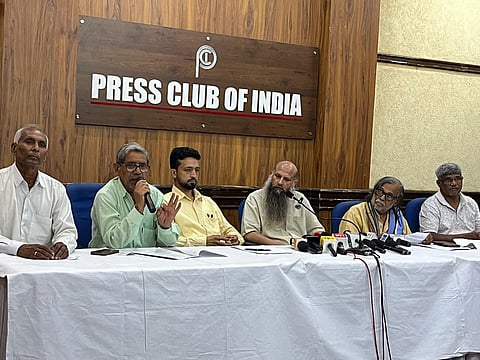

New Delhi- As the global community marks the International Day of Biodiversity on 22nd May , environmentalists and grassroot people from different states of India like Karnataka, Odisha, Uttarakhand, Haryana and Rajasthan arrived in the national capital to present the extremely grave ground situation of India’s natural ecosystems. They also released a letter that citizens and civil society groups across the country have sent to the Chief Justice of India (CJI) expressing their serious concerns on the recent oral remarks made in court by the CJI on 11th May during the hearing of a matter relating to expansion of the Pipavav Port in Gujarat regarding the overall ‘right’ of citizens to protect the environment and question illegal decisions and irregularities in the courts of law.
The letter to the CJI which has been endorsed by rural and urban citizens from various walks of life and collectives and organisations across India states: “As captured in the publicly available court proceedings video and reported in the media, you are quoted as having observed: In this country, the kind of litigations that are filed only to stall all development projects. You show us a single project in this country where these alleged environmentalists, activists, they say we welcome this project. You have so many degrees. I’m RTI activist, I’m environmentalist, I’m social activist, I’m so and so activist!!!”
Joseph Hoover, Managing Trustee, United Conservation Movement from Bangalore stated, “The remarks of the Hon’ble Chief Justice of India have caused deep anguish among us. This kind of framing risks portraying citizens who seek lawful scrutiny of environmental decision-making as a ‘suspect constituency’, rather than as ‘participants in a constitutional democracy’ performing both a right and a duty. It also risks producing a chilling effect well beyond this single case. Oral observations that delegitimise environmental objections – delivered from the nation’s highest judicial platform – may discourage future petitioners, embolden appraisal authorities to treat ‘public concern’ as an inconvenience and signal to the NGT and other courts that environmental scrutiny is disfavoured. We demand that the Hon’ble Supreme Court withdraws the oral remarks made by the Chief Justice of India during the Pipavav Port hearing on 11th May 2026, so that they are not understood as casting doubt on the legitimacy of bona fide environmental public-interest litigations or on the Constitutional role of affected communities and citizens in seeking enforcement of environmental laws. We urge that a public statement be issued that what was said on 11th May should not be taken as the opinion of the Supreme Court on environmental litigation and litigants. We also urge that oral observations from the bench in matters involving environmental scrutiny be made with awareness of their systemic effect on litigants, on subordinate tribunals, and on the Constitutional culture of accountability that public interest litigations exist to protect.”
Prafulla Samantara, Senior environmentalist from Odisha and National Convenor, Lok Shakti Abhiyan said, “We take strong objection to the casual deployment of the label ‘environmentalist’ as a term of delegitimisation. ‘Environmentalist’ has a positive connotation: as citizens who are fulfilling their duty under Article 51 (A)(g) of the Indian Constitution which says that it is the fundamental duty of every citizen to protect and improve the natural environment including forests, lakes, rivers, and wildlife. In fact, the Constitution envisages every citizen including Judges to be a ‘guardian of the environment’. We citizens who discharge our Constitutional duty by raising concerns about inadequately appraised development projects are not obstructing the State, but are performing an obligation that the Constitution places upon us. Public Interest Litigation is itself a judicial innovation of the Court, designed expressly to ensure that affected communities and conscientious citizens frequently excluded, for a variety of reasons, from formal legal processes could nonetheless hold the State and the industry to account. Citizens and affected communities who approach the NGT and the Supreme Court are, therefore, not subverting these institutions, but are merely using them for their intended purpose. To characterise this as a “problem” is to characterise Constitutional democracy itself as a problem. We demand that the Hon’ble Supreme Court and all other courts in India treat local communities and citizens approaching the judiciary in public interest litigation matters as rights-bearing participants in environmental decision-making rather than as obstacles to it. We urge the Hon’ble Supreme Court to continue to stand firm in the decades of legacy of environmental jurisprudence it has itself built, and to signal clearly that in the world’s largest democracy, the rule of environmental law is a pillar of – and not barrier to – ‘development’ that is Constitutionally and legally sound, widely inclusive and ecologically sustainable.”
Atul Sati, Convenor, Joshimath Bachao Sangharsh Samiti, Uttarakhand stated, “India’s major biogeographic regions – be it the Himalayas, Aravallis, Western Ghats, North East, our islands like Andaman & Nicobar are not merely repositories of biodiversity. They are the functional infrastructure upon which our country’s water, food, and climate systems depend. Their degradation is not a conservation concern peripheral to development – it is a threat to development itself. The scale and frequency of Himalayan disasters in the monsoon season of 2025 was such that the Supreme Court itself proclaimed: ‘If things proceed the way they are as on date, then the day is not far when the entire state of Himachal Pradesh may vanish into thin air.’ The Court’s own words stand as a powerful rebuke to any suggestion that judicial scrutiny of development in the Himalayas, or that of any of the ecologically sensitive regions across India, is anti-national or anti-development. We wish to point out that socially and ecologically destructive projects which have been approved in violation of the law cannot be termed as ‘developmental projects’. Full compliance with environmental laws is essential for an activity to be termed as ‘sustainable development’. In ecologically-sensitive landscapes, the issue is not whether one can devise some post-facto mitigation measure on paper; the issue is whether impacts were properly identified early enough to avoid the most damaging siting and design choices. When citizens point out deficiencies in an Environmental Impact Assessment, they are not being ‘obstructionist’. They are merely seeking ‘application of mind’ from authorities who may have overlooked critical ecological data. Further, the suggestion that environmental litigation routinely paralyses development is directly contradicted by available evidence. NGT – the very institution established to provide meaningful environmental adjudication – upholds challenged clearances in 80% of the cases. This is not the profile of a system being captured by so-called ‘obstructionists’. The claim that ‘everything gets dragged to court’ is also incorrect. Environmental PILs constitute a small fraction of the total Supreme Court docket. Besides, the fact remains that of the approximately 12,500 Environment, Forest, Wildlife and CRZ clearances that are now granted annually (a record high reached in 2022), only a minuscule fraction faces legal scrutiny. Data from 2020 to 2025 reveals that, on average, fewer than 70 of these approvals are legally challenged by citizens or activists before the NGT each year. Characterising this small subset of contested clearances as evidence of a generalised anti-development lobby is completely unacceptable.”
Gyarsi Lal, a labourer from Pawana Aheer village nestled in the Aravallis in Kotputli Behror district in Rajasthan says, “For India’s poor, a clean and safe environment is not an ideological preference – it is a condition for our survival. Mining and blasting next to homes, children’s school and agricultural fields in my village is threatening our ‘right to exist’. We have complained to the local government authorities many times but nobody listens to us poor people. We just want to live a peaceful life without our lives being blasted away. Is that too much to ask for? The judiciary is, for us citizens in rural areas, the institution of last resort.”
Lokesh Bhiwani, Founder, Stand With Nature from Haryana said, “Parliament’s enactment of the National Green Tribunal Act in 2010 was itself an acknowledgement that industrial projects can and do cause real and systemic environmental harm, and warrants a dedicated and specialised judicial forum. Full compliance with environmental laws is essential for an activity to be termed as ‘sustainable development’. Litigants often articulate their livelihood concerns and when their very ‘right to life’ is threatened through Statutory Appeals before the NGT since the Parliament has conferred this statutory right on the citizens of our country. Once rights have been conferred, it is inappropriate for the Supreme Court to vilify citizens who exercise the rights conferred by the Parliament.”
Prabhu Dayal Verma, a retired school teacher in North Rajasthan said, “Our struggle of the last few years had seen some light and hope with the positive order from the National Green Tribunal in early November 2025 in the ‘Jodhpura Sangharsh Samiti vs Union of India & Ors’ upholding the ‘Right to Life’ of the people of Jodhpura village from the Aravalli belt of North Rajasthan who have been negatively impacted by mining and stone crushing activities of Ultra Tech Cement company. The Chief Secretary, State of Rajasthan has been directed to undertake measures to rehabilitate the victims of pollution away from the proximity of limestone mining. Even after 6.5 months of the NGT order and countless meetings with the local authorities, we are still waiting to be rehabilitated. Our only hope is in knowing that we can knock on the doors of the NGT if the government does not do what the court has directed. The judiciary is our only hope of survival.”
Tannuja Chauhan, an Environmentalist from Delhi said, “India is the 9th most vulnerable nation on Earth to climate change. Hence, protecting our remaining carbon sinks and ecological lifelines is not an ideological position, but a matter of national security. For millions of people across India who are dependent on forests, climate-sensitive agriculture, clean water, and coastal fisheries for their livelihood, the NGT and the Supreme Court are their ‘last resort and ray of hope’. We cannot afford for the Supreme Court to signal that people’s concerns are ‘obstructionist’. We urge the Hon’ble Court to view environmental litigation not as a hurdle to be cleared, but as a procedural safeguard that ensures India’s progress does not result in the functional collapse of its life-support systems. A responsible democracy does not ask citizens to choose between development and the environment. It asks whether development has been planned lawfully, appraised honestly, and designed intelligently enough to holistically protect and benefit all life, livelihoods and ecological security. When it has not been, it provides citizens with legal remedies. The Supreme Court of India exists, in part, to ensure those remedies are available and effective. The need of the hour is not less environmental scrutiny, but better planning, better appraisal, better compliance, greater transparency and a judicial climate that reassures citizens that lawful environmental concern remains integral to Indian democracy and to the fundamental ‘Right to Life’ itself.”
You can also join our WhatsApp group to get premium and selected news of The Mooknayak on WhatsApp. Click here to join the WhatsApp group.
'The Mooknayak' practices democratic journalism. It is a media platform committed to the Constitution, democracy, and social justice. If you also want 'The Mooknayak' to always raise the voices of the marginalized and show the pain of the voiceless, please subscribe.
PLEASE SUBSCRIBE US