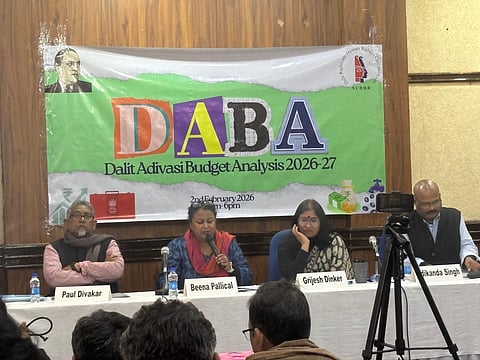
Some Recommendations are as follows:
Central Legislation
Introduce the Central SCP&TSP Legislation: The government should enact a central law for the SCP & TSP Budget to legally bridge the development gaps.
Enforce Transparency and Accountability: The law should mandate adherence to strict legislative principles of transparency and accountability to ensure fiscal discipline.
Public Health:
3. The government should ensure that allocations for SCs and STs under various health initiatives, including NHM, PMJAY, Jan Aushadhi, and PM POSHAN, remain intact and are not misappropriated.
4. Access to affordable medicines should be improved by increasing the number of Jan Aushadhi Kendras in rural and SC/ST areas and ensuring that public hospitals adhere to generic drug prescription policies.
5. Public health expenditure needs to rise above 1.3% of GDP with clear, measurable outcomes for the health indicators of SCs and STs.
6. Special emphasis must be placed on the health of SC and ST women, with tailored interventions for maternal, reproductive, and mental health that address the complexities of caste and gender.
Education:
The government must ensure timely disbursement of scholarships by strengthening Aadhaar Payment Bridge systems and holding entities accountable for delays.
It is recommended that Post-Matric and National Overseas Scholarships be increased in alignment to the inflation rates of tuition fee.
We strongly recommend to reconsider or restructure the PM Girls Hostel in order to protect educational opportunities for SC and ST girls as ensuring safe accommodation is vital for equitable access to education and long-term socio-economic growth.
In addition to implementing the Promotion of Equity in Higher Educational Institutions 2026, UGC should provide adequate resources for their effective implementation.
Social Security:
Social security schemes like pension, health insurance and food subsidies may alleviate immediate hardship but do not ensure upward mobility without access to education, skills, or better educational opportunities. Therefore, social security for SCs and STs should prioritise capacity building over mere protection.
For SC/ST informal workers, ensure universal social security through simplified registrations system, portable benefits for migrants, stronger employment and wage support, expanded health insurance and pensions, and improved livelihood through skill training and credit support.
Livelihood:
Loan schemes and programmes for the income generation and livelihood are promising and impactful only if the intention meets the installed terms and conditions for availing the scheme's benefits. Therefore, we strongly recommend review and change in the terms and condition of the loan schemes in such a way that it is accessible. The delayed actions, denied request and unnecessary interference of the banks and financial institutions in disbursement of the loan amount must be taken into accountability, timely intervention and legal action against this unjust treatment must be ensured.
Access to Justice
There should be a separate scheme for the effective implementation of Prevention of Atrocities act and must have an allocation not lesser than Rs. 1000 Crs. to address the increasing atrocities against SCs and STs. A total of 50 % of the fund must be spent for SC and ST women to address the intersectional violence against them.
Create separate budget lines for victims’ compensation and rehabilitation; police initiatives such as special police stations and Special Protection Cells; judicial measures including the establishment of exclusive special courts, appointment of exclusive Special Public Prosecutors, provision of free legal aid; and awareness generation under the allocation for effective implementation of the PoA Act and the PCR Act. This will enhance transparency and accountability of state governments and enable state machinery to address specific needs more effectively.
The compensation amount needs to be revised. As per the amendment 2016 of SC/ST Rules, the minimum compensation is Rs. 85,000/- only, it includes atrocities such as preventing vote and filing nomination in election, intimidating PRI members from performing, social and economic boycott and giving false complaints. Minimum compensation amount under atrocity act should be increased to 5 lakhs rupees. The same has to be revised for other atrocities as well based on its severity.
Specifically for murder and rape survivors the compensation amount needs to be increased from 8 lakhs to 25 lakhs.
Sanitation and Frontline Workers:
Critics strongly recommend reinstating a human rights approach in the NAMASTE Scheme, as in the earlier SRMS. Women sanitation workers, particularly garbage pickers, urgently need timely medical care and health insurance, as strenuous cart-pulling work severely impacts their reproductive health. Despite coverage under Ayushman Bharat, they face systemic delays and denial of care. A dedicated medical insurance component for women sanitation workers, with additional benefits beyond Ayushman Bharat, is therefore essential.
Mandate 20% of fund allocation for the welfare and safety of the workers under the Swachhta Udyami Yojana (SUY)- Grameen, we recommend at least Rs.8000 Crs. (Welfare) and Rs.6000 Crs. (safety) to expand the livelihood opportunities other than sanitation work under the SUY schemes to stop pushing SCs back into sanitation work in different forms. Break this systemic push and provide assistance for scope of work outside of sanitation work realm.
Gender Budget
50% of the budget must be allocated for SC&ST women’s issues under a Special SC ST Women’s component (DWC) within the SC and ST Budget.
Critics recommend increasing allocations to raise wages and reduce the administrative burden by hiring more frontline workers across sanitation, public health, and community-based institutions such as Anganwadi and early childcare centres. At least Rs.5,000 Crs. should be earmarked for wage enhancement, health support, and work-related protections for frontline workers exposed to hazardous and exhausting conditions. All women-dominated workforces, including sanitation, ASHA, care, domestic, ANM, Anganwadi, migrant, and contractual workers must be ensured dignified and respectful working conditions, fair wages, and adequate support.
People with Disabilities
Substantially increase the budget for disability welfare schemes by at least 40%, with a clearly demarcated SC/ST sub-allocation to address compounded caste- and disability-based exclusion in education, employment, and social protection.
Allocate a dedicated budget line of Rs 300 Crs. for intersectional disability inclusion, specifically targeting SC/ST persons with Disabilities. This allocation will support community-based outreach, last-mile UDID enrolment in SC bastis and ST habitations, training of frontline service providers, and the establishment of district-level accessibility and inclusion committees.
Allocate Rs 150 Crs. for accessible education and skilling infrastructure in SC/ST dominated regions, including assistive technologies, barrier-free campuses, hostels, and scholarships for SC and ST PwDs.
Youth Employment
Increase allocations for SC/ST components within youth employment and skilling schemes by at least 50%, with a mandatory earmarking for transition into regular salaried employment rather than short-term or informal placements. This increase should prioritise SC/ST youth in urban informal sectors such as construction, sanitation, logistics, and gig work.
Create a dedicated “SC/ST Youth Employment Security Fund” with an initial allocation of Rs 500 Crs. This fund will support wage subsidies for first-time SC/ST youth workers, expansion of urban employment guarantee pilots, and placement-linked incentives for employers offering secure, non-discriminatory employment.
Children
Significantly increase the budget for child labour prevention initiatives targeting SC/ST children by 50%. This increased funding will support enhanced educational support programmes, expansion of residential schooling and hostels, alternative income-generation opportunities for families, and sustained community engagement to prevent child labour.
Establish a “Child Rights Monitoring Fund” with an initial allocation of Rs 250 Crs. focused explicitly on SC/ST children. This fund will support caste-disaggregated data collection, tracking of dropout and exclusion patterns, independent audits of child protection systems, and the design of targeted corrective interventions.
Allocate Rs 200 Crs for strengthening child protection and justice mechanisms for SC/ST children, including POCSO special courts, survivor compensation, counselling services, and rehabilitation programmes, with priority for SC and ST girls facing caste and gender-based violence.
Introduce a dedicated allocation of Rs 100 Crs. for school-based, caste-sensitive mental health programmes, recognising discrimination, segregation, and violence as key contributors to psychological distress among SC and ST children.
Land Rights and Agriculture
Redistribute at least 5 acres of land to SC&ST communities: There are no innovative schemes to help SC&ST communities reach a viable threshold of at least 5 acres of land. Therefore, government should earmark a portion of the agricultural budget under SC/ST budget towards a dedicated land purchase scheme. This scheme should focus on the state-led acquisition of cultivable land to be redistributed to SC/ST families, with a specific priority for female heads of households, who currently hold only a tiny fraction of land (0.23 Crore for SC female and 0.16 Crore for ST female).
Climate Resilience
It is strongly recommended to bring a separate and exclusive Climate Budget covering the programs and schemes for climate change adaptation and resilience primarily for the SCs/STs.
The budget allocation for climate resilience and adaptation should also follow the principles of SCP-TSP, as the allocation should be based on the proportion of the population of SCs and STs.
The programs and schemes made for relief and rehabilitation and compensation for the loss and damage should also be amended with the view to make landless SC and ST households eligible and also there should be a proper representation of the community in the loss and damage assessment and relief distribution process.
Despite having the lowest carbon footprints, the marginalized and vulnerable communities bear a disproportionate burden of climate impacts and must therefore be central to climate policy. All adaptation, and loss and damage measures should be explicitly guided by a ‘reparative justice framework’. The energy transition must ensure that these communities do not bear any social, economic, or environmental costs, making equity and protection of the most affected a core priority.