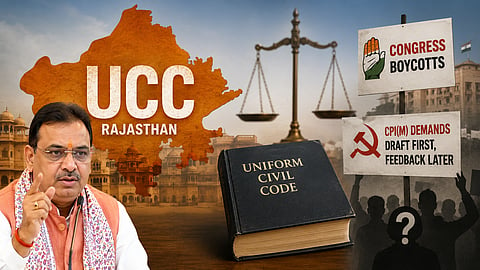
Jaipur- The Rajasthan government has initiated the process for enacting a Uniform Civil Code (UCC) in the state by constituting a high-level committee to prepare a draft legislation. The move follows a State Cabinet decision on June 22. Rajasthan is the fifth BJP-ruled state to begin formal steps toward a UCC after Uttarakhand (which enacted its law in February 2024), Gujarat, Assam, and Madhya Pradesh.
The committee is headed by former Supreme Court judge Justice Ranjana Prakash Desai. Its members include former IAS officer Shatrughan Singh, Additional Advocate General Basant Singh Chhaba, former Principal of Government Law College, Sri Ganganagar, Ramswaroop Agarwal, Additional Chief Secretary (Home) Bhaskar A. Sawant, and Dr. Shuchi Chauhan. The panel has been tasked with drafting the Rajasthan Uniform Civil Code, 2026, covering personal laws related to marriage, divorce, inheritance, succession, adoption, and maintenance. The panel was tasked with holding public consultations in different phases across the state.
The division-level public hearings (Jan Sunwai) on the Uniform Civil Code, scheduled for two days at each divisional headquarters, began on July 2 from Bikaner division and culminated with the final hearings in Udaipur on July 14. The consultations are being held even as no draft of the proposed legislation has been released in the public domain.
The BJP government led by Chief Minister Bhajan Lal Sharma announced its intention to examine the feasibility of introducing a Uniform Civil Code in Rajasthan after coming to power. A committee has been constituted which is an empowered committee constituted to review the implementation of the Uniform Civil Code (UCC) in the state of Rajasthan, to gather opinions and suggestions from the public, and submit its report to the state government. The committee's mandate includes:
1.Examining existing personal laws governing marriage, divorce, inheritance, adoption and succession.
2.Studying constitutional provisions, judicial pronouncements and the experiences of other states.
3.Inviting suggestions from citizens, religious organisations, legal experts, civil society groups and stakeholders.
4.Submitting recommendations to the state government on whether and how a Uniform Civil Code can be implemented in Rajasthan.
The committee is not a legislative body. It has been tasked with preparing recommendations after completing consultations.
The debate over a Uniform Civil Code is rooted in Article 44 of the Constitution, one of the Directive Principles of State Policy, which states:
"The State shall endeavour to secure for the citizens a uniform civil code throughout the territory of India." Directive Principles are not enforceable by courts, but they are intended to guide governments in policymaking.
Supporters argue that a UCC would promote equality by providing a common legal framework for civil matters irrespective of religion, while critics contend that any such law must emerge through broad consultation and must adequately safeguard India's religious and cultural diversity.
Government states the proposed law aims to create a common set of rules for all citizens irrespective of religion, promote gender equality, eliminate disparities in personal laws, and align with Article 44 of the Constitution (Directive Principles of State Policy).
Officials have referenced possible features drawn from similar exercises elsewhere, including mandatory registration of marriages and divorces, a ban on polygamy, registration of live-in relationships, and equal rights for sons and daughters in ancestral property. Tribal communities are expected to be kept outside the purview of the proposed code, consistent with the approach in other states.
The committee was mandated to hold public consultations known as Jan Sunwai across Rajasthan’s divisional headquarters. These interactions were intended to gather views from the public, social organisations, legal experts, and community representatives before finalising the draft. A dedicated online portal has also been set up for citizens to submit suggestions.
Hearings were scheduled and held in phases during early to mid-July including sessions for Bikaner, Ajmer, Jodhpur (July 6-7), Kota, Jaipur division (July 10-11), and Udaipur (July 13-14). Government representatives have described the process as inclusive and transparent, aimed at shaping a progressive law suited to Rajasthan’s social fabric.
No complete draft of the proposed legislation has been released in the public domain so far. The consultations are taking place as an input-gathering exercise prior to the preparation of the final draft bill.
The Congress has strongly objected to the public hearings being conducted without the release of a draft. Rajasthan Pradesh Congress Committee president Govind Singh Dotasra wrote to the Chief Secretary on July 5, demanding that the hearings be withdrawn until a full draft is made public. He argued that meaningful feedback cannot be given without knowledge of the proposed provisions and expressed concern that the exercise could create apprehensions among different religious, caste, and tribal communities regarding their rights, traditions, and customs.
The party has boycotted the hearings. Congress leaders have described the consultations without a draft as lacking validity and potentially disruptive to social harmony. They have also accused the government of diverting attention from issues such as healthcare, education, law and order, and employment. At the Udaipur division hearing, Congress representatives walked out, terming the process a formality.
Opposition parties have consistently maintained that a draft must be placed in the public domain before seeking feedback or organising Jan Sunwai-style consultations, so that stakeholders can examine specific provisions and respond with informed suggestions.
The state government has defended the process, stating that public suggestions will be considered while preparing the draft and that any shortcomings can be debated when the bill is introduced in the Assembly. BJP leaders have described the consultations as a positive step toward building consensus.
A divisional-level public hearing was held on Monday at the Collectorate Mini-Auditorium, presided over by Basant Singh Chhava, a member of the drafting committee and Additional Advocate General; representatives from various community organizations presented their suggestions regarding the draft during the event.
Udaipur MP Dr. Mannalal Rawat, Vallabhnagar MLA Udaylal Dangi, Divisional Commissioner Pragya Kevalramani, Collector Gaurav Agrawal, Additional Collector Deependra Singh Rathore, and Jitendra Ojha, along with other officials, were present at the hearing. Citing the Fifth and Sixth Schedules of the Constitution as well as various court judgments, MP Rawat noted that much like in Uttarakhand and Goa, tribal communities have been exempted from the UCC based on their positive customary practices; he argued that the proposed bill here should maintain this exemption. Additionally, he stated that the UCC should apply to individuals of tribal origin who have converted from Hinduism to Christianity or Islam.
The Congress leaders boycotted the meeting.
The CPI(M) criticised the BJP and the Central Government for attempting to polarise society in the name of the UCC, alleging that the move is undermining gender justice for women.
CPI(M) District Secretary and former Councillor Rajesh Singhvi said the party fully supports equal rights for women across all communities. He accused the Central Government of pursuing a politically motivated agenda by ignoring the 21st Law Commission’s 2018 report, which had rejected the need for a Uniform Civil Code. Singhvi pointed out that despite this, the government has directed the newly appointed 22nd Law Commission, chaired by Justice Ritu Raj Awasthi, to re-examine the issue.
“This repeated exercise of seeking public opinion is a clear waste of public time and money, and diverts the Commission from its core duties and priorities,” Singhvi said. He asserted that the UCC discussion is not genuinely about women’s rights but serves as an electoral strategy.
You can also join our WhatsApp group to get premium and selected news of The Mooknayak on WhatsApp. Click here to join the WhatsApp group.
'The Mooknayak' practices democratic journalism. It is a media platform committed to the Constitution, democracy, and social justice. If you also want 'The Mooknayak' to always raise the voices of the marginalized and show the pain of the voiceless, please support us.
Please Contribute