Can Growing a Beard, Wearing a Niqab or Speaking Arabic Trigger Police Suspicion? Gujarat Anti-Radicalisation SOP Sparks Constitutional Debate

MP John Brittas has requested Chief Minister Bhupendra Patel to ensure that if the reported SOP is indeed in force, its implementation should be kept in abeyance pending a comprehensive review.
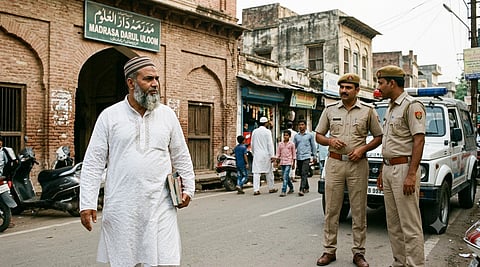
The purported SOP lists beard, niqab, Arabic expressions and other behavioural indicators for police attention.
The purported SOP lists beard, niqab, Arabic expressions and other behavioural indicators for police attention.AI generated image for symbolic representation
Published on

New Delhi- A purported Standard Operating Procedure (SOP) issued by the State Intelligence Bureau (SIB) of the Gujarat Police for newly established Anti-Radicalisation Cells has triggered constitutional concerns after reports claimed it lists certain religious practices and identity markers among indicators for identifying "radical" individuals. In response, Rajya Sabha MP John Brittas has written to Gujarat Chief Minister Bhupendrabhai Rajnikant Patel, urging an immediate review of the SOP if the reported provisions are indeed authentic and currently in force.

In his letter, Brittas made it clear that he was unable to independently verify the authenticity or completeness of the purported SOP. However, he said the media reports and extracts circulating in the public domain were serious enough to warrant the Chief Minister's personal attention. He stated that if the reported contents are genuine, they raise issues of "profound constitutional importance."

What is the controversy?

According to reports, the Gujarat Police's State Intelligence Bureau issued a Standard Operating Procedure on 1 June following the establishment of Anti-Radicalisation Cells across the state. Reports indicate that these cells have already become operational in several districts.

Media reports further claimed that extracts from the SOP have entered the public domain. Among the reported provisions are behavioural indicators that could be used during the "detection stage" to identify a "radical individual." These reportedly include suddenly growing a beard, wearing a naqab, frequently using Arabic expressions in ordinary conversation, reacting strongly to incidents affecting Muslims anywhere in the world, withdrawing from education or employment for religious reasons, frequently meeting religious leaders and visiting mosques or madrasas identified as "sensitive."

The purported SOP lists beard, niqab, Arabic expressions and other behavioural indicators for police attention.
How a Muslim Shopkeeper in Mumbai Became a Victim of Alleged Hate: “My Only Crime is Wearing a Beard and Cap While Running a Showroom”

In his letter, Brittas acknowledged that preventing terrorism, violent extremism and activities threatening public order and national security is unquestionably the constitutional duty of the State. He said there could be "no two opinions" on the need for robust intelligence gathering against genuine security threats.

However, he argued that counter-radicalisation measures must remain firmly anchored in the Constitution, the rule of law and the fundamental rights guaranteed to every citizen.

He expressed concern that, if the reported provisions accurately reflect the SOP, they risk treating ordinary manifestations of religious identity and constitutionally protected conduct as grounds for police suspicion.

Brittas also referred to reports suggesting that the SOP envisages extensive surveillance measures, including monitoring of social media platforms, online forums, messaging applications and encrypted communication platforms. The reported framework also allegedly includes preparation of dossiers on individuals, mapping community networks, and profiling religious institutions and teachers.

He stated that intelligence agencies are entitled to monitor unlawful activities based on credible information. However, he warned that any framework enabling surveillance or profiling primarily on the basis of religion, appearance, attire, language or religious observance would raise serious constitutional concerns.

According to Brittas, such measures if implemented without clearly defined legal thresholds, objective safeguards and judicial oversight, could conflict with constitutional guarantees relating to equality before law, freedom of religion, freedom of speech, dignity and the right to privacy.

The purported SOP lists beard, niqab, Arabic expressions and other behavioural indicators for police attention.
Synthetic Hate: How AI-Generated Imagery is Fueling a New Wave of Islamophobia in India

Distinguishing terrorism from religious practice

The Rajya Sabha MP stressed that there must be a clear distinction between objective indicators of involvement in terrorism and ordinary religious or cultural practices.

He cited examples of legitimate security indicators, including possession or dissemination of material relating to banned terrorist organisations, procurement of explosive precursors and demonstrable operational links with terrorist networks.

Such indicators, he said, cannot be equated with lawful religious observance or personal identity. Conflating the two, he warned, risks violating constitutional protections under Articles 14, 19, 21, 25 and 26 of the Constitution.

Brittas argued that Indian constitutional jurisprudence has consistently held that the State cannot proceed on the basis of stereotypes or collective suspicion.

He said every citizen must be assessed on the basis of credible evidence of unlawful conduct, rather than on the basis of faith, language, attire, appearance, cultural identity or lawful religious practices.

According to him, any institutional framework that creates an impression of profiling an entire community would undermine the constitutional guarantee of equal protection of laws.

He further observed that effective intelligence depends upon trust between citizens and law enforcement agencies, and that policies perceived as stigmatising an entire community may weaken that trust, discourage public cooperation with investigators and ultimately undermine counter-extremism efforts.

Profiling based on religion, attire, language, or religious practices violates Articles 14 (equality), 19 (freedom of expression), 21 (life and liberty), 25 (freedom of religion), and 26 (management of religious affairs).

Brittas has requested Chief Minister Bhupendra Patel to ensure that if the reported SOP is indeed in force, its implementation should be kept in abeyance pending a comprehensive review.

He has also urged the state government to have the SOP examined by an independent body comprising constitutional experts, eminent jurists and experienced policing professionals to ensure that it fully conforms to the Constitution of India and established principles of criminal jurisprudence.

He further requested that any provisions permitting profiling or surveillance based on religion, religious practices, attire, language, appearance or other constitutionally protected characteristics be withdrawn or appropriately modified.

According to Brittas, all counter-radicalisation measures should remain strictly evidence-based, focused on demonstrable unlawful or violent conduct, supported by objective intelligence, and accompanied by adequate safeguards against arbitrary or discriminatory application.

Sharing the contents of his letter publicly, Brittas said that if reports regarding the Gujarat State Intelligence Bureau's Anti-Radicalisation SOP are true, the implications are deeply disturbing.

He stated that ordinary religious practices cannot become grounds for police suspicion and emphasised that counter-terrorism must be evidence-based, not faith-based.

"The Constitution admits no room for suspicion based on faith," he said, while reiterating his appeal to the Gujarat Chief Minister to review the reported provisions and ensure that any operational framework fully complies with constitutional guarantees.

The purported SOP lists beard, niqab, Arabic expressions and other behavioural indicators for police attention.
Bareilly Tazia Procession Row: Two Men Allegedly Used 12-Year-Old Boy to Shout 'Pakistan Zindabad' Slogans to Frame Muslim Community
The purported SOP lists beard, niqab, Arabic expressions and other behavioural indicators for police attention.
MP Judge Tabassum Khan Faces Threats After Sentencing 14 in Cow Vigilante Lynching Case
The purported SOP lists beard, niqab, Arabic expressions and other behavioural indicators for police attention.
Outrage Over BJP Assam's 'Point-Blank Shot' Video: Congress Labels It Fascist Regime's Genocide Dream
The purported SOP lists beard, niqab, Arabic expressions and other behavioural indicators for police attention.
Maktoob Media Editor Granted Bail in Kerala Police Case Over Report on Alleged Anti-Muslim Bias: "Journalism is Not a Crime," Says Aslah Kayyalakkath

You can also join our WhatsApp group to get premium and selected news of The Mooknayak on WhatsApp. Click here to join the WhatsApp group.

Support The Mooknayak

'The Mooknayak' practices democratic journalism. It is a media platform committed to the Constitution, democracy, and social justice. If you also want 'The Mooknayak' to always raise the voices of the marginalized and show the pain of the voiceless, please support us.

Please Contribute
The Mooknayak English - Voice Of The Voiceless
en.themooknayak.com