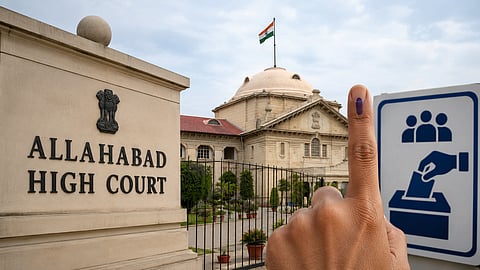
Allahabad High Court Questions UP Govt Over Panchayat Poll Delay, Seeks Election Timeline and OBC Commission Report

The Court allowed the petitioner to implead the OBC Commission as a party and granted the State Government one final opportunity to file a detailed affidavit placing on record the OBC Commission's report, if available, along with a clear timeline indicating when the Panchayat elections would be conducted.
"No Panchayat Can Continue Beyond Five Years", Says Court
"No Panchayat Can Continue Beyond Five Years", Says Court AI Image
Published on

Prayagraj- The Allahabad High Court has strongly questioned the Uttar Pradesh government's decision to defer Panchayat elections and continue Gram Pradhans as administrators, observing that the impugned orders appear to have been issued under a statutory provision that had already been declared unconstitutional by a Division Bench of the Court.

Justice Siddharth Nandan made the observations while hearing Writ-C No. 23749 of 2026. The petitioner challenged the government orders dated May 25 and May 26, issued under Section 12(3-A) of the U.P. Panchayat Raj Act, 1947, and also sought a direction to the State Election Commission to complete the three-tier Panchayat elections in accordance with Articles 243E and 243K of the Constitution.

Counsel for the petitioner argued that Section 12(3-A), under which the impugned orders were issued, had already been struck down by a Division Bench of the Allahabad High Court in Pram Lal Patel v. State of U.P. (2000) as being violative of Articles 243E and 243K of the Constitution.

Referring extensively to the earlier judgment, the Court reiterated that the Constitution mandates a fixed five-year tenure for Panchayats and that fresh elections must be completed before the expiry of that tenure. Quoting the Division Bench, the Court noted, "The words 'shall and no longer' used in Article 243E leave no room for ambiguity. No Panchayat can continue beyond five years, and elections to constitute the next Panchayat must be completed before the expiry of the existing term."

The Court also recalled the Division Bench's finding that "The State Government cannot defer Panchayat elections beyond five years or encroach upon the constitutional powers vested in the State Election Commission under Article 243K."

During the hearing, the State submitted that a similar issue is pending in another Public Interest Litigation and argued that the delay was due to the exercise being undertaken by the OBC Commission, constituted pursuant to the Supreme Court's directions in Vikas Kishanrao Gawali v. State of Maharashtra, to determine reservation for Other Backward Classes in Panchayat elections. According to the State, elections could not be held until the reservation exercise was completed.

The High Court, however, expressed surprise that despite the Commission having been constituted pursuant to the Supreme Court's directions, it had still not submitted its report.

The State Election Commission informed the Court that the electoral rolls had already been published on June 10, 2026, and that it was fully prepared to conduct the elections. It submitted that the only impediment was the State Government's stand, as the government was required to provide the necessary logistics and administrative support.

After examining the impugned orders, the Court observed that they had been issued under a provision already declared unconstitutional and therefore "the impugned orders are apparently non est and the Gram Pradhans cannot be permitted to continue as administrators."

The Court allowed the petitioner to implead the OBC Commission as a party and granted the State Government one final opportunity to file a detailed affidavit placing on record the OBC Commission's report, if available, along with a clear timeline indicating when the Panchayat elections would be conducted.

Taking a stern view, the Court directed that if the State failed to furnish a satisfactory response, Respondent No. 2 would have to appear before the Court in person on the next date of hearing.

The Court further directed the officer concerned to file a personal affidavit explaining "under what circumstances the impugned orders were issued when the statutory provision relied upon had already been declared unconstitutional by a Division Bench of this Court."

Warning of possible legal consequences, the Court observed, "Failing a satisfactory explanation, it may be construed that a prima facie case of contempt has been committed in respect of the Division Bench judgment."

The matter has been listed for further hearing on July 13.

"No Panchayat Can Continue Beyond Five Years", Says Court
Jantar Mantar Updates | Sonam Wangchuk Begins Indefinite Hunger Strike in Support of CJP's Education Accountability Demands
"No Panchayat Can Continue Beyond Five Years", Says Court
A Dalit Sarpanch Forced to Stand on One Leg | The Shocking Cases That Pushed Rajasthan High Court to Deliver Its Most Historic Verdict Against Khap Panchayats
"No Panchayat Can Continue Beyond Five Years", Says Court
One Act of Desecration, One Extraordinary Judge, One Order That Turned a Criminal Case Into a Lesson for an Entire Nation

You can also join our WhatsApp group to get premium and selected news of The Mooknayak on WhatsApp. Click here to join the WhatsApp group.

Support The Mooknayak

'The Mooknayak' practices democratic journalism. It is a media platform committed to the Constitution, democracy, and social justice. If you also want 'The Mooknayak' to always raise the voices of the marginalized and show the pain of the voiceless, please support us.

Please Contribute
The Mooknayak English - Voice Of The Voiceless
en.themooknayak.com