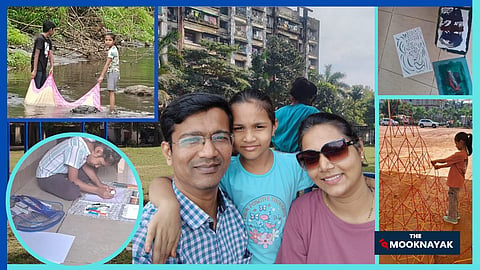
Vivek Sakpal, a computer science engineer turned publisher, and Ritu. Vivek, an ardent advocate for homeschooling, views schools as a mere "formal way of learning," not true education.

These Ambedkarite Parents Pulled Their 6-Year-Old from Classrooms Forever. Why They Did It & Their Call for Bahujan Families to Join the Revolution!

At its core, Vivek sees the current education system as rigged. "The present pattern of education is designed to suit a particular community. This community is good at one thing: memorize and speak. They don't know anything else, so they created a system that suits them. They have an examination; I have to get into that system, pass it, and then fight for merit."
Published on

In a world where six-year-olds are often defined by rote recitations of rhymes, numbers up to 50 or 100, or simple scribbles of mountains, huts, and flowers, meet Avanti, a vibrant exception who redefines childhood curiosity.

This spirited girl from Mumbai can climb trees with ease, explains the delicate ecosystem of a fish tank ("That's how the fish live inside the aquarium," she might say, wide-eyed), and turns her drawing book into a canvas of wonder. Flip through her pages, and you'll spot a bicycle, not the flat, side-view sketch we all know from textbooks, but a bird's-eye masterpiece: handles and wheels as Avanti sees them from her perch atop the seat. It's a glimpse into a mind unboxed by convention.

Avanti delights in drawing and painting, and she even crafts her own poems from the sentences she overhears on television.

But here's the twist: Avanti has never set foot in a school. Instead, she learns science from the rhythms of the environment, language from the worlds of films and cartoons she adores, and social graces from the neighborhood friends she charms effortlessly. While most kids shy away from strangers, Avanti, guided by her mother Ritu, a mathematics, teacherbreaks the ice with people of all ages. "She's very good at it," Ritu beams. "Avanti vibes well with everyone and has many friends in the neighborhood."

So why keep this bright spark out of formal schooling? The answer lies with her parents: Vivek Sakpal, a computer science engineer turned publisher, and Ritu. Vivek, an ardent advocate for homeschooling, views schools as a mere "formal way of learning," not true education. "Schooling is a new concept: it's just 200 to 300 years old," he explains. "But way before that, we built dams, bridges, roads. Learning has always been there, without the confines of four walls."

Based in Mumbai, Vivek is part of a pan-India network of homeschooling families, estimated at over 10,000 strong. He's personally connected with about 300 such households, though he notes a stark gap: "Most of them hail from dominant classes. No Ambedkarite or Bahujan families are there." As an Ambedkarite himself, Vivek is actively seeking like-minded families to bridge this divide.

Avanti attempts to catch a fish during a family outing.

His critique of schools is unflinching. "I'm not asking people not to send their kids to school, nor am I against schools," he clarifies. "But I truly believe that reading and writing is just literacy, and any family can teach their kids that. Then what does a school do and what does it not?"

For Vivek, the answer is clear: Schools peddle syllabus-driven knowledge tailored to the regime in power. He cites glaring omissions: "They removed Godse recently, so when kids study Gandhi, they don't know who killed him or why. Similarly, kids will know about Babasaheb Ambedkar, but they won't know he converted to Buddhism decades ago."

Vivek's journey began six years ago, right after Avanti's birth. "I started researching what a school does and what it doesn't," he shares. "A school clearly kills the curiosity in a child. Schools were basically created to create laborers when civilization shifted from farming to factories, schools were needed to churn them out."

He's emphatic that learning should be student-driven. "Basic literacy ABC and 123 any parent can teach. There are audio-visuals and practical ways to teach math, science, and language. But schools impart syllabus-driven knowledge, not student-driven learning." He points to everyday disconnects: "We all learned Pythagoras' theorem or the periodic table, but how many apply these in daily life? It may be needed, or it may not. Real education is practical knowledge."

A train journey anecdote underscores his point. "Once, Avanti asked me why there are so many small rocks under the railway line. Such questions that students see around them, schools kill their curiosity."

The plummeting quality of education seals his resolve. Sarcasm creeps in as he quips: "Quality of schools has gone up with air-conditioned and digital classrooms and language labs. However, the quality of teachers has drastically gone down. If you look at the teachers, how many were from the top 10 scorers in their school time? Most who were at the bottom chose teaching and then they ask students to excel in all subjects."

Avanti vibes well with everyone and has many friends in the neighborhood.

Schools, he argues, splurge on amenities while shortchanging educators. "They spend major budgets on amenities, there are airconditioned classrooms, digital teaching, well equipped labs, but what salary is given to teachers? The day schools give, say, 1.5 lakh salary to a teacher, maybe then the quality of education would improve because teachers are the service providers."

Ritu, who once taught at a reputed institution, echoes his sentiments. "Years ago, when I joined as a teacher, I was taken aback by the kind of education imparted there," she recalls. "I decided I won't let my daughter learn in such schools that lack actual knowledge."

Does Avanti miss out on peers and playground camaraderie? Ritu dismisses the notion outright. "No, I don't think she's missing anything. She has many friends in the neighborhood, interacts with them so well, and is active. One or twice, there were incidents when she was teased for not going to school, but Avanti handles it with natural ease she tells them she's learning from home."

Vivek dismisses online schooling as a superficial fix. "That's just a change in mode absence of physical classroom and learning from home based on syllabus. Only the classroom setting changes; nothing else. But Avanti is completely learning from the environment." Ritu adds: "Vivek takes her to the market, to the mechanic, she learns everything from her perspective. She asks questions and learns in her day-to-day life without even realizing it's learning."

Another common concern, which Vivek is quick to address : the legality of homeschooling in India. "Homeschooling is completely legal and permitted under both the Right to Education (RTE) Act and the National Education Policy (NEP)," he asserts confidently.

He elaborates on the pathways available for certification, emphasizing flexibility for homeschooled learners. "Once the learner reaches Class 10, they can take examinations through the Cambridge International Board, the Government of Maharashtra Board, or the National Institute of Open Schooling (NIOS)," Vivek explains. "Through these, the student can appear for exams and obtain a recognized certificate."

Looking ahead to Avanti's future, the couple has a clear, child-centered vision. They have no intention of enrolling her in a traditional school until she reaches Grade 10. "Once Avanti is old enough to decide for herself, she can choose her own path for further education," Vivek adds.

Critics might invoke Babasaheb Ambedkar's legacy as a scholar who devoured books. Doesn't homeschooling deviate from "Educate, Agitate, Organize"? Vivek laughs it off. "Certainly not. Babasaheb said educate, agitate, and organize, but that doesn't mean only syllabus-based learning."

At its core, Vivek sees the current system as rigged. "The present pattern of education is designed to suit a particular community. This community is good at one thing: memorize and speak. They don't know anything else, so they created a system that suits them. They have an examination; I have to get into that system, pass it, and then fight for merit."

He envisions a fairer meritocracy: "If there were 50 marks for pottery, 50 for fishing, 50 for making products out of leather, let's see how skilled they are then. Only then would we know who deserves merit. When the pattern of reservation changes, the pattern of merit would change."

Traditional skills, he insists, embed science and math naturally. "Farming has science; ship building and machinery have mathematics. There are natural ways of learning school education isn't the only source."

 Vivek, an ardent advocate for homeschooling, views schools as a mere "formal way of learning," not true education.
Vivek, an ardent advocate for homeschooling, views schools as a mere "formal way of learning," not true education.

Vivek laments that homeschooling families mostly come from "oppressor" backgrounds, particularly business communities. "It's not because they don't value education, they value community-based business education. Another reason: They don't want their children to mingle with other youths and get a partner from other castes; they want to keep it closed."

As a publisher and education researcher, Vivek warns of a darkening horizon. "The present generation has seen, read, and educated in a non-partial setup. But with the present regime slowly erasing actual history and culture from textbooks, no one knows what textbooks will look like in 10 years." He's pushing to build a curriculum that "preserves the actual history and culture of the nation. This is the right time we can do it now; otherwise, a decade from now, we won't even be in a situation to fight because the new generation won't have read the actual history."

For Ritu, the focus remains on Avanti's joyful growth. She laughs about one quirk: "The only problem is she doesn't follow a routine. She doesn't wake up at 6, she gets up whenever she wants. She doesn't sit at the study table at a particular time. She's active the whole day, but it's during the night hours that she gets into the 'what' and 'why' of things. I give her paper and pen only when she asks, so she realizes it's not from books or syllabus, she's learning every hour while she's awake."

In Avanti's world, education isn't a chore: it's an adventure. As her parents challenge the status quo, they invite us to question: In the pursuit of knowledge, do we build walls... or wings?

 Vivek Sakpal, a computer science engineer turned publisher, and Ritu. Vivek, an ardent advocate for homeschooling, views schools as a mere "formal way of learning," not true education.
Unschooling is Cool, believes the couple who didn't send their daughter to school!
 Vivek Sakpal, a computer science engineer turned publisher, and Ritu. Vivek, an ardent advocate for homeschooling, views schools as a mere "formal way of learning," not true education.
"10 reasons Why UGC Equity Regulations 2026 is Against SC, ST, and OBCs More than the General Category": Nethrapal

You can also join our WhatsApp group to get premium and selected news of The Mooknayak on WhatsApp. Click here to join the WhatsApp group.

The Mooknayak English - Voice Of The Voiceless
en.themooknayak.com