

— ✍️ Com. Kajal
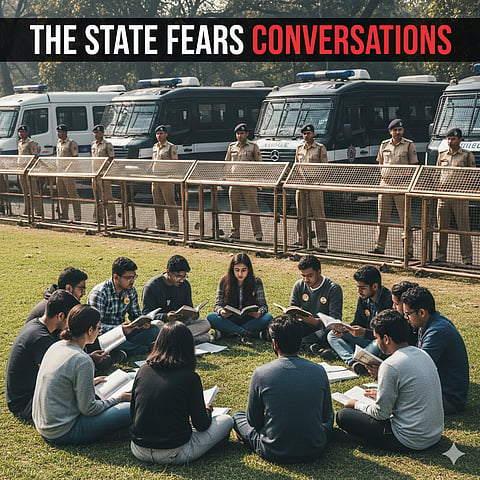
On 18 February, Himkhand had called for a reading circle to be conducted on “Queer by Nature, Stolen by Empire”, in collaboration with Pechaan – the Queer Collective of JMC DU, to discuss the politics of queerness and the ways Brahminism marginalizes queer communities to enforce heteropatriarchal relations in order to maintain a caste-based society. But before we could even reach San Martin Park, where the reading circle was scheduled to take place, a large police force was deployed, barricades were set up, and detention vehicles were parked in preparation to stop the event. We were subsequently picked up from the streets and taken to Chanakyapuri Police Station, where we were detained for more than 5 hours late into the night, our phones seized without proper procedure, and an FIR was registered against us under BNS sections 223a and 221, reportedly on instructions from higher authorities.
This raises a simple but serious question – what is the state so concerned about when people read, learn, and think independently? What threat does a group of people reading a book together pose that it requires such a strong response?
These questions matter because this is not an isolated incident but part of a pattern. Prior to this, the disruption by ABVP of speakers, professors and student participants at Samta Utsav organized by AISA on 12 February, a further incident the next day against students protesting for implementation of UGC guidelines for a more equitable campus, the imposition of BNS Section 163 inside Delhi University Campus prohibiting public assembly or gathering of five or more people, the suspension of JNUSU representatives for protesting against facial recognition gates and CCTVs at Central Library, and the FIR on students of TISS Mumbai for conducting a reading circle commemorating the death anniversary of G.N. Saibaba are not random events but indicate a systematic restriction on various forms of ideological expression, even within legal frameworks. The scale and intensity of such measures suggest a deep unease within structures of power.
History shows that free thought can be seen as a serious challenge in times of growing authoritarian control. In 1920s Nazi Germany, the state first targeted independent thinking to consolidate control over society. Universities, research institutions, and cultural spaces were purged of dissenting scholars, especially Jews, Marxists and liberals. Autonomous thinking and critical inquiry were viewed as threats to centralised authority. Instead of supporting open scientific advancement, resources were directed towards theories that justified exclusion, militarism and nationalist goals. Research that did not align with these priorities was defunded or censored. Independent thinkers faced exile, imprisonment, or worse. An environment of conformity and fear became the foundation for later atrocities.
As global crises deepen, governments in many peripheral countries face pressure to accelerate the transfer of land, resources, and labour to sustain larger economic systems. Adivasi communities defending their rights to water, forests and land often face severe force, including the use of advanced weaponry. In oppressed regions, resistance is met with internet shutdowns, use of force in civilian areas, and erosion of democratic norms that were already limited. Restrictions on democracy tend to spread gradually from the margins to more central areas and populations previously considered secure.
In India, similar patterns are visible under policies like the Surajkund Scheme. Dissenting voices are frequently labelled and delegitimised, censored or criminalised. Critical thinkers face arbitrary detention. Campuses that allow open expression and democratic participation are placed under heavy surveillance. Study groups and reading circles that examine structural inequalities and dominant ideologies face raids and administrative action. Forms of dissent that were once considered peaceful and acceptable are now treated with the same seriousness as more extreme threats. The authorities appear less concerned about public disorder than about open conversations.
In response to increasing restrictions, we are seeing changes in how mass movements operate. Among civil society, environmental, student, and left organisations, two trends are visible: some groups seek safer approaches, while others respond to the closing of democratic spaces by strengthening their resolve and continuing resistance. Spontaneous movements have begun to follow a similar path. The era of long, largely peaceful campaigns like Narmada Bachao Andolan, Chipko Movement and Anna Hazare’s anti-corruption movement has become more difficult as democratic space shrinks. Instead, recent examples from Ladakh, Rajasthan’s anti-ethanol plant protest of December 2025, Turkman Gate protests of 2026, and others show a growing acceptance of shorter, more disruptive forms of resistance among working and exploited sections. Middle sections of society have largely shifted to online activism, including the rise of independent media outlets over the last decade.
However, choosing extreme caution during periods of heavy state restriction, or trying to practise progressive and transformative politics only within narrowly “safe” and legal boundaries without challenging authorities, misunderstands how such controls have historically operated. Repressive measures eventually reach everyone, regardless of how carefully or legally dissent is expressed. The response that arrives for a reading circle in a park today may reach others tomorrow. What is targeted is not recklessness but the very possibility of alternative ideas and organised resistance. That is exactly what a group of people reading and discussing together represents.
- Kajal, 22, is a social and environmental activist at The Himkhand. She has been a political prisoner and was jailed for 3 weeks at Tihar Central Prison, arrested for protesting against air pollution at India gate.
Disclaimer: The opinions expressed in this article are those of the author and do not necessarily reflect the views of the publication or any associated entities.
You can also join our WhatsApp group to get premium and selected news of The Mooknayak on WhatsApp. Click here to join the WhatsApp group.