Discussion
Why does India Remember Colonial Humiliation but Forget Caste Humiliation?
Colonial humiliation gives the nation an outsider to condemn. Caste humiliation asks it to confront its own people.

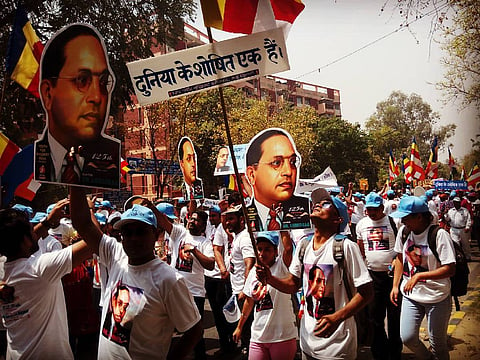

— ✍️ Mohit Nirmender
Jallianwala Bagh remains one of India's most recognisable memories of colonial violence. On 13 April 1919, General Reginald Dyer ordered his troops to fire on an unarmed crowd gathered in a walled garden in Amritsar, killing hundreds. More than a century later, it still appears in school lessons, political speeches, and public commemoration, remembered not simply as colonial violence but as a violation of Indian dignity.
That question of who is allowed to belong was not settled when colonial rule ended. Dalits in India continue to face exclusion in everyday life, including restrictions on wedding processions, denial of temple entry, unequal access to water, and exclusion from public institutions. In May 2026, a twenty-year-old Dalit student named Atin Kumar was allegedly assaulted at a library in Firozabad after a group of men learned his caste. He died by suicide the next day, leaving behind a note that referred to the assault. Two humiliations, one colonial and one caste-based, converge on the same question. Who gets to enter a room or claim equal standing without first being questioned about who they are?
India has not forgotten these injuries, but it has not given them equal standing in collective memory. The phrase "Dogs and Indians Not Allowed" remains immediately legible as a symbol of colonial contempt. Chuni Kotal, an Adivasi student from the Lodha community who died by suicide in 1992 after facing discrimination at her university , and Rohith Vemula, whose 2016 death set off nationwide protests, both entered wider conversation at the time. Neither acquired the same durable place in civic memory that colonial humiliation holds. Atin Kumar's death has, so far, received far less attention than the cases that briefly dominated debate around caste and higher education.
This is the uncomfortable asymmetry. India has built museums, memorials, and commemorative practices around humiliation inflicted by a foreign ruler, but it has not built comparable ways of remembering humiliation produced within Indian society. The problem is not that such recognition is impossible. The insult is readily recognised when it comes from a foreign coloniser. It struggles to register with the same weight when the source is domestic and hierarchical. The harder question is why that recognition falters when it comes from within.
National memory has a hierarchy. What gets repeatedly taught and commemorated becomes easier to recognise as a shared injury. The NCERT Class 8 history textbook offers one way to see it.
In the older Our Pasts III, the Ilbert Bill appears in the story of colonial rule. In 1883, when the government proposed allowing Indian judges to try British or European defendants, white opposition forced the bill to be withdrawn. The textbook says the episode “highlighted the racial attitudes of the British in India” (NCERT 2019, 110). A few pages earlier, it recounts Ambedkar’s childhood experience of caste exclusion. Born into a Mahar family, he “was forced to sit outside the classroom on the ground” and was denied water from taps used by upper-caste children (NCERT 2019, 104). Both hierarchies rested on superiority assigned at birth. The British claimed superiority over Indians as a colonised people. Upper castes claimed superiority over those born outside their fold. The logic was similar, the object of that superiority was not.
The new Class 8 book changes the structure, but the contrast remains. Exploring Society: India and Beyond, Grade 8, Part 2 continues to present colonial discrimination as part of British rule (NCERT 2026, 40). When the book turns to the freedom struggle, political resistance is narrated through the arrests, trials, imprisonment and deaths of those who fought it (NCERT 2026, 54–55, 66–67). Caste-based exclusion and the struggles against it, by contrast, are compressed into a table of reformers, movements and contributions (NCERT 2026, 40–41).
Jallianwala Bagh shows what happens when colonial violence becomes part of that larger story. The textbook gives the massacre a sustained account of the sealed exits, the firing and the deaths and injuries that followed (NCERT 2026, 62–63). The Jallianwala Bagh National Memorial Act, 1951 gave the massacre a permanent place in the country's commemorative institutions. Its centenary in 2019 brought an official ceremony, a commemorative coin and a postage stamp. Popular cinema has carried the memory further, from Sardar Udham in 2021 to Kesari Chapter 2 in 2025.
But colonial violence does not automatically become a national memory.
Six years earlier, in 1913, British forces fired on Bhil followers of Govind Guru at Mangarh Hill. In 2022, Prime Minister Narendra Modi said that more than 1,500 people had been killed there and acknowledged that such a significant event “could not find its place in the history books". He called for wider recognition of Mangarh. Even this renewed recognition was framed through comparison with a massacre already firmly established in national memory.
As Prof. Y. S. Alone points out, this situation is known as "protected ignorance": knowledge exists but is excluded from the forms through which society decides what to notice, represent, and remember. Mangarh illustrates the problem: The massacre had not disappeared, rather, it was omitted from the narrative by which the nation remembers itself.
The same pattern appears beyond the textbook, when caste history enters popular culture. When the film Phule tried to bring that history to the screen, it faced protests. The Hindu Mahasangh and other Brahmin organisations protested the film, including over its depiction of a Brahmin boy throwing cow dung at Savitribai. The objections quickly drew media and institutional attention. The CBFC sought changes to caste-related references, and the film’s release was postponed.
Colonial violence can be remembered as something imposed on Indians by an outsider. Caste violence is harder to absorb into the same national story because it exposes humiliation produced within Indian society itself. One history allows the nation to condemn the outsider. The other forces it to confront what existed within its own social order.
That difference does not stay in the archive. It shapes what happens when humiliation enters ordinary life.
In March 1927, Dr. B. R. Ambedkar led thousands of people to Chavdar Tank in Mahad to claim the right to drink from a public source. The tank was public. Dalits were denied access because their touch was considered polluting. The struggle was therefore not simply about water, it was about who could claim a public resource as an equal citizen with dignity.
And even a century after Mahad, access to water can still depend on caste. A 2026 BBC report from Bundelkhand documented Dalit residents waiting for dominant-caste families to finish using shared handpumps before approaching them. A local organisation recorded 113 cases under caste atrocity laws in the area in 2025, with most complaints tracked during May and June involving water.
Caste discrimination does not stop even when a natural calamity strikes. The 2004 tsunami affected communities across Tamil Nadu, yet Dalits faced another form of exclusion. They were being denied adequate relief, blocked from relief camps and, in one case, denied water supplied by UNICEF and other relief agencies because members of the Meenavar fishing community, described as a higher-caste community in the area, claimed that Dalits would “pollute” it. Even in a disaster that affected everyone, caste could still shape who received relief, who could enter a camp and who could share water.
The same status can follow a person far beyond a village handpump. After Mallikarjun Kharge, president of the Congress and a Member of Parliament, addressed a rally at Haldwani's Ramlila Maidan in August 2026, members of the Shri Ram Sena Dharmarth Seva Nyas Sangathan held a “shuddhikaran”, or purification ritual, at the venue two days later. The organisation denied that the act was caste-based. Kharge described it differently, saying that the ritual made him feel the pain of untouchability and humiliated him as a Dalit (Teltumbde 2026).
What connects these incidents is not simply discrimination. It is a status assigned at birth. The person denied water, the Dalit family waiting for relief, the citizen at a public handpump and the president of a national political party are separated by nearly a century and very different circumstances. Yet caste can reach each of them before citizenship does. What is not recognised as a shared injury can be easier to take lightly.
When a history does not become part of a nation's shared memory, it does not simply fade. It becomes available for something worse than forgetting. It becomes material for jokes.
Water shows this starkly. During a Delhi University protest against new University Grants Commission guidelines, a YouTuber went from student to student, mockingly asking whether they too had been denied water for five thousand years (Chaudhary 2026). Months later, at a formal debate on reforming India's reservation policy, one panellist arguing against reservation turned the history of caste-based water exclusion into a taunt. “Were you cactuses,” he asked the opposing side, “how did you survive then? You were trying to draw water from the Thakur's well. Why couldn't you dig your own?”.
And then there is the everyday insult. “Quota khane wale”, those who eat the quota, turns the remedy for caste-based exclusion into something to mock, treating reservation as proof of unworthiness rather than a response to exclusion. Research on discrimination has linked repeated experiences of degradation with higher rates of anxiety and depression.
The question is not only why someone makes such a joke. It is how society teaches people to see such mockery as normal. People do not learn these attitudes from nowhere. At home, children learn who deserves respect and who can be laughed at. They learn which names are spoken with pride and which are used as insults. Family and community can shape how children understand hierarchy long before they can question it. In school, some histories are taught while others remain at the margins. By then, much of what deserves respect, and what can be dismissed, already feels natural.
The same difference appears in public culture. Every Independence Day and Republic Day, colonial suffering is readily turned into speeches, songs and performances. Caste atrocities and humiliation rarely receive the same space. Even when caste history does reach popular culture, it can arrive after protests, objections and demands for changes. What is left out of public memory is therefore harder to recognise for what it is. To understand why it matters, people have to look for it themselves. To unlearn what has been taught, and to understand what was never taught, requires conscious effort. Not everyone makes it.
The difference becomes visible in what we allow ourselves to laugh at, Jallianwala Bagh is not ordinarily treated as a joke. That massacre fell on Indians as Indians, regardless of caste, and became part of the story of colonial violence and national suffering. Caste exclusion has not acquired the same shared place in the national story. It was suffered by those born into it, while others could live on the other side of that humiliation. An injury that belongs to someone else's history can be laughed at without feeling like an injury to oneself. Laughing at it costs nothing.
When that recognition never arrives, equal citizenship stays split between what the law recognises and what society actually grants. Rohith Vemula wrote in his final letter in 2016 that his birth itself had been his fatal accident (Sabrang 2019) . A decade later, Atin Kumar's death again raised questions about caste humiliation and the lives of people who encountered it. Yet such deaths can still be absorbed into the language of private tragedy rather than recognised as part of a continuing social pattern.
Colonial humiliation gives the nation an outsider to condemn. Caste humiliation asks it to confront its own people.
We have learnt to remember what was done to us. The harder task is to remember what was done by us, and to recognise the humanity that caste taught us to overlook. Until that changes, the Constitution will keep promising equal dignity while society keeps deciding whose dignity counts.
-Mohit Nirmender is an independent researcher studying state institutions, public infrastructure, and social inequality in India.
You can also join our WhatsApp group to get premium and selected news of The Mooknayak on WhatsApp. Click here to join the WhatsApp group.
'The Mooknayak' practices democratic journalism. It is a media platform committed to the Constitution, democracy, and social justice. If you also want 'The Mooknayak' to always raise the voices of the marginalized and show the pain of the voiceless, please subscribe.
PLEASE SUBSCRIBE US