The Gandhi-Ambedkar Synthesis Erases Ambedkar’s Political Thought

Ambedkar does not need to be rescued by a Gandhian synthesis. Nor should his politics be confined to the category of segregation in order to make another leader appear more inclusive.
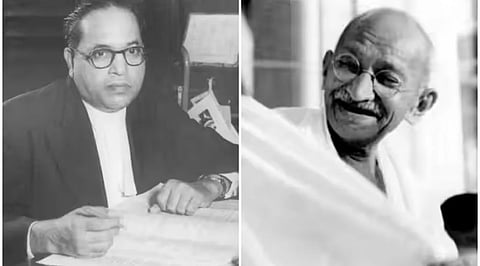
A critical examination of attempts to synthesize Gandhi and Ambedkar's political philosophies, arguing that such reconciliation diminishes Ambedkar's radical demand for caste annihilation, independent political representation, and state intervention.
Published on: 

Yogendra Yadav’s recent essay in The Indian Express, “Babasaheb and Bapu are now friends, and for all of us, that is a reason for hope”, draws on Ramachandra Guha’s Arguments with Gandhi to propose a renewed conversation between Gandhi and Ambedkar. The proposition may sound conciliatory. But it rests on a serious intellectual problem: it attempts to bring Ambedkar into a Gandhian framework by softening the fundamental differences between their political philosophies. This is not merely a question of how two historical figures should be remembered. It is about whose understanding of caste, power, social transformation and democracy should shape our political imagination.

The problem is not that Gandhi and Ambedkar should not be studied together. They must be. The problem begins when studying their differences becomes an exercise in constructing a synthesis that diminishes Ambedkar’s independent political thought. Ambedkar was not an extension of Gandhi’s moral project, nor was his politics an incomplete version of a more inclusive Gandhian vision. Their disagreements were substantive, political and philosophical. To overlook them in the name of reconciliation is to distort the very history that needs to be understood.

Caste annihilation cannot be reduced to self-respect

One of the formulations invoked in this discussion, associated with D. R. Nagaraj, contrasts Gandhi’s emphasis on self-purification with Ambedkar’s emphasis on self-respect. This distinction is inadequate if it suggests that Ambedkar’s politics was primarily about restoring the self-respect of those oppressed by caste. Was the Mahad Satyagraha merely an assertion of self-respect? Was Ambedkar’s political activity in the 1940s confined to awakening the consciousness of the Depressed Classes?

Self-respect was certainly important to Ambedkar, but it was never the limit of his political imagination. His central concern was the annihilation of caste as a system of graded inequality. That required a transformation of social relations, access to resources, political power, legal rights and the institutions that sustained caste hierarchy. It required the intervention of the state, not merely a change of heart among those who benefited from the existing order.

The distinction between Gandhi and Ambedkar cannot be dissolved by pointing to Gandhi’s later support for inter-caste marriage. Gandhi’s position on untouchability, jati and varna evolved in different ways, and these positions must not be treated as interchangeable. Opposition to untouchability did not automatically amount to a rejection of the ideological foundations of caste. Gandhi’s continuing engagement with varna remains central to understanding the distance between the two.

Inter-caste marriage, by itself, cannot dismantle the institutional power of caste. A social order sustained by property, endogamy, religious authority and unequal access to power can accommodate individual acts of transgression without surrendering its structure. The question is not whether inter-caste marriages are desirable. It is whether their advocacy, without a radical rejection of the hierarchy that produces caste, amounts to a programme for its annihilation.

A critical examination of attempts to synthesize Gandhi and Ambedkar's political philosophies, arguing that such reconciliation diminishes Ambedkar's radical demand for caste annihilation, independent political representation, and state intervention.
Gandhi & Ambedkar: Shared Visions & Divisive Philosophies in India's Saga

Satyagraha: moral transformation or political compulsion?

Ashok Gopal’s A Part Apart: The Life and Thought of B. R. Ambedkar offers an important way of understanding the difference between Gandhi’s and Ambedkar’s approaches to satyagraha. For Gandhi, satyagraha was closely connected to non-violence, self-purification and the transformation of the relationship between the opposing sides. Its moral force was intended to persuade the opponent to recognise and abandon wrongdoing.

Ambedkar’s understanding of resistance was different. Satyagraha was a means through which people denied their rights could challenge an unjust arrangement and compel the opposing side to retreat. The purpose was not dependent on the oppressor’s moral awakening. The oppressed could not be asked to wait indefinitely for the conscience of the privileged to change.

This distinction should not be carelessly translated into the claim that Ambedkar advocated violence as a general political principle. His practice at Mahad, including his insistence on discipline after attacks on protesters, demonstrates the importance he attached to organised and responsible resistance. The point is that he did not make the moral transformation of the oppressor the precondition for the assertion of rights.

This difference also explains why the state occupied such an important place in Ambedkar’s political thought. If caste oppression is embedded in social institutions and protected by unequal power, its removal cannot be entrusted to the self-purification of upper-caste Hindus. Law, constitutional safeguards, representation and state intervention are indispensable. Gandhi’s reliance on moral reform and the conscience of Hindu society could not substitute for this programme.

The distinction is fundamental. It cannot be overcome by celebrating a late convergence of views or by presenting the two leaders as participants in a shared moral journey.

Gandhi’s political choices cannot be explained away

The attempt to construct a Gandhian-Ambedkarite synthesis also requires a selective reading of Gandhi’s political record. Vaikom, the Kalaram Temple movement, Gandhi’s positions on varna, his insistence on the word ‘Harijan’ despite objections, and his attachment to the village-centred ideal of Gram Swaraj all raise questions that cannot be settled by referring to his changing views on inter-caste marriage.

Ambedkar’s criticism of the village as a site of entrenched social oppression was not an incidental disagreement over administrative arrangements. It reflected a fundamental difference in their understanding of social power. For Ambedkar, the village could reproduce caste domination and social exclusion; it could not be romanticised as the natural foundation of democracy.

The history of the All-India Anti-Untouchability League, later renamed the Harijan Sevak Sangh, is equally instructive. Ambedkar was associated with the organisation but soon became dissatisfied with its functioning and the dominance exercised by upper-caste leadership. His departure is important because it demonstrates that even an initiative ostensibly directed against untouchability could reproduce the very hierarchy it claimed to challenge.

This history complicates the narrative of a shared reformist project. It also raises a larger question: why should Ambedkar’s political disagreements with Gandhi be treated as obstacles to be overcome, while Gandhi’s ideological commitments are so often presented as evidence of his moral evolution?

The false categories of ‘Segregative’ and ‘Aggregative’ politics

The same problem becomes more explicit in Yogendra Yadav’s 2012 essay, “Ambedkar and Lohia: A Dialogue on Caste”, published in Seminar. There, Yadav places Ambedkar and Rammanohar Lohia within two contrasting political categories: Ambedkar’s politics is described as ‘Segregative’, while Lohia’s is described as ‘Aggregative’.

According to this formulation, Ambedkar sought to create an independent political identity for Dalits, secure separate representation and build autonomous political power. Lohia, by contrast, sought to bring together Shudras, Dalits, Adivasis, women, Muslims and the poor into a broader political bloc.

The difficulty is not simply that both leaders displayed elements of both approaches. The difficulty is that the categories themselves impose a misleading framework on their politics. They turn distinct political strategies, developed in response to particular historical conditions, into a hierarchy in which Ambedkar appears to represent separation and Lohia a more expansive political imagination.

Ambedkar’s Independent Labour Party cannot be understood as merely a tactical vehicle for Dalit interests. Its engagement with the khoti system and wider questions of labour and agrarian exploitation demonstrates a political programme extending beyond a narrowly defined community constituency. His subsequent political initiatives must also be read in the context of his continuing concern with the representation and independent organisation of oppressed groups.

More importantly, Ambedkar explicitly argued for political unity among oppressed communities. In his address at Lucknow on 25 April 1948, he spoke of the need for Scheduled Castes and Backward Classes to organise under a common political leadership, programme and party. His speech in the Constituent Assembly on 17 December 1946 had already articulated the challenge of bringing a heterogeneous society towards common political purpose. These were not incidental departures from an otherwise ‘segregative’ strategy. They were integral to his political thinking.

Lohia’s politics, too, cannot be adequately captured by the label ‘Aggregative’. The proposal to bring different oppressed groups together does not, by itself, resolve the question of representation, internal hierarchy or political leadership. A broad coalition can reproduce inequalities within itself unless it confronts the power relations among its constituent groups.

The categories therefore fail in both directions. They diminish Ambedkar’s efforts to build wider political solidarities and overlook the problems of power within Lohia’s proposed political aggregation. More seriously, they make Ambedkar’s insistence on independent political agency appear narrower than Lohia’s coalition-building. This is not a neutral classification. It privileges one model of politics over another and obscures the structural reasons for Ambedkar’s insistence on autonomous representation.

Why does Ambedkar’s intellectual leadership remain difficult to accept?

The question of Ambedkar and Lohia is worth revisiting, but not through the misleading categories of segregation and aggregation. Lohia’s letter of 1 October 1956 to his associates, written around his proposed meeting with Ambedkar, is revealing. He described the meeting as a tribute to the intellectual capacity of the Backward Classes and Scheduled Castes, as well as an opportunity with important political consequences.

The meeting took place only shortly before Ambedkar’s death. Yet the larger political and intellectual engagement that might have followed did not develop into a sustained tradition. Why did the socialist movement fail to build a lasting relationship with Ambedkar’s intellectual leadership? Why has the question of Ambedkar’s leadership so often been displaced by attempts to fit him into categories created by others?

This is not a minor historiographical disagreement. It points to the continuing influence of graded caste hierarchy on the production of political thought. Even those who advocate social justice can find it difficult to accept Ambedkar not simply as a representative of the oppressed, but as an intellectual and political leader whose ideas should provide the foundation for a wider democratic project.

The effort to bring Gandhi and Ambedkar together, as though their differences were historical misunderstandings awaiting resolution, risks repeating this problem. It makes Ambedkar acceptable by reducing the radical implications of his politics. His demand for the annihilation of caste, independent political representation, constitutional safeguards and state intervention becomes secondary to a narrative of moral reconciliation.

Ambedkar does not need to be rescued by a Gandhian synthesis. Nor should his politics be confined to the category of segregation in order to make another leader appear more inclusive. The task is to confront the full force of his political thought, including its challenge to the social, religious and political structures of domination. Any account of Indian democracy that evades this challenge may offer reconciliation as a comforting narrative, but it cannot claim to have understood Ambedkar.

About the Author

Sanjeev Chandan is the editor of StreeKaal, a feminist platform with both print and digital editions. He is currently working on a novel set between 1947 and 1956, tracing the constitutional and political developments of that transformative decade through the lives of Dr B. R. Ambedkar and Dr Savita Ambedkar.

A critical examination of attempts to synthesize Gandhi and Ambedkar's political philosophies, arguing that such reconciliation diminishes Ambedkar's radical demand for caste annihilation, independent political representation, and state intervention.
Ambedkar's Way: CM Stalin Urges Students to Reject Godse Path, Embrace Ideals of Gandhi, Ambedkar, Periyar
A critical examination of attempts to synthesize Gandhi and Ambedkar's political philosophies, arguing that such reconciliation diminishes Ambedkar's radical demand for caste annihilation, independent political representation, and state intervention.
How Thanthai Periyar, Baba Saheb Ambedkar, And Mahatma Gandhi Looked at Villages?
A critical examination of attempts to synthesize Gandhi and Ambedkar's political philosophies, arguing that such reconciliation diminishes Ambedkar's radical demand for caste annihilation, independent political representation, and state intervention.
What Connects Ambedkar, MLK Jr., and Gandhi in the Fight Against Discrimination?

You can also join our WhatsApp group to get premium and selected news of The Mooknayak on WhatsApp. Click here to join the WhatsApp group.

Subscribe The Mooknayak

'The Mooknayak' practices democratic journalism. It is a media platform committed to the Constitution, democracy, and social justice. If you also want 'The Mooknayak' to always raise the voices of the marginalized and show the pain of the voiceless, please subscribe.

PLEASE SUBSCRIBE US