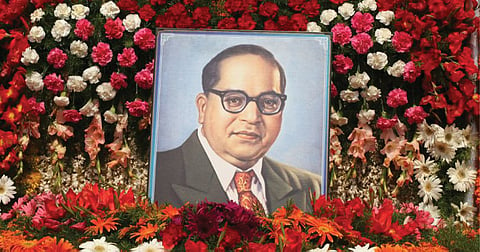
"We are because he was.”
On this Mahaparinirvan Diwas, these words echo through our hearts with profound emotion and unshakeable conviction. They are not mere words; they are a testament to the unbreakable bond between a visionary and the millions he liberated. For generations scarred by marginalisation, exclusion, and fierce resistance, Babasaheb is far more than a historical figure, he is the bedrock of our dignity, the master builder of our dreams, and the eternal flame igniting our path toward true humanity. To reflect on Babasaheb today is to feel the weight of gratitude that wells up from the depths of our souls. Our freedom to speak without fear, to educate ourselves without barriers, to walk with our heads held high, to confront injustice head-on, and to dream of a world remade in equality, all these gifts trace back to the courageous path he blazed. His victories were never solitary; they were the collective rising of a people long crushed under oppression.
His struggles burned with a fire that refused to dim, not for personal glory, but for the voiceless millions stripped of agency, respect, and basic human worth. In his relentless fight, we found our own strength, our own voice. His legacy endures not as a distant echo from history, but as a powerful, pulsating force alive in our veins. It is the unquenchable fire that warms our spirits in the coldest moments of despair. It is the radiant light that pierces through darkness, guiding us forward. It is the indomitable courage that arms us against the injustices that still linger in our world today.
Babasaheb’s life was nothing short of a revolutionary upheaval. He exposed caste not as a mere social irregularity, but as a deep-seated moral abomination, one that systematically steals dignity from the oppressed while conferring illegitimate superiority on the oppressors. With unwavering clarity, he proclaimed that education is liberation’s most potent weapon. Intellect belongs not to a privileged few but to every human being as an inalienable right. Dignity is never granted from above; it must be seized with fierce determination.
For communities that were treated as less than human for centuries, Babasaheb’s rise from pain to great leadership is one of the most inspiring stories of equality today. His life shows that no chain can hold us if we keep fighting. For many from oppressed families, he feels like a close friend. In childhood, when classmates stayed away or did not share food because of caste, his story gave us power to keep going. When society’s contempt tried to crush our spirits, his words became our shield, lifting us to stand taller. When waves of humiliation threatened to drown us, his profound writings became the anchor that held us steady. We do not just remember him in ceremonies. We live his teachings every day. We do not just speak about him. We follow his path. We do not only respect him. We carry his spirit in every fight for justice.
Universities proudly declare themselves as enlightened realms of neutrality, progress, and pure objectivity. But for those who carry the scars of caste oppression, these institutions often betray a painful truth: they mirror society’s entrenched hierarchies in disguised forms. The physical campus may appear modern and inclusive, but the invisible hierarchies sting with familiar pain. The vocabulary has changed, yet the exclusionary intent remains intact.
Discrimination hides in sophistication, inflicting wounds that cut just as deeply. Scholars from Dalit backgrounds repeatedly confront the same age-old exclusions, now cloaked in academic jargon. The system practices prejudice, It vows equality on paper but fiercely guards inherited hierarchies in practice. This stark contradiction reveals itself most clearly in the politics of knowledge production: whose insights are granted credibility, whose voices are truly heard, and whose lived experiences are dismissed as mere caste-bound anecdotes.
One of the most poignant revelations in higher education is the invisible line drawn between those who are fully “part” of the institution and those kept perpetually “apart.”
Some are welcomed wholeheartedly as insiders. Others are granted entry but never true belonging. This silent yet suffocating divide plays out in daily interactions: who receives invitations to exclusive intellectual networks, whose ideas are met with genuine respect, whose critiques are deemed valid and profound, who is afforded patient listening, and who faces hasty dismissal. Here, exclusion transcends physical barriers; it is a profound intellectual apartheid.
Scholars from Dalit backgrounds may occupy the same lecture halls, but their voices seldom command the same authority or space. Their presence is acknowledged superficially, tolerated, scrutinised, but rarely embraced or trusted fully. And yet, in the face of this marginalisation, these scholars rise with extraordinary resilience.Their very entry into forbidden spaces shakes the foundations of old power structures. Their bold arguments disturb the complacent authority of the dominant.Their innovative scholarship directly confronts and erodes the unearned prestige long held by privileged castes. By boldly occupying arenas designed to exclude them, they tear down the walls of “apartness,” asserting that true academia must belong to all who dare to think.
Among the cruelest weapons in academic discrimination is testimonial injustice.the deliberate withholding of credibility not because of flawed ideas, but simply because of who dares to voice them.This form of violence does not roar; it whispers poisonously. It does not wound visibly; it slowly erodes confidence from within. It does not bar the door outright; it undermines from the shadows. For scholars from Dalit backgrounds, this injustice strikes repeatedly and predictably.Their passionately researched work is casually dismissed as “too emotional,” even as dominant-caste narratives are exalted as impeccably “scholarly.” Their meticulously constructed theoretical contributions are brushed aside as insignificant “review material,” subtly implying an inherent lack of originality or depth.
Their sharp arguments are labelled suspiciously as “identity-driven biases,” while the perspectives of the privileged are automatically crowned as pure, unbiased neutrality. Solid, evidence-based analyses are downgraded to mere “anecdotes,” and their conference presentations are greeted with scepticism, impatience, or outright condescension.At its heart, this is not honest intellectual disagreement, it is premeditated disbelief, rooted in the arrogant assumption that certain backgrounds are incapable of producing truly rigorous knowledge.This modern disbelief recreates an intellectual form of untouchability, stripping away equal epistemic respect. Its pain is both personal and systemic, reverberating with the echoes of historical bans that forbade the oppressed from reading, writing, or daring to interpret the world.The Academia, in its refined way, continues this ancient violence through polished language and subtle gestures.
Yet, rising above this relentless adversity, scholars from Dalit backgrounds forge ahead with unbreakable spirit. They deliver transformative, pathbreaking scholarship that expands the horizons of human understanding and boldly dismantles the myth of inherited intellectual superiority.
On Mahaparinirvan Diwas, we remember Babasaheb with a depth of gratitude that words can barely hold. The Society and people who were told we were nobody, he became the first person to tell us we were somebody. Because of him we found the courage to speak our truth; because of him we learned to study and claim education as our birthright; because of him we dared to question the injustice that tried to shape our lives; because of him we allowed ourselves to dream, even when the world insisted we had no right to dream.
When we were children pushed to the back of classrooms, when classmates refused to sit beside us as though our presence polluted their place, when children hid their tiffins and teachers disguised cruelty as discipline, it was Babasaheb’s life that rose inside us like a quiet flame, reminding us that we belonged, that our humiliation was not our destiny, and that our pain would one day transform into power.
When society tried to silence our voices, his words taught us that silence is the first victory of oppression; when discrimination left wounds that felt too deep to heal, it was his courage that stitched us back together. He gave us a language for our suffering and a vision for our liberation. Even today, when we hear yet another story of a young Dalit man beaten, attacked, or killed for falling in love, for walking with dignity, or for simply existing with confidence, his spirit whispers to us that we are unbreakable, that our story did not begin in chains and it will not end in silence.
His legacy is not a memory, it is a living heartbeat, our struggles, our families, our aspirations. His work is a living manuscript written every day by those who refuse to bow. His thoughts are not frozen in books, they breathe in every protest that demands justice, in every child who enters a school with hope, in every woman who refuses to accept discrimination, in every man who asserts his dignity, and in every voice that rises against injustices. We walk forward with his fire in our breath, with his dream in our heart.
- The author is an Ambedkarite activist and a PhD scholar at Jamia Millia Islamia, New Delhi, pursuing his research at the Centre for Dalit and Minority Studies.
You can also join our WhatsApp group to get premium and selected news of The Mooknayak on WhatsApp. Click here to join the WhatsApp group.