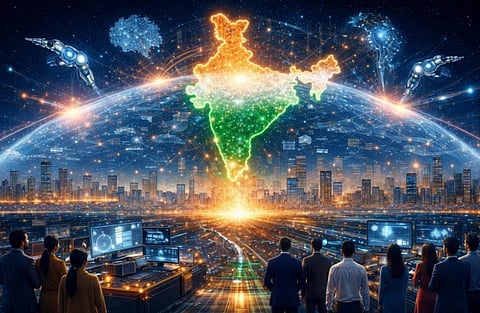
The hardest constraints in AI today are not model capabilities. They are compute access, representative data, talent pipelines, and financing. These gaps are most acute in the Global South. India’s argument is simple but disruptive: governance must address access.
Equity in AI is not merely a slogan – it is a design imperative. Technology reflects the systems that build it. When those systems exclude women, rural populations, or speakers of non-dominant languages, AI will magnify those inequities at scale. When models are trained on unrepresentative datasets, error rates cluster where data is limited — often rural populations, minority language speakers, and low-resource facilities.
For a country with over 2000 ethnic groups, a billion non-English speakers and approximately 800 million rural dwellers, equity is not a “nice-to-have” enabler, it is a critical multiplier.
Take for instance healthcare. India’s healthcare market, one of the fastest-expanding health market in the world is currently valued at $638bn, and has grown at an impressive CAGR of 17.5% for last ten years. At the same time, uneven access, overburdened clinicians and high out-of-pocket expenditures remain a challenge. And this is where the AI would come in handy.
A new analysis by Kinaura Partners shows the potential of AI in African healthcare market offers a potential productivity gains of $6bn against a total healthcare market of $160bn. A rough India equivalent would mean a $24bn opportunity through AI-led efficiency gains in healthcare. To put this into perspective, this is almost 24 times the budget of country’s flagship Ayushman Bharat scheme! Imagine the value gains at stake.
This value will come from at-scale adoption of AI across the entire healthcare value chain - diagnostics and imaging, hospital operations and workflow management, patient monitoring, population surveillance, drug discovery and development, supply-chain forecasting, and clinical-decision support.
Imagine SMS-based triage tools guiding a rural health worker through symptom checklists in Bundelkhand. Or AI chatbots fluent in Bhojpuri or Tamil helping families recognize early warning signs of tuberculosis or dengue before complications set in. Or decision-support systems trained specifically on Indian disease burdens — kala-azar, Nipah, scrub typhus, assisting frontline clinicians who may never have seen a specialist. Think of low-bandwidth AI tools flagging high-risk pregnancies in aspirational districts or predicting outbreaks through wastewater and climate-linked surveillance.
But there’s a catch.
Kinaura highlights that almost 32% of the potential value gains from AI is dependent on correcting systemic bias in how AI would be designed, trained and deployed. What does this mean? It means that that the AI deployment in Indian healthcare should take into account and correct for any potential bias caused by its demography, socio-economic variance, urbanization, linguistic diversity and digital penetration.
As Kinaura highlights in its Equity in AI report, unlocking full value in AI would require equity to be ingrained intentionally from the start across the full stack – data, models, applications, funding and infrastructure, governance and policy, and people and institutions. The current AI models are built on overwhelmingly white, male, urban and wealthier population data. The model itself, which decides how the data is interpreted, reflect the assumptions and beliefs of the person who built them. For instance, the current LLM models have been found to be steeped in caste bias, indicating a critical need to “Indianise” the models. Similarly, most of the AI applications today require smartphones or laptops, limiting the access to wealthier Indians. The global AI stack continues to be biased with respect to the AI funding, regulations and governance. And so, there’s work to do.
But here's the good news – India is cognizant, and is already working to solve equity. One of the key components of IndiaAI mission is building in-house compute capacity - 38000+ GPUs have already been deployed, up from an initial target of 10000. Through it AIKosh platform, India’s own dataset platform, large datasets are being developed for training AI models by integrating data from both government and non-government sources. And with the aim of developing its own LLMs which use and work on Indian data and languages, four startups have been selected to develop foundation models. The AI action summit being organized in Delhi next week is another cog in India’s continued push for Global South representative AI governance. The intensified push on internet and smartphone penetration has meant that 85% of Indian households now own atleast one smartphone and 95% of villages have access to high-speed internet, which is one of the highest rates in global south.
All these initiatives show that India is serious about ensuring equity in AI. And this must remain the case.
Over the last few years, India has successfully positioned itself as the voice of Global South in AI governance. From elevating development priorities in global forums to explicitly arguing that AI governance must ensure access, not just regulate, India has reframed the AI debate. With AI touted to add an estimated $1.7tn to the Indian economy by 2035, India is truly becoming a leader and a formidable voice in AI, not just for the Global South, but for the entire world.
India now stands at the centre of the global AI story. The real test of leadership will not be how fast it scales AI, but how deliberately it builds it for everyone.