From President’s Rule to Permanent Disorder: What the 13 May Killings Reveal About Manipur’s New Phase of Conflict

The Naga–Kuki cleavage, dormant since the conflict of 1993–1998, has resurfaced within a regional security environment characterised by an over-supply of weaponry, a fragmented insurgent ecology, and a contested narrative landscape concerning territorial entitlement and land use.
The killing of the three pastors, if anything, has suggested that the violence in Manipur has slowly transitioned into becoming a permanent feature of a state that has now institutionalised violence and disorder.
The killing of the three pastors, if anything, has suggested that the violence in Manipur has slowly transitioned into becoming a permanent feature of a state that has now institutionalised violence and disorder. (Internet)
Published on

— ✍️ Mangpi Haokip

The killing of three Kuki Baptist pastors in an ambush on the morning of 13 May has reopened questions about the trajectory of Manipur's three-year conflict, even as the state recently restored what it colloquially termed as a “Popular government” following one year of President’s rule.

The political sequence that culminated in New Delhi’s direct intervention began with the resignation of the then Chief Minister N. Biren Singh on 9 February 2025. Five days later, the constitutional machinery of the state was effectively suspended with the formal imposition of President's Rule, and the state's Legislative Assembly was cast into “suspended animation” – a constitutional euphemism for a state of deep freeze. By August 2025, Union Home Minister Amit Shah was on the floor of the Lok Sabha announcing a six-month extension of the initial 6 months of President's rule. The message from New Delhi was unambiguous.

In its attempts to project a return to normalcy, the Union government finally lifted the President’s rule on 4 February 2026. With this, one year of constitutional limbo has ended, and normal business of the state was once again to be resumed. The optics were carefully crafted, and the timing carried the unmistakable fingerprints of an electoral calculation. It doesn’t require a seasoned expert to suggest that New Delhi was setting its sights on the Assembly Election of 2027, when Manipur will go into polling once again, with the current assembly poised to end in one year. Restoring a functioning government under such circumstances, by any measure, was but a sine qua non.

The new cabinet was assembled with a calculated arithmetic of ethnic proportionality: a Meitei Chief Minister in Yumnam Khemchand, an RSS veteran and two-time Singjamei legislator, widely regarded as a ‘consensus’ figure, someone whose temperament and political standing made him palatable across the divide, unlike his predecessor N. Biren Singh, who perhaps epitomised the grievances and predicaments of the Kuki-Zo people. In other words, he was New Delhi's attempt at a reset. Along with him were two deputies, one from the Naga and one from the Kuki communities. It was a signal of the BJP's classic social-engineering playbook, a tried-and-tested formula for managing competing ethnic, communal, and political groups by way of co-opting and ensuring just enough power to keep each stakeholder bound to the arrangement. It is a model the party has adopted, refined, and replicated across the country's most complex and combustible constituencies where outright resolution of deep-rooted tensions is neither easy nor perhaps intended, but where the appearance of balance serves as a functional substitute for peace. Subsequently, Nemcha Kipgen(50 A/C Kangpokpi) of the BJP, representing the Kuki-Zo community, and Losii Dikho(48 A/C Mao) of the Naga People’s Front, representing the Naga community, were installed as the state's first deputy chief minister, a role with no precedent in Manipur's political history, and one whose sudden introduction raised as many questions about intent as it answered about governance. It also marked a conspicuous departure from the long-standing constitutional convention that Manipur had never adopted in its cabinet composition earlier.

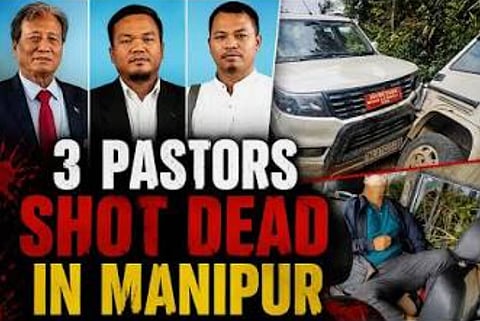
The attack on three pastors on the morning of 13th May marked one of the biggest developments in the state's unending cycle of violence in the recent past.

The convoy of religious cohorts was returning from Churachandpur District in Manipur’s southern region, a Kuki-Zo dominated belt, after participating in the maiden United Baptist Convention meeting following its split from the Manipur Baptist Convention. The Manipur Baptist Convention was a conglomerate of the Baptist Christian groups in Manipur. Following the initial rupture of 3rd May, the Kuki-Zo groups within the MBC have exited to form their own congregation.

The attack took place in between Kotjim and Kotlen in Kangpokpi District, and claimed the lives of three pastors namely Rev V Sitlhou, Rev Kaigoulen and Pastor Paogoulen and left four others seriously injured. A condemnation followed suit, including the Chief Ministers of three North East States, Meghalaya, Nagaland and Mizoram. Chief Minister of Nagaland Neiphiu Rio tweeted, “I strongly condemn the brutal killing of Kuki Church leaders in Manipur. Such barbaric violence against innocent lives is unacceptable and has no place in any civilised society. Condolences to the bereaved families and the church community during this time of grief”

On 3rd May 2026, barely ten days before the ambush of the convoy of the religious pastors, the Kuki-Zo people across the country mark and commemorate the 3rd Anniversary of the Manipur violence under the theme “Separation Day”, a reflection of the entrenched geographical and demographic cleavage that largely defines the reality of a state's sharp, fractured ethnic fault lines. That this attack occurred just days after a solemn commemoration not only exposes New Delhi's attempt to impose a hollow, manufactured peace in a state where the very idea of it has lost all credibility. In other words, it is also a damning indictment of a security apparatus that, for all its heavy presence on the ground, remains structurally insufficient.

The attack was heavily attributed to be the work of the Zaliangrong United Force-Kamson(ZUF-K) faction, a group backed and, at times, even sheltered by the Nationalist Socialist Council of Nagalim- Issak Muivah (NSCN-IM). For decades, the NSCN-IM has functioned as a de facto parallel government across the Naga-dominated hill districts of Manipur. The ceasefire with New Delhi since 1997 and the 2015 framework agreement with the GoI have emboldened the group to operate virtually as a civilian government. Many argue that, since entering into a ceasefire agreement with the Government of India, the armed outfit has strategically cultivated a proxy organisation to carry out its dirty and sundry acts of violence, targeted killings, looting, extortion, illegal taxation, and the systematic intimidation of civilian populations in the hill districts of Manipur while also maintaining plausible deniability, and subsequently continuing to exert control on the ground.

What makes this template particularly striking is the deep ideological contradiction at its heart. The NSCN-IM was built on the foundational doctrine of "Nagalim for Christ" — a vision of a sovereign Naga homeland rooted in Christian identity. Yet the targeted killings of these church pastors and religious leaders stand as a grotesque and jarring contradiction of this very morally laden and spiritual edifice upon which the movement was supposedly built.

The killing of the three pastors, if anything, has suggested that the violence in Manipur has slowly transitioned into becoming a permanent feature of a state that has now institutionalised violence and disorder.
'Locked In, Starved, and Beaten': Kuki Nanny Alleges Years of Torture at IIM Bangalore Professor's Home | TM Exclusive

The attribution to the ZUF-K group lent further credibility in the interview given by PK Mishra, a former Director General of the Border Security Forces (BSF) and a seasoned expert on insurgency across the Northeast, with News9, where he has directly attributed these killings to be the work of the "NSCN-IM backed ZUF-KAMSON"

 Two interrelated propositions emerge from this trajectory. The first concerns the state capacity. The inability of the security apparatus to prevent, deter, or — over a period now exceeding two weeks — conclusively attribute responsibility for the 13 May ambush is symptomatic of a broader institutional deficit. Responsibility for the attack remains the subject of mutually contradictory claims among armed and civil society groups.

The second proposition concerns the structural transformation of the conflict itself. What began in May 2023 as a bilateral antagonism between the Meitei and Kuki-Zo communities has, over the past three years, created permissive conditions for the escalation of inter-community and intra-insurgent disputes. More recently, relations between the Kuki-Zo and Naga peoples, another group of predominantly Christian tribal communities in Manipur's hills, have deteriorated sharply, with clashes breaking out in several places.

 The ongoing issue of hostage-taking on both sides marks the latest episode in the renewed and fractured relationship between the Kukis and Nagas. The Naga–Kuki cleavage, dormant since the conflict of 1993–1998, has resurfaced within a regional security environment characterised by an over-supply of weaponry, a fragmented insurgent ecology, and a contested narrative landscape concerning territorial entitlement and land use. The pre-existing rivalries between the National Socialist Council of Nagalim (Isak-Muivah faction), the Zeliangrong United Front, and various valley-based insurgent groups have, in this environment, also acquired a renewed operational significance

 The cumulative evidence does not support the proposition that Manipur is presently in a post-conflict phase. The formal indicators of constitutional restoration, such as the revocation of the President's Rule, the constitution of an inclusive coalition cabinet, the resumption of legislative business, and the issuance of declaratory commitments to reconciliation, have been put in place.

The killing of the three pastors, if anything, has suggested that the violence in Manipur has slowly transitioned into becoming a permanent feature of a state that has now institutionalised violence and disorder.  Three years after the initial rupture of May 2023, the fault line has not narrowed. It has grown even wider, cutting across communities that were initially not part of the conflict and reaching into spaces that had, until now, been spared — the church, civil society, and the very platforms built for dialogue and reconciliation. That those moving through the state on matters of faith and community are now being targeted is perhaps the most troubling development of all.

The restoration of representative government in February 2026 has, on the evidence currently available, reconstituted the form of governance without reconstituting its substance. Peace, in any meaningful operational sense, remains elusive.

- Mangpi Haokip, is a Research Scholar at the University of Hyderabad and Vice President, Kuki Students' Organisation-Hyderabad (KSO-H).

Disclaimer: This article reflects the personal views of the author. The publication does not endorse, approve, or assume responsibility for the content, opinions, or assertions made therein.

The killing of the three pastors, if anything, has suggested that the violence in Manipur has slowly transitioned into becoming a permanent feature of a state that has now institutionalised violence and disorder.
"The Nation Failed Her": Kuki Collective's Fierce Demand for Arrests After 2023 Gangrape Survivor's Tragic End
The killing of the three pastors, if anything, has suggested that the violence in Manipur has slowly transitioned into becoming a permanent feature of a state that has now institutionalised violence and disorder.
"What Certificate Do I Show?": The Tragic Death of Anjel Chakma and the Cost of Being 'Different' in India

You can also join our WhatsApp group to get premium and selected news of The Mooknayak on WhatsApp. Click here to join the WhatsApp group.

Support The Mooknayak

'The Mooknayak' practices democratic journalism. It is a media platform committed to the Constitution, democracy, and social justice. If you also want 'The Mooknayak' to always raise the voices of the marginalized and show the pain of the voiceless, please support us.

Please Contribute
The Mooknayak English - Voice Of The Voiceless
en.themooknayak.com