Discussion
Ending Poverty for SC/STs: Own Land, Own Factory, Own Contract – The Ahinda Asset Plan Explained
An SCP/TSP Asset Transfer Framework for Dalits, Adivasis and Backward Classes


— ✍️ Nethrapal
Bengaluru- For decades, the political and social discourse surrounding AHINDA—the foundational socio-political coalition representing Alpasankhyataru (Minorities), Hindulidavaru (Backward Classes), and Dalitaru (Dalits)—has been dominated by electoral arithmetic and welfare-driven consumption smoothing. While landmark legislative measures like the Scheduled Castes Sub-Allocation and Tribal Sub-Allocation (SCP/TSP) Act have successfully prevented fund diversion, a critical structural question remains: How do we move beyond temporary relief and create permanent, intergenerational wealth for these marginalized communities?
The answer, as the Ahinda groups have determined, does not lie in expanding the safety net of subsidies, but in systematically transferring the "Means of Production" directly into the hands of the community. True empowerment requires transitioning individuals from wage-dependent laborers into self-employed capital asset owners.
When Ahinda groups analyzed the root cause for extreme poverty among Dalits and Adivasis, they found that those communities which continued with traditional manual labour without any actual asset ownership had greater poverty than the rest. Groups which got urbanised faster with access to wealth and education moved up the ladder, and many of them moved up even without the help of reservations in government jobs and education. It is in this background that Ahinda groups have undertaken a detailed study of the underlying segments which need special attention.
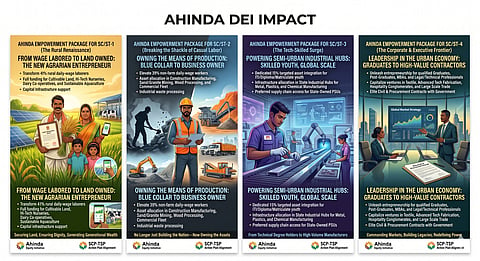
By analyzing the community through a demographic and capacity-oriented lens, a data-backed blueprint has been prepared. True AHINDA empowerment, according to this proposal, can be achieved by executing a targeted, four-tier structural intervention.
Target Beneficiaries: Rural Agricultural Laborers – this segment constitutes approximately 41% of the total SC/ST households in rural areas. The primary objective is to break the cycle of daily-wage vulnerability by establishing stable agrarian assets.
Core Interventions & Asset Creation Proposed:
Direct Land Ownership: Facilitating the procurement of cultivable land through direct state acquisition or outright purchase to establish permanent family holdings.
Hi-Tech Horticulture: Promoting high-yielding horticulture setups, setting up commercial nurseries, and supporting both individual and community-led collective farming models.
Animal Husbandry Co-operatives: Providing structural capital for dairy farming, establishing Go-Shalas (cow rearing centers), and funding the domestication of buffaloes, sheep, goats, and lambs. This also incorporates critical backyard poultry farming and the excavation of commercial fish ponds.
Infrastructure & Input Security: Equipping rural entrepreneurs with modern agricultural tools, localized irrigation systems, capital support, and compost/organic fertilizer manufacturing centers. Auxiliary components include eco-restoration activities like cleaning local water bodies and maintaining district rural roads.
Target Beneficiaries: Non-Agricultural Daily Wage Laborers – this captures the 39% of SC/ST households surviving as daily wage earners in non-agricultural, unorganized sectors. The goal is to elevate casual laborers into micro-demanded industrial asset owners.
Core Interventions & Asset Creation Proposed:
Construction Supply-Chain Integration: Creating manufacturing assets to supply essential building materials including mechanized brick-making, stone cutting, polishing, floor-furnishing manufacturing, and high-demand stone pebble crushing for M-Sand (Manufactured Sand) and Muram.
Mining & Heavy Earthwork: Capitalizing entry into sand mining, stone excavation, and granite mining operations. This also supports commercial contracts for painting, electrical furnishing, and structural works for roads, railways, and tunnels.
Wood, Leather, & Livestock Processing: Funding the establishment of wood-sale yards, commercial sawmills, furniture workshops, mechanized poultry setups, and leather goods manufacturing units.
Industrial Services: Provisioning industrial waste management operations and setting up organized corporate security and "watch and ward" service agencies.
Target Beneficiaries: Skilled and Semi-Skilled Semi-Urban & Urban Youth – this targets the top 15% of SC/ST community youth who have attained basic matriculation or completed specialized technical training via Diplomas, ITI courses, or equivalent certifications. It focuses on transitioning technical knowledge into enterprise ownership within state-sponsored industrial hubs.
Core Interventions & Asset Creation Proposed:
Small Scale Industries (SSIs): Allotting plots and incubating micro-factories within industrial corridors for the precision manufacturing of iron, steel, molded plastics, industrial chemicals, paper, and heavy packaging materials.
Agro-Processing & Value Addition: Setting up commercial flour mills, modern meat-processing plants, and hygienic slaughterhouses to tap into the regional food supply chain.
Commercial Transport Fleet Operations: Providing the necessary capital, land, and vehicle credit clearances to establish transport businesses handling regional passenger travel and high-volume freight logistics.
Public Sector Undertaking (PSU) Linkages: Ensuring structural pathways for these new SSIs to act as direct, preferred vendors supplying essential goods and services to State-Owned PSUs.
Target Beneficiaries: Highly Educated Urban Youth & Professionals – this addresses the high-potential urban sector, specifically designed for highly qualified SC/ST youths holding undergraduate, postgraduate, or professional degrees (such as B.Com, BBM, MBA, and other technical qualifications). It aims to support the top 5% of educated households in entering high-value corporate and administrative markets.
Core Interventions & Asset Creation Proposed:
Advanced Manufacturing & Large-Scale Trade: Establishing larger enterprises across manufacturing and trading sectors with emphasis on high-margin areas like technical textiles, processed metals, automated plastic products, and large-scale food processing.
Elite Service & Hospitality Enterprises: Funding upscale service-sector ventures, corporate hospitality units, and trade setups in premium wood, furniture, and the automobile industry.
Institutional Government Contracting: Providing direct financial backing, compliance support, and technical credibility to help young professionals secure major civil and engineering contracts with Government and Semi-Government agencies.
Institutional Supply Chains: Promoting direct corporate channels for the supply of high-end goods, consulting services, and tech solutions to governmental institutions.
The Ahinda DEI Impact framework, as drafted in this proposal, moves beyond traditional welfare-based models, shifting the focus of SCP/TSP fund utilization from mere consumption subsidies toward targeted capital asset creation.
By mapping intervention strategies to the community's structural reality—allocating resources proportionately among agricultural workers (41%), non-farm laborers (39%), skilled technicians (15%), and advanced graduates (5%)—the initiative builds a self-sustaining ecosystem of ownership.
Welfare schemes keep families afloat, but asset ownership is what propels them forward. This systematic creation of assets provides the necessary material foundation to foster sustainable growth, financial autonomy, and genuine economic democracy for marginalized communities.
As policy debates surrounding social representation intensify, true social justice cannot exist without economic parity. By shifting focus away from consumption spending and toward the targeted creation of capital assets—proportionately distributed across rural farmers, industrial laborers, skilled technicians, and urban graduates—the state can spark a self-sustaining economic revolution. Securing land, providing heavy machinery, incubating factories, and backing corporate contracts is the blueprint to transform the AHINDA coalition from a historical social movement into an economic powerhouse.
- The author has over 16 years of experience in the Indian Revenue Service (IRS), and is a seasoned tax enforcement leader who is passionate about ensuring compliance and fairness in the tax system. He has a strong academic background with a B-Tech from IIT-Madras in Electrical Engineering, where he received a Silver Medal, and a PGDM from IIM-Bangalore, where he specialized in Finance and Economics. This proposal has been prepared by Ahinda groups and would be submitted for the consideration of the Government of Karnataka.
You can also join our WhatsApp group to get premium and selected news of The Mooknayak on WhatsApp. Click here to join the WhatsApp group.
'The Mooknayak' practices democratic journalism. It is a media platform committed to the Constitution, democracy, and social justice. If you also want 'The Mooknayak' to always raise the voices of the marginalized and show the pain of the voiceless, please subscribe.
PLEASE SUBSCRIBE US