— ✍️ Dr Madhusudan Nag & Shakuntala Ghadai
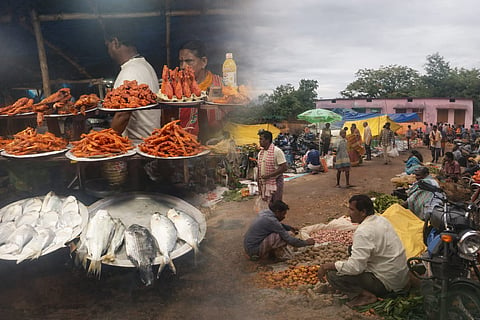
When a district administration seeks to prohibit the sale of meat, fish, and eggs for Republic Day, it is framed as a matter of “decorum.” In Koraput, the administration issued a directive asking officials to stop the sale of non-vegetarian items on 26 January, citing the dignity of the national celebration; after public backlash, local reporting indicates that the order was withdrawn. However, the episode remains analytically revealing precisely because it shows how quickly an everyday domain food can become an object of state signalling. The dispute, in effect, is not about food alone; it is about the political economy of whose everyday life is treated as negotiable in the name of the nation.
Koraput is not just any district. As per Census 2011, its total population is 1,379,647. Scheduled Castes constitute 14.25% and Scheduled Tribes 50.56%. It is, in other words, a largely Adivasi-majority region, with food cultures and local markets in which fish, eggs, and meat are ordinary, not exceptional, sources of everyday nutrition and livelihoods. That is precisely why the Koraput order is revealing: it shows how “soft” cultural regulation is most easily tested where political voice is weakest.
The ban rests on an implicit cultural assumption: that a “proper” Republic Day is aesthetically and morally aligned with vegetarianism. But large-scale survey evidence does not support the myth of a predominantly vegetarian India. National Family Health Survey (NFHS)-5-based estimates show that an overwhelming share of adults consume non-vegetarian food at least occasionally: around 83.4% of men and 70.6% of women (15–49) report eating fish/chicken/meat daily, weekly, or occasionally. That is not a fringe behaviour; it is the modal reality.
And because India’s diets are regionally patterned, a one-day district-wide prohibition is not socially neutral. Eastern food cultures, Odisha included, are historically more fish-and-egg friendly than the “north-vegetarian” imagination that dominates national cultural messaging. State-wise NFHS-5 analysis suggests that Odisha is among the lowest “vegetarian-only” states, with about 3.9% reporting a vegetarian-only diet, far below the national headline figure of roughly 19%. In other words, this is not simply “a ban”; it is a cultural hierarchy made administrative.
Behavioural economics popularised the idea of the nudge: tweak the “choice architecture” so people are gently steered toward a social objective while retaining freedom of choice. What Koraput faced was the opposite. A prohibition is not a nudge. It is a command. It shifts the state from choice architect to moral policeman.
This matters because calling coercion a nudge is how paternalism normalises itself. Once the language of behavioural policy is borrowed to legitimise restrictions, the policy conversation stops asking the most important questions: Who bears the cost? Who gets to choose? Who is being disciplined and why here?
Why pilot such moral regulation in an Adivasi-majority district? Not because Adivasis are uniquely in need of dietary “discipline,” but because marginal regions often function as laboratories for administrative signalling. The state’s calculus is straightforward:
1. Lower expected resistance: marginalised districts typically have fewer organised interest groups with immediate access to the capital’s media and legal resources.
2. Higher enforceability: informal markets and small vendors are easier to intimidate, and losses are dispersed among many petty sellers who lack bargaining power.
3. Symbolic payoff: projecting a vegetarian aesthetic on a national holiday produces a public performance of “culture,” even when it contradicts local norms.
This is how “soft targeting” works: not by explicit hostility, but by choosing sites where governance can be exercised with minimal political cost.
Importantly, Odisha is currently governed by a right-of-centre party, and the broader national climate has seen recurring attempts, formal and informal, to elevate a particular north-Indian vegetarian respectability as a default “national culture.” One need not claim that every district order is centrally scripted to see the structural pattern: a politics of dietary majoritarianism finds the state’s administrative machinery unusually available.
Food is not only culture; it is also a question of welfare, prices, and livelihoods. A district-wide restriction affects:
· Perishable supply chains: fish and meat are time-sensitive commodities. Even a one-day disruption can create waste and losses, especially where cold-chain infrastructure is thin.
· Petty vendors and eateries: the burden falls on small sellers, precisely those with the least ability to smooth income shocks.
· Poor consumers: wealthier households can substitute or stock up; poorer households face a binding constraint in daily food purchases.
In standard welfare terms, this is a policy with regressive incidence: costs are concentrated among those least able to absorb them, justified by a cultural notion of “decorum” that is neither measurable nor democratically agreed upon.
There is also a conceptual category error. Republic Day is not a religious occasion requiring ritual purity. It is a constitutional celebration, a reminder that citizenship is equal, plural, and not contingent on one’s dietary conformity. When state action implicitly ranks diets into “respectable” and “unrespectable,” it creates a hierarchy of citizenship through the backdoor.
That is why critics have called it an infringement on personal liberty and an arbitrary restriction, especially in a tribal-dominated district.
Conclusion
The worrying part is not just the order, but how quickly it can become a passing headline rather than a public argument in Odisha media; this is how cultural coercion normalises itself. Koraput matters because marginal districts are cheap testing grounds: low resistance, easy enforcement, dispersed costs on vendors and poor households. A republic does not celebrate itself by regulating dinner; it protects equal citizenship in everyday life. As Babasaheb Dr B. R Ambedkar warned, without fraternity, liberty and equality need a “constable” to enforce them, and that is precisely what Republic Day must resist.
Dr. Madhusudan Nag is a Senior Researcher at the National Institute of Technology (NIT), Bhopal and holds a PhD in Economics from the Centre for Development Studies, Kerala. His research explores labour migration, political economy and inequality.
Shakuntala Ghadai is a PhD scholar at the Centre for Development Studies, Kerala. Her research explores gender, food security, and rural livelihoods in eastern India.
You can also join our WhatsApp group to get premium and selected news of The Mooknayak on WhatsApp. Click here to join the WhatsApp group.