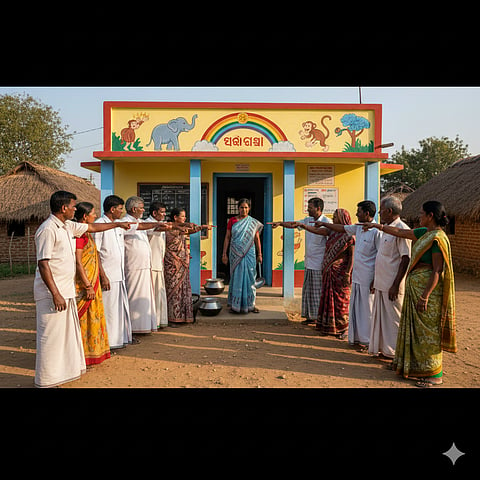
New Delhi- In the midst of heightened national discourse on reservations, affirmative action, and social equity, fueled by the recent controversy surrounding the University Grants Commission's (UGC) Promotion of Equity in Higher Education Institutions Regulations, 2026, and ongoing Supreme Court deliberations on applying the "creamy layer" principle to Scheduled Castes (SC) and Scheduled Tribes (ST) a stark incident in rural Odisha highlight how deeply entrenched caste prejudices continue to undermine efforts toward inclusion and equality.
In Nuagaon village, under Ghadiamala gram panchayat in Rajnagar block of Kendrapara district, an anganwadi centre has remained shuttered for nearly three months, or over 80 days. The closure stems directly from upper-caste parents' boycott of the facility following the appointment of 23-year-old Sharmistha Sethy, a graduate from the Scheduled Caste community, as helper-cum-cook in November 2025.
Prior to her joining, the centre served around 20 children, all from upper castes, providing pre-school education, supplementary nutrition like chhatua (a fortified cereal mix) and eggs, and health services for pregnant women and lactating mothers. Attendance plummeted to zero from November 21 onward, as villagers refused to let their children consume food prepared by a Dalit woman, citing traditional caste practices and prejudice. Even services for mothers and children were rejected, effectively paralyzing the centre and depriving vulnerable groups of essential early childhood care under the Integrated Child Development Services (ICDS) scheme.
Sharmistha Sethy, the sole eligible candidate after repeated advertisements for the post in 2024 and 2025, has faced direct warnings against cooking and ongoing ostracism. The village, home to about 45 families including a small number of Dalit households, saw the boycott enforced through a dominant upper-caste committee. District authorities, including the District Social Welfare Officer and Sub-Collector, have conducted multiple counseling sessions and mediation efforts, but the impasse persists, highlighting the limits of administrative intervention in the face of social resistance.
Ghadiamala sarpanch Sailendra Mishra noted that despite repeated requests to villagers and local leaders to resume sending children to the anganwadi, their efforts have been ignored, resulting in pregnant women also skipping the centre and missing essential health support.
Anganwadi worker Lizarani Pandav reported notifying the Rajnagar block's CDPO, who promised strict measures against those obstructing attendance by children and expectant mothers. CDPO Dipali Mishra explained that resistance from many upper-caste parents stems from objections to food prepared by a Dalit woman, and despite joint counseling sessions with the tehsildar on Tuesday, no resolution has been reached. Villager Ramakanta Das confirmed that numerous parents opted against sending their kids to avoid food cooked by the Dalit appointee.
A group of Dalit leaders visited the village on Tuesday, criticizing the administration's lack of decisive action and citing the Supreme Court's 2004 interim order in PUCL vs Government of India, which prioritizes SC/ST individuals as cooks in meal programs. Kendrapara district collector Raghuram R Iyer stated that, upon learning of the issue, he instructed the district social welfare officer to prepare a comprehensive report, with assurances of action against those responsible for barring access under the guise of caste objections, while also pursuing peaceful dialogue to end the impasse.
This episode is not an aberration but part of a persistent pattern of discrimination against Dalit women in grassroots government roles, particularly as cooks and helpers in anganwadis and mid-day meal programs. Such biases often lead to boycotts, harassment, forced transfers, or facility closures, undermining nutrition and education initiatives designed to benefit marginalized children. Over the past five years, similar incidents have been reported across states:
In Gujarat (2025), Dalit anganwadi workers faced harassment and parental refusal of food prepared by them, with many avoiding such jobs due to low pay and threats.
Karnataka saw multiple cases, including a 2022 boycott in Bidar district over a Dalit helper and recent ones in Chamarajanagar, where parents shifted children away from facilities with Dalit cooks.
Tamil Nadu documented repeated rejections and transfers of Dalit appointees on grounds of "pollution" fears since 2021.
Odisha itself witnessed a comparable 2019 incident in the same Rajnagar block, where a Dalit cook went on hunger strike after upper-caste parents locked the centre.
These recurring events expose the gap between policy intent such as prioritizing SC/ST hires and ground realities, where caste hierarchies disrupt public services meant to foster social integration. As debates rage over UGC guidelines (stayed by the Supreme Court in January amid concerns of vagueness and potential misuse), the creamy layer exclusion in SC/ST reservations and broader reservation frameworks, the Kendrapara case serves as a serious reminder: true equity demands not just legal provisions but the dismantling of everyday prejudices that deny basic rights and opportunities to the most disadvantaged. Authorities continue mediation, yet without societal change, such shutdowns risk perpetuating cycles of exclusion and malnutrition among the very children these centres aim to uplift.
You can also join our WhatsApp group to get premium and selected news of The Mooknayak on WhatsApp. Click here to join the WhatsApp group.