Dalit News
TM Exclusive | "How Can Our Lives Not Be Shorter, When This Is How We Live?"
Low wages, no ESI-PF, toxic gas and months without pay: sanitation workers across India tell The Mooknayak why the IIPS findings don't shock them.

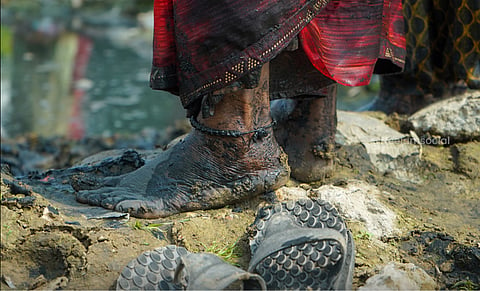

On World Toilet Day (November 19), a report released put a bitter number in front of the country. According to Bridging the Life-Expectancy Gap of Sanitation Workers in India, by Reckitt and the International Institute for Population Sciences (IIPS), sanitation workers in India have an average life expectancy of 63.8 years. That is 11.4 years lower than professional and managerial workers. Even against agricultural and manual workers with similar schooling and income, the gap is 9.6 years.
The report finds that 30.2 percent of recorded deaths among sanitation workers are linked to toxic gas exposure and poisoning. Only 1 percent of workers contribute towards health insurance. Urban male sanitation workers have the lowest life expectancy of any group studied, 62.3 years, about nine years below urban men nationally. The study estimates that this disparity costs the economy about 1.03 percent of India's GDP every year.
These figures may shock policymakers. But in a year when sanitation workers have gone on strike in state after state, and some have stood waist-deep in a sewage-choked river just to be heard, the numbers surprise almost no one who does this work. The Mooknayak spoke to sanitation workers and to volunteers of self-help groups across several states, who support the community. Their answer was nearly the same everywhere: the study is putting numbers on what they have been living for years. "The figures are only revealing it now," they said. "We live this nightmare every single day."
Bharti Pakhale has worked in sanitation for eight years in Bhilai, Chhattisgarh. The 40-year-old supervises the sorting of dry and wet waste in her ward. She earns ₹8,000 a month and works eight hours a day.
Asked about weekly offs, she says: "There is no provision for a weekly off. We have to take leave when there is an emergency. Everyone takes it according to their need, so four days of rest a month is all we get."
Her contract has no ESI or PF. When a medical need arises, workers pay from their own pockets. "With just ₹8,000 a month, how does one manage? This is the ground reality, but we have no option."
Bharti grew up in a Dalit family and could not study much. In her view, people in such circumstances, especially women, are left with no other choice. Her hopes now rest on her 14-year-old daughter, who is in school. "My husband and I tell her all the time: what we are facing, you should never face. Study well and get a good, respectable job."
Although she belongs to a Scheduled Caste, Bharti says she has at least not faced discrimination at her workplace.
Her demand is simple: "If our demand of at least ₹15,000 a month, with ESI and PF, is accepted and implemented, we will get some relief."
Women workers face a separate burden. They report at 6 am and work until 2 pm, and get no relief even during their periods. Bharti says there should be provision for period leave.
Her experience of mechanisation differs from official claims. "There are robotic machines for cleaning gutter lines, but the major work is still done by human hands. There are safety gears, but despite them, a worker is still exposed to toxic gases and polluted air."
When told what the report says about sanitation workers' life expectancy, Bharti sighed. "If our lives turn out this short, it is no surprise."
Uttam Kumar, 30, of Kharagpur in Bihar, belongs to a Dalit family. He began accompanying his parents to work at 15 to help them, and it has been his livelihood ever since.
Today, Uttam and his wife Anjani together earn ₹20,000 a month. In return, they work eight-hour shifts. They are a family of four, with two children aged 10 and 7.
"We get a uniform and shoes once a year. No health card has been made for us," Uttam says. Then he asks: "We are a family of four. We have to run the house, educate the children, and pay for medicines when someone falls sick. You tell me, how will our life be very good?"
When he started, he was paid ₹4,600 a month. Thirteen years later, he earns ₹10,000.
His view of the study is direct. "If there is any such survey, I am sure there will be no change in the quality of our lives until there is a uniform policy for sanitation workers across India."
In Jodhpur, Rajasthan, Prakash Vidrohi, a leader of the Safai Karmachari Sangh, has the bleakest account.
"At least one to two sanitation workers die every year in Jodhpur, and the reason is hazardous working conditions," he says. "They boast about robotic, mechanised systems, but the harsh reality is that manual scavenging and manual labour are the norm across Rajasthan. The safety gear they give is not effective, and our men are exposed to toxic, harmful chemicals emitted from sewer chambers."
On housing, he asks: "There are railway quarters for railway employees, quarters for other departments, but have you ever heard of a safai karmachari colony anywhere in Rajasthan? Nagar palikas or UITs have never allotted any project for our housing and welfare."
The Jodhpur Municipal Corporation (JMC) issues a health card, but if an employee cannot renew it because of some unforeseen circumstance, it becomes useless. Once there is a gap, renewal becomes a herculean task thanks to the clerks. According to Vidrohi, the card covers only routine ailments. For serious illness, the Ayushman card is all most sanitation workers have.
He also lays out the pay gap. "Permanent JMC employees get ₹55,000 a month, but the contract workers are in a far worse situation. They get only ₹7,000, with no ESI or PF deducted. Everything is corrupt."
He cites a recent example of exploitation. According to him, women workers were taken outside the JMC area to a remote gram panchayat in Luni and made to clean the roads of a private Raja Ram temple, run by a large and well-resourced trust. Vidrohi complained to officials about why staff were made to work outside the jurisdiction. There was no response. Instead, he says, officials told him: "Ye to dharam ka kaam hai, aapko kya aapatti?" (This is religious work, what is your objection?)
Workers who report at 6 am and work until 2 pm are still not free. "It is around 4 when one reaches home after calling it a day, and there is no overtime pay for the effort we put in."
Vidrohi is angry about the conditions for menstruating women workers. "They have no access to toilets and no resting places. People won't let them in if they need to change during periods. We all know the condition of the public toilets in market places: either locked, or in a bad state because they are used by ordinary people or beggars who have no sense of hygiene."
He ends with this: "I can vouch that in India, cows and dogs have a better life than safai karmis. For those doing mehtar work, life is worse. There are laws for cows and dogs, but nobody takes notice of sanitation workers."
Even Chandigarh, counted among India's most planned and cleanest cities, is not doing well for its sanitation workers. Shama, a member of a self-help group that surveys issues concerning sanitation workers in the city, told The Mooknayak that her work keeps her in regular conversation with them.
"Chandigarh's area is very large, but the number of sanitation workers keeping it clean is small. So they have to do more work. The entire day goes in cleaning just one section," Shama says. Her group had recommended that manpower was too low for the area and more people should be deployed. "But I think no action has been taken on that recommendation even after 8 months now."
On leave, she says sanitation workers get one weekly off, but if someone falls ill during the month, money is deducted for the days off. "The government may or may not deduct, but the contractor will definitely deduct." In other words, even resting when sick has to be paid for out of their wages.
In Damoh, Madhya Pradesh, the situation is even more pitiable. Rajat Kachchawa, associated with the Valmiki Self Help Group, says the number of sanitation workers is very small compared with the population. "There are about 50 permanent employees and about 100 on contract. In all, 150 to 200 sanitation workers are working."
The biggest blow is the wait for wages. "Salaries don't come for three months at a time. I come from this community myself. People have to sell their household jewellery bit by bit to run their families. They cannot even educate their children, and their names are struck off from schools. What survey are you even talking about?" Rajat says.
He points out that Diwali is the country's biggest festival, yet even on this occasion sanitation workers in Damoh did not receive their payment. "How does anyone celebrate a festival when getting through daily life is itself difficult?"
Contract workers receive ₹10,000 a month, from which only PF is deducted. With no ESI, even medicines for minor ailments must be bought from their own pockets. Those with Ayushman cards can get treatment for serious illness, but only select private hospitals are covered, and some money still has to be paid in the name of admission.
Rajat runs awareness programmes for the Dalit community. He has taken the workers' plight to local officials, but says there is no concrete action, only assurances.
His demand is clear: "The contract system must end. All municipalities across the country should recruit sanitation workers directly instead of through contractors, and pay a minimum respectable salary. Timely disbursement must be ensured, and medical cover and PF must be mandatory. Facilities for children's education should also be extended, so that the next generation can at least live a respectable life."
The most striking image of sanitation workers' anger this year came from Tamil Nadu.
The trouble began on August 1, 2025. Hundreds of workers in Zones 5 (Royapuram) and 6 (Thiru Vi Ka Nagar) lost their jobs when the Greater Chennai Corporation handed their work to Chennai Enviro Solutions Limited, a subsidiary of the Hyderabad-based contractor Ramky Enviro Engineers. The workers feared job losses and pay cuts. They demanded to be made permanent under the Corporation, a promise they say the ruling DMK made before the 2021 election.
What followed was a protest that moved from one symbolic place to another. Workers sat outside the Corporation's headquarters at Ripon Building. On the 97th day of the strike, nearly 50 of them were detained at Marina Beach after wading into the sea. They also protested at a burial ground, at the DMK headquarters and at the late Chief Minister Karunanidhi's memorial.
On January 5, 2026, they stepped into the Cooum river. Some of them, women included, entered the sewage-filled water up to their waists, raising slogans against the privatisation of the two zones. Police and fire personnel went into the river and forcibly removed them. One worker told the People's Archive of Rural India (PARI): "We have always been sent into sewers like this."
The workers' union leader K Bharathi of the Uzhippor Urimai Iyakkam said the government was holding talks with nurses, government employees and teachers but was not willing to speak to sanitation workers. By then, the workers had gone more than five months without wages, 165 days by January 12. Unions delivered rice, oil and dal twice to keep families going.
The workers ended the agitation on January 12, after the government agreed to their core demand that they continue to be paid directly by the Chennai Corporation. But the larger questions of permanency and the justification for outsourcing are still pending before the Industrial Tribunal of Tamil Nadu. The workers are mostly from Scheduled Caste communities such as Arundhathiyars and Adi Dravidars, and many are women, several of them single parents.
Chennai was not alone. Through 2026, sanitation workers in several states have put down their brooms with a near-identical list of demands: regularisation, an end to contract labour, higher wages, and ESI and PF.
In Haryana, more than 30,000 municipal workers in cities including Hisar, Karnal, Sirsa, Rohtak and Gurgaon were on strike from May 1, 2026. The strike ended after two weeks, when the government agreed to a fixed monthly scale of ₹15,220 for contractual sanitation workers, along with ESI and PF benefits. The union has warned that if the accepted demands are not implemented by June 30, the strike will resume.
In Madhya Pradesh, Indore, a city celebrated for its cleanliness, saw sanitation workers launch a five-day strike in October over long-pending demands. In Bhopal, nearly 13,000 daily-wage municipal workers prepared to strike during the festive season, demanding a monthly salary of ₹25,000. The strike began on November 3, with garbage piling up across markets just before Diwali. It ended after the Chief Minister promised to address demands for higher wages and regularisation, including a special committee to oversee this.
What the report converts into figures through modelling, sanitation workers live every day, from the banks of the Cooum to Bhilai, Jodhpur and Damoh. The report says only 1 percent of workers contribute to health insurance. In Bhilai, Jodhpur and Damoh, contract workers get no ESI, and in some places no PF either. The report names toxic gas as a major cause of death, and in Jodhpur, one or two sanitation workers die every year. The report treats mechanisation as a key solution, while workers from Bhilai to Jodhpur say the real work is still done by hand.
Dr Srinivas Goli, Associate Professor at IIPS, says poverty alone does not explain the gap. Roughly three in ten recorded deaths among sanitation workers are poisoning deaths, against roughly one in twenty in other occupations. According to him, such clustering points to a specific exposure at work, one that mechanisation and gas detection can remove.
The report's six strategic priorities include reducing hazardous manual entry through mechanisation, improving workforce records, supporting sanitation-worker households and strengthening livelihood security. Reckitt's Harpic World Toilet College has so far trained 2,50,000 sanitation workers.
But the demands on the ground are very simple: timely and adequate wages, an end to the contract system and privatisation, social security such as ESI and PF, effective safety equipment, enough staff for the work, toilets, resting places and period leave for women, a colony to live in, support for children's education, and a uniform policy across the country.
A person whose day begins with a 6 am duty, who goes months without wages, whose pay is cut when they fall ill, whose child's name is struck off from school for want of fees, who must stand in a polluted river to make an employer listen, and who must breathe toxic gas on the job: how can that person's life not be shorter? The figure of 63.8 years may be the answer to exactly that question.
Bharti's daughter goes to school every day. "We want our children not to face all this," Bharti says.
You can also join our WhatsApp group to get premium and selected news of The Mooknayak on WhatsApp. Click here to join the WhatsApp group.
'The Mooknayak' practices democratic journalism. It is a media platform committed to the Constitution, democracy, and social justice. If you also want 'The Mooknayak' to always raise the voices of the marginalized and show the pain of the voiceless, please subscribe.
PLEASE SUBSCRIBE US