Dalit News
Systemic Injustice & Police Apathy in SC/ST Cases: Police Fail to File Final Reports, Denying Victims Right to Protest
Ambedkarite lawyer highlight procedural lapse in Hyderabad Case

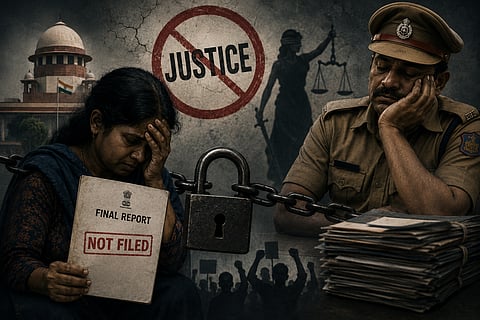

Hyderabad- In a glaring example of systemic delays and alleged manipulation in cases registered under the Scheduled Castes and Scheduled Tribes (Prevention of Atrocities) Act, police in Telangana are accused of withholding final investigation reports from both victims and courts. This practice effectively freezes victims' legal remedies, preventing them from filing protest petitions against faulty or biased closures.
The issue came to light through documents shared by prominent Hyderabad-based human rights lawyer and Ambedkarite activist Dr. B. Karthik Navayan. In a recent post, Dr. Navayan highlighted how Investigation Officers (IOs) routinely misguide complainants by directing them to collect "final reports" or closure notices from the court, while failing to actually submit these reports to the judiciary as required under law.
A specific case from Cyberabad exposes the depth of the problem. In Crime No. 753/2025 registered at PS Vanasthalipuram, complainant Vadlamudi Bujji filed an urgent copy application on June 16, 2026, seeking the final report and witness statements to prepare a protest petition.
The court's official return memo was categorical: "Police have not yet filed the final report before this court, Hence CA Returned."
This discrepancy reveals a pattern where police claim to have completed investigations and closed cases but deliberately avoid filing the necessary documents in court. As a result, victims like Bujji are left in limbo unable to access documents, challenge the closure, or seek further justice.
Dr. Karthik Navayan described the tactic as a "dangerous game with the law." By weaponizing procedural delays and misinformation, the very institutions meant to protect marginalized communities are shielding perpetrators and denying timely remedies guaranteed under the SC/ST (PoA) Act.
Under the Code of Criminal Procedure (CrPC), 1973 (applicable alongside the PoA Act):
Section 173(2): Every investigation shall be completed without unnecessary delay. As soon as it is completed, the officer in charge of the police station shall forward to the Magistrate empowered to take cognizance of the offence, a report in the prescribed form. This is known as the final report (charge sheet if sufficient evidence is found, or closure report otherwise).
The police officer shall also communicate the action taken to the person who first gave the information about the commission of the offence (the informant/complainant).
Legal experts point out that under the SC/ST (PoA) Act and CrPC provisions, police are obligated to file final reports (charge sheets or closure reports) promptly in court. Victims or their representatives must be served copies to enable them to file protests if the investigation appears compromised.
However, ground realities in many states, including Telangana, show routine violations.
Complainants are often told to approach courts for documents that were never submitted. Delays allow accused persons to influence proceedings or evade accountability. Atrocity cases involving Dalit and Adivasi victims frequently see diluted charges or premature closures.
Such practices not only violate statutory procedures but also erode public trust in the criminal justice system, particularly for vulnerable sections already facing caste-based discrimination.
Dr. Navayan, who has two decades of experience advocating for SC/ST rights and documenting misuse of procedures against victims, has consistently raised concerns about police and administrative apathy in atrocity cases. His documentation of this and similar instances serves as a critical alert to activists, legal practitioners, and monitoring bodies like the National Human Rights Commission (NHRC) and SC/ST Commissions.
His question echoes across affected communities: When the protectors of law become obstacles, where should victims turn?
This incident emphasize the urgent need for strict accountability measures against errant IOs, including departmental action and contempt proceedings. Digital tracking of PoA case filings to prevent such "missing report" tactics, mandatory service of documents to complainants within stipulated timelines and greater oversight by Special Courts designated under the PoA Act.
You can also join our WhatsApp group to get premium and selected news of The Mooknayak on WhatsApp. Click here to join the WhatsApp group.
'The Mooknayak' practices democratic journalism. It is a media platform committed to the Constitution, democracy, and social justice. If you also want 'The Mooknayak' to always raise the voices of the marginalized and show the pain of the voiceless, please subscribe.
PLEASE SUBSCRIBE US