Dalit News
Jodhpur Valmiki Sanitation Workers' Agony: Collector Insists on One Worker Doing Four's Job, Impractical Night Working!
Vow to File Inhuman Treatment Complaint with Human Rights Commission

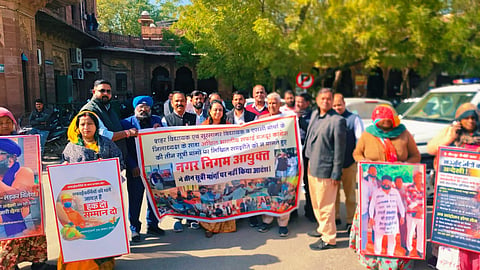

Jodhpur- The ongoing agitation by sanitation workers in Rajasthan's Jodhpur Municipal Corporation has transcended street protests and evolved into a sharp administrative confrontation. Sardar Prakash Singh 'Vidrohi', District President of the All India Sanitation Workers' Congress, has penned a strongly worded letter to the District Collector, directly targeting the shortcomings in the sanitation system.
The letter levels serious allegations against Municipal Commissioner Siddharth Palani Chamy, accusing him of crushing the Valmiki community, providing protection to non-Valmiki employees, and issuing arbitrary orders. Vidrohi has warned that if demands are not met, the organization will file complaints against officials in the Human Rights Commission and pursue legal action. In a statement to The Mooknayak, Vidrohi branded this as the BJP government's "Manu mindset," which violates constitutional rights.
This letter marks a pivotal turn in the movement that began on November 17, 2025, escalating from half-naked satyagrahas in the winter chill to threats of a broom-down strike. The workers' struggle centers on the dignity of the Valmiki community and equitable workload distribution. Vidrohi's letter highlights the sanitation workers' pressing issues in three key points. It not only questions the Municipal Commissioner's policies but also points fingers at the District Collector's role, as he personally attends sanitation review meetings. The main points of the letter are as follows:
1. Impractical Nighttime Sanitation Directive: According to Municipal Commissioner Letter No. 3585 dated January 4, 2026, instructions were issued to ensure sanitation arrangements from 8:00 PM to 2:00 AM. Ward in-charges were ordered to provide sanitation workers during this period. Vidrohi questions the rationale of such orders, noting that ward in-charges have no reserved pool of sanitation workers. Even if workers are made available, what arrangements has the corporation made at the municipal level for their protection and safety? Who will address the life and property risks for workers toiling in the dark of night? This directive is not only impractical but endangers workers' safety.
2. Undue Pressure on Valmiki Workers and Opposition to Non-Valmiki Appointments: The letter directly asks the Collector why he issues directions in sanitation meetings at the municipal office exclusively targeting Valmiki sanitation workers. Has he ever asked the Commissioner for a list of workers who haven't performed sanitation duties for the past seven years? Most of these are non-Valmiki employees, whose absenteeism is crippling the entire system. Vidrohi argues that if sanitation responsibility falls solely on Valmiki workers, why are non-Valmikis appointed to these posts? They accept appointments but shirk core cleaning duties.
The Collector is accused of pressuring Valmiki workers in meetings to take on excessive workloads, even expecting one worker to handle the tasks of four. This is inhuman. Under the Municipal Act (Municipal Pattern Act), provision exists for five sanitation workers per 1,000 population, but in reality, wards with 10,000-15,000 residents have only 15-20 workers. Vidrohi suggests that for organized sanitation, adequate staff should be appointed in every ward to reduce the burden and ensure smooth operations.
3. Biased Use of Monitoring Teams: The Collector has formed a supervisory team to monitor and inspect working sanitation staff for better system management, but this team focuses only on active (primarily Valmiki) workers. Vidrohi asks if such monitoring has ever been applied to lazy, negligent non-Valmiki workers who avoid cleaning duties. The answer is no, because the administration itself shields them. This emboldens their audacity, while the Commissioner remains a silent spectator.
In the letter's conclusion, Vidrohi issues a stern warning: "Compelled by this, the organization will file complaints against such officials in the Human Rights Commission and register cases, for which you will bear full responsibility."
In his conversation with The Mooknayak, Vidrohi delved deeper into the roots of the agitation. He stated, "Sanitation workers in Jodhpur are facing severe injustice. The Municipal Commissioner is actively suppressing the Valmiki community. The current BJP government harbors a Manu mindset towards the Valmiki society. It favors non-Valmiki sanitation workers, exempts them from cleaning duties, and stations them in other departments. This is against the Constitution, yet the Commissioner runs his own law. He issues orders as he pleases, indulging in sheer arbitrariness. The opposition Congress is helpless. The struggle has been ongoing since November 17, 2025, but resolution remains at zero."
Vidrohi emphasized that Jodhpur has around 3,300 sanitation workers, including 700 from non-Valmiki communities. Their refusal to perform cleaning shifts the entire burden onto the Valmiki society. The ward coverage has expanded from 60 to 100, doubling the pressure. The November 15, 2025, reassignment of wards for 2,000 workers poured fuel on the fire. He reminded that an agreement witnessed by MLAs Atul Bhanasali and Devendra Joshi promised reinstatement to original posts and nearby ward assignments for women and differently-abled workers, but it remains unfulfilled.
This administrative escalation builds on the movement's history: chaotic confrontations at the municipal office on November 17, 2025, with failed talks; Friday sit-ins under the Valmiki United Struggle Committee banner amid police barricades; and Vidrohi's iconic half-naked protest on Ambedkar's Mahaparinirvan Diwas.
The three core demands: cancelling ward reassignments for 2,000 workers, abolishing 2018 supervisory posts, and reassigning 700 non-Valmikis to core duties, persist unmet.
You can also join our WhatsApp group to get premium and selected news of The Mooknayak on WhatsApp. Click here to join the WhatsApp group.
'The Mooknayak' practices democratic journalism. It is a media platform committed to the Constitution, democracy, and social justice. If you also want 'The Mooknayak' to always raise the voices of the marginalized and show the pain of the voiceless, please subscribe.
PLEASE SUBSCRIBE US